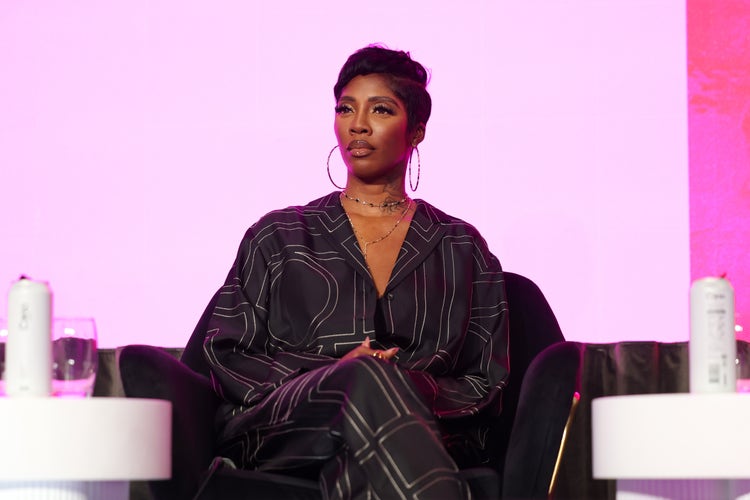
Tiwa Savage is not going to stop evolving. When she dropped This One Is Personal, her fourth and most vulnerable studio album, the Nigerian-born singer redefined what fans expect from her sound. The project leans deeply toward ’90s-style R&B while pulling from her own heartbreak, healing, and decades-long career at the forefront of Afrobeats. In an exclusive sit-down with REVOLT, Savage opened up about why she took that creative leap, the toll fame can take after years in the spotlight, and how she’s building her future beyond music, including a skincare line inspired by African ingredients. She also spoke warmly about her son and what she hopes he learns from watching her hustle.
This One Is Personal is one of your most vulnerable projects. What was the scariest part of making such an honest record, and what pushed you to go through with it?
It was a real experience for me. So, for me, it was just like, “Ah, it's so personal, are people gonna relate to it?” That was pretty much the only thing I had that was really tugging on my heart. But ironically, people are connecting to it more than any other project I've ever done during my career. And then also, like, moving away from being so Afrobeat heavy and leaning towards the R&B side of it again, I wasn't sure. I've built my career over the [past] decade with mainly Afrobeat as my main genre. But I think my core fans have been expecting this anyway. They kind of knew that I've always dabbled in rhythm and blues, and I think they were kind of expecting it. So, it was refreshing for them and for me as well.
Can you share a moment or lesson from your own journey that made its way onto the record?
A lesson that I learned... I think for me… healing, because the album, like I said, it's very personal, but it was born out of a really bad heartbreak. Like a really, really hard heartbreak that I feel nearly took me out. I learned that I had been bottling so much in over the years, so much trauma. I've faced a lot of controversies as well in my career, and I've kind of bottled it and just not dealt with it. So, doing this record, I had to face some of those things, and I had to put them into music. I had to almost relive some of the experiences, but I also learned that that was how I was really able to truly heal by talking about it and releasing that. I learned that whatever it is that I might face now, I try not to bottle it in or pretend like it doesn’t exist. I try to deal with it.
So, making the album is what truly healed you?
Yeah, 100 percent. Like, I thought I was healed. Like, I thought I was just getting on with things, [that] I wasn't dealing with stuff, but it was still affecting me in ways that I didn't know. So, definitely 100 percent [felt] that [while] creating this album. The way I know I healed is, like, before, I would go to certain places and it would remind me of certain things, and it would make me feel sad. But now, I could go to a restaurant and feel absolutely nothing.
Because you already released it?
Yeah, it's really, really done.
This album blends Afrobeats with ’90s R&B. What’s one R&B record or even artist from your youth that inspired this sound?
Definitely Brandy, I would say. With the way I even recorded it was like vocal layering, harmonies, ad-libs, yeah. I think you hear a lot of that influence throughout the project.
You made your debut on the U.K. charts with This One Is Personal. Congrats! After so many milestones, what did that recognition feel like?
It feels good because, you know, like when you achieve certain things, you don't know that there [are] even [more] things. It was just incredible because I'd always achieved other things, but then having that was just like, wow, there's so much more to this world that I'm discovering. It felt like I was starting again; I just felt new again. It just felt like a whole new territory. For me, it's an exciting challenge. Debuting at [No.] 18 is so incredible, but now I'm like, “I want to be Top 5 next time.”
At one point, you hinted that you weren’t making any more albums. Were you serious?
No (laughs). Don’t ever take me seriously. I mean, do take me seriously when it comes to music. But I think that's my coping mechanism. I joke about so many things. Like, recently I joked about the next person I want to date has to have a yacht and a private plane and everyone's just like, “What?” I mean, part of me is not really joking (laughs). But I mean, if it happens, I'll be like, “Thank you, God.” They say speak it into existence. I'm just putting it out there. But it's not like if I do find someone who's kind and loving and doesn't have a private jet, I'm gonna be like, “I can't be with you.” I do joke a lot, so no, it is not my last project.
Okay, thank God. Has there ever been a moment in your career when you thought about quitting?
I think a lot of times when I wake up, I think about quitting. I'm like, “Oh, my God, I just want [a] soft life. I just want someone to just give me a billion dollars and just live.” I think as an artist, the more you become successful and the more years you spend in the industry, you realize that you're spending more time with the business side of it than the music side of it. When I first started, I wasn't thinking of streams. I wasn't thinking of TikTok challenges. I wasn't thinking any of that; I was just doing music, so it was a hobby. But now my hobby has turned into my job, and let's face it, all of us want a break from our jobs every once in a while... no matter how much you love it.
You’ve been called the “Queen of Afrobeats” and even the “Beyoncé of Afrobeats.” How do you personally define your legacy?
I think it's about a girl, an African girl who just came and conquered. That's really the essence of my story. It's just this African girl who conquered.
You’ve worked with icons like Monica, Mary J. Blige, Whitney Houston, and even Brandy. How do those experiences influence the way you mentor or collaborate with younger artists?
I learned from them, especially because I wasn't in the forefront, how hard it is to still work and be gracious even when you're not feeling like it. I've been blessed, like you said, to work with icons like that. I've heard many horror stories about other artists, but I've never experienced that. I've always just been around women that are very just, like I said, gracious. Even though so many things are happening in their lives and their families or whatever, when they're in front of the camera, they're very professional. So, I want to be that when I'm working with anybody else.
I want your first experience with me to be a pleasant one, no matter what is going on in my life. So when I'm meeting new artists, up-and-coming artists, I try to be as humble and as accommodating as possible, because I never want them to be like, “I met such and such, and she was that and that,” and then it puts such a bad taste [in their mouth]. And I'm also representing women in the industry. So, I'm always thinking about that when I'm working with — especially up-and-coming — female artists.
We all know you are very humble, but do you feel you’ve paved the way for the new generation of female Afrobeats artists?
I mean… I guess what's understood doesn't need to be said (laughs). Well, I mean, I didn't plan to. I didn't come into the industry thinking I was [going to pave the way for anybody]. I was just chasing my dreams. And a lot of times, I was the scapegoat, actually. Man, I was banned from [the] radio in Nigeria for being too sexy or having tattoos and stuff like that. So, at the time, I didn't think I was paving the way. I just thought I was going through so [many] challenges. But now, looking back, seeing other females wearing really sexy outfits, and they're not being canceled for it... I see the purpose of my journey now.
What advice would you give newer female Afrobeats artists about building a lasting career?
Right now, I don't know if it's going to change in the future, but as a female, you need to work 10 times harder. That's just what it is. It's just facts. I wish it wasn't, but that's just what it is. I also feel like God has built us to be able to do that as women. We can multitask. Like, I can be doing something and do my makeup, and men can't do that. No offense. So, I think we're also built to be able to withstand a lot of things. So, my advice would be if you have to do something 10 times more than your male counterpart, I would do it instead of thinking it's a disadvantage, even though it is. But I also feel like the reward is higher. As a woman, you know, just being able to be a mother, be a wife, be a friend, be a sister, and be successful. We're wearing so many crowns that the men don't even have to wear. So, yeah, I would say just do it because you can do it. God has built you to be able to do it.
I have to ask you this — what’s your take on how African artists are often boxed into the Afrobeats category at award shows, even when they’re making R&B, pop or other genres?
You are trying to get me in trouble (laughs). I hate being limited. I feel like, as a true musician, you shouldn't be limited by your geographic location. So just because I'm from Kenya, that doesn't mean I can't do Hip Hop. If you are going to do whatever it is outside of where you're from, you have to make sure you can do it well. Don't come out here and say you're a Hip Hop artist and you can't spit rhymes... you'll be chewed up. But if you are good, I don't think that the world should limit you because of where you're from. In fact, I think it should be celebrated.
Now, in terms of us being grouped into one category, it is unfortunate. But if we would grow our own economy and grow our own award ceremonies, maybe we wouldn't even need that validation from foreign awards. I feel like now we're still trying to get recognized by international awards or categories, but if we had a huge award in Africa that can recognize that there's Fuji, there's Amapiano, there's Afrobeats, [and] there's Afrofusion, I think that's the bigger topic. That's the bigger conversation. Because I know, like, in the K-pop industry, I don't really think they care what's going on. They've built their own industry. That's what we probably need to do. In the meantime, people are trying to break the barrier. Like, someone like Burna [Boy] does Afrofusion. With this project that I've just done, I hope it's being recognized as a true R&B project and people are not just thinking, “Oh, she's Nigerian.” A lot of people have been hearing it and don't even know who I am and would just be like, “She's actually a Nigerian girl.” So, I think more and more people from Africa need to step out of that. And also, I guess we need more people on the board of these award ceremonies that are African so they can make decisions and change things.
And on the flip side, how do you feel about non-Afrobeats artists winning or being recognized in Afrobeats award categories? Like Chris Brown and Usher, for example?
I love that, yes, someone like a Chris Brown and an Usher coming into our world is amazing. I feel like that's a separate topic, but I also feel like we're all one. Like Burna’s mom said, we're all Africans first before anything. So, I love the fact that Chris Brown is able to jump on an Afrobeats record, and he sounds good. He doesn't sound forced. Some other people, I don't know.
Chris, Usher, they sound amazing. And the same way we welcome them, I feel like we deserve that same hand extended to us when we are doing stuff like a country album. Like Shaboozey doing country or whoever else is doing Hip Hop or whatever, like Nasty C. He is killing the Hip Hop game. I feel like he should be getting more recognition. So, I think it should work both ways. Right now, it feels one-sided.
You’ve been doing music for over a decade. What’s the hardest truth about fame that nobody warned you about?
It does change you. You know, people say, “Fame and money would never change me.” I don't think you can get to a certain level of success and [not] change. For me, it's like, just not being able to be as free in terms of even something small as making a joke on social media, and everyone is just like, “Huh?” And I sometimes forget, and I want to comment on something, and I can't because I'm a public figure. I just love to be free, I love to be able to do what I want, and I'm doing that more now. I'm like, I don't care. I’d have two shots of tequila, I’m on my phone, and I'm saying rubbish on my Twitter... I think people are starting to know that, “Okay, Tiwa is joking right now.” Not being able to just be human is hard. Even after so long, it's still so hard to be free.
On Instagram, you’ve been open about your love for your skincare routine and natural beauty, and we see a lot of celebrities launching skincare lines. Is that in your plans as well?
Yes, 100 percent. I think especially coming from an African woman. I'm working on it as we speak. I want to use some of our natural resources and products like shea butter. And I know a lot of people are doing shea butter now, but like black soap and all of those things. Even aside from that, there's so many other ingredients that I'm discovering from different parts of Africa. You see some people's skin in some countries, like Sudanese women, how beautiful… Their dark, beautiful skin... and so rich. I definitely want to package that, put it in a bowl. I think everybody should just be allowed or should have access to feeling or looking beautiful, even before makeup. That's skincare.
What's the timeline for launching it?
Well, I'm looking for investors, so if you're out there and you have a couple of billions (laughs). It has to go through a long process of testing and stuff, but definitely next year.
Your son is a big part of your life. I saw that he even edits some of your social media videos. How does he feel about your stardom, and what do you hope he takes from watching your journey?
He sees how hard I work. He sees that I'm away from home a lot of times and he sees that I'm not just out on vacation, he sees that I'm working. He always sends me little notes like, “I love you,” “I miss you,” “Make sure to get some rest,” “Take care of yourself.” So, I hope that he's not thinking because my mom's famous, I don't have to work or because my mom has attained a certain wealth or success… I hope he knows that he has to work. I hope he learns from that, just to see how hard I'm working and my hustle spirit. I hope he gets that. How does my fame affect him? I don't really think he cares that much about it, maybe because he's grown up in it and he's always known… I mean, when he was young, he didn't know the extent of how popular his mom is, but now he's more into Roblox and anime. He's obsessed with that more so than whatever I got going on.
How do you balance your creative drive with being present for your son?
Well, thank God for technology, because I am on the phone with him every day. I have a really great support system. My mom, huge shout out to her. I have, I don't want to call her our nanny, but my son's nanny, she's like family to me. She's been with us since he was 3 months and he's 10 now. So, she's been with him his whole life. And she's like his mom, his second mom. I'm so at peace when I have to travel. When I'm away working, I know that he's well taken care of. But I can also be a bit excessive. I have cameras all over my house. I'm watching it every time, I'm able to hear what's going on at home, no matter how far I am. I'm always on the phone with him. And I've built such a close relationship with him. Like, he's open with me, even when it's uncomfortable. When he gets in trouble at school and he's put on time out, he will probably try and tell me first before I find out from the teacher. And I hope it continues because I hear that when boys are about 14/15, they start withdrawing from their moms. But for now, we’re really close.
If you had to describe This One Is Personal in one sentence to someone who has never heard your music, but you had to be brutally honest, what would you say?
This One Is Personal will take you on an emotional journey of heartbreak, love, and hope. And while you're on that journey, you feel nostalgic.