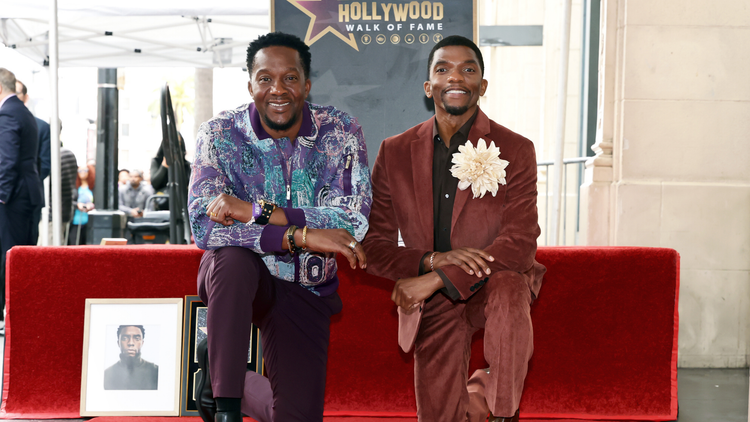
The world knew Chadwick Boseman as T’Challa in Black Panther, James Brown in Get On Up, Levee Green in Ma Rainey’s Black Bottom, and so many more. Derrick and Kevin Boseman knew him first as their little brother — the extraordinarily gifted kid who could draw, play ball, lose himself in books, and "always tried to do what was right," according to Derrick.
Boseman Family LLC is, in many ways, an extension of that same belief that anything is possible with love and family. Initially established in November 2025 and officially launched a few months later, the company encompasses television and film, education, and community initiatives, with Derrick and Kevin drawing from both their respective creative backgrounds and the example Chadwick left for them to build on.
Derrick is most interested in telling Black stories “truthfully and honestly,” while Kevin wants to challenge Hollywood’s long-held assumptions about who gets to be seen as heroic. “We all have to be the hero of our own life,” he emphasized. “It’s really about, once you’ve put on that cape and taken the vibranium, what intention you’re moving with — whether those intentions are good or bad.”
No conversation about Chadwick’s legacy can avoid Black Panther, even more so with David Jonsson inheriting the mantle as Toussaint, a.k.a. T'Challa II. Derrick and Kevin learned of the casting only shortly before everyone else, but they understand the magnitude of what comes next in a way very few people can. “This will be life-changing for him,” Kevin stated. They watched the role alter Chadwick’s life — professionally and existentially — as fans began writing to him and treating him with the reverence more commonly afforded to royalty. Derrick remembers it in almost literal terms: “People saw him as an actual king.”
Ahead, REVOLT spoke with Derrick and Kevin Boseman about the importance of brotherhood, the stories they want to bring into the world through Boseman Family LLC, and what it means to carry Chadwick’s legacy forward.
You celebrated the official launch of Boseman Family LLC in June, but I imagine the idea had been taking shape long before then. What made that the right time to move forward?
Derrick: It was actually born almost, I hate to say it, out of thin air. I met with our business managers, and just through talking over and over again, we came to that conclusion. It was something that I’d always dreamed of, and I think it’s something that Chad would have wanted because he wanted his work to go further. It’s taken on a life of its own.
Kevin: We’ve created a creative business that is focused on TV and film, publishing, education, and legacy building. So that’s really what Boseman Family LLC is about. Essentially, it’s about storytelling, using the skills that we have as storytellers and also being inspired by Chad’s rich, rich career as a storyteller.
What was the family dynamic like between the three of you growing up, and how did that relationship change over the years?
Derrick: I’m the oldest, 10 years older than Chad and six years older than Kevin, so I’ve always been the big brother. As far as our relationship, it has grown. We [converse] all the time. We’re forced to now. I think it’s a beautiful thing because we’re learning things about each other that we didn’t know previously.
All of us left home and went to different places. We would see one another during holidays, or if a graduation came up for a member of our family, we would get together then. But we have a closeness now and a bond that has strengthened because of this. Actually, Chad being sick brought us all together.
Boseman Family LLC is described as a "multi-platform creative company developing purposeful work across film, television, theatre, publishing, and cultural initiatives." What kinds of stories are the two of you most excited to help bring into the world?
Derrick: Our stories — Black stories, mainly. It would more than likely be in the same vein that we saw Chad acting in. I’ve been a student of history my entire life, from a small child. I remember when I should have been doing my homework, I was reading about Black people and learning about Black people. That’s been my focus my whole life. So, telling our stories truthfully and honestly, and being bold about it.
Kevin: I think telling our stories, and I will add, for me personally, also telling the stories of people whose stories are not often told. Hollywood has a way of deciding who the hero is supposed to be and what the hero is supposed to look like. I believe we’re all heroes.
We all have to be the hero of our own life. So, in that way, anybody can step into the role of the hero, put on the cape, and take the vibranium. It’s really about, once you’ve put on that cape and taken the vibranium, what intention you’re moving with — whether those intentions are good or bad.
I know you likely get asked a lot of questions about Chadwick, but when you think back to him growing up, what stands out the most?
Derrick: That he was gifted in multiple areas. My time spent with him was teaching him basketball as a small kid, and then when he got older, my time spent with him was talking about Blackness. I gave him “The Autobiography of Malcolm X,” and I think that transformed his mind, as it did mine. I remember him being very, very gifted and very, very artistic. He could draw from a very young age. He had to have gotten that from our father because our father was an artist.
I also remember him being spiritual, even as a little boy, and very, very focused. He was a great student, and he always tried to do what was right. That’s what I remember about him. He really didn’t want to get into trouble for anything.
Kevin: Chad and I shared a room. We had a three-bedroom house. Our parents were in one room, Derrick was in the other room, and Chad and I shared a room. This was when Derrick still lived at home. So my memories of him are of me being a moody teenager, growing up and being in my bedroom listening to sad music, and him wanting to come in and me kicking him out, things like that.
Then there were the beautiful times when we were the same size. I’m the short one of the three of us, and he grew to my height. There are really four or five years between us, almost, but four years scholastically, so we were somewhat close in age, and we hung out a little bit. I remember going around town when I was maybe a senior in high school, and he was in the eighth grade, and people thought we were twins because we could wear each other’s clothes and we looked alike. So, I have fond memories of hanging out with him as a young teenager.
We reported on Colman Domingo saying he felt like Chadwick was looking over him and Michael B. Jordan “from the other side.” What goes through your minds when you hear people who knew and worked with your brother speak about still feeling his presence?
Derrick: Chad had a way about himself of elevating people and making them feel like they could do things that they didn’t even know they had the ability to do. It was just part of his makeup to build people up and give them confidence in themselves.
For many of us, 'Black Panther' was our first introduction to Chadwick, and his portrayal of T’Challa left a lasting impact. How do you both feel about David Jonsson being cast as T’Challa's son and carrying that legacy forward?
Kevin: I’ll say we found out just very slightly before it was announced. Ryan [Coogler] was kind enough to give us a heads-up. He’s been a joy to get to know and very kind to us. I think we were both very excited about the idea of the son growing up, now being in his 30s and becoming the king. We’re excited for what that story will be, for Ryan to continue this story that he began so masterfully, and excited for David Jonsson.
This will be life-changing for him. We know how life-changing it was for Chad, and we wish him the best in the role and in his life as he wears the crown of the king. He’s going to wear that crown not only in the movie, but in his life. He is now the king.
Derrick: That’s exactly what that role does for you. People look at you in your personal life as the king, too. Chad would tell me that people sent him things and wrote him letters. People saw him as an actual king. “Heavy is the head that wears the crown,” is the saying, and so I am happy for him, and I’ll be praying for him because it’s going to change his life in so many different ways.
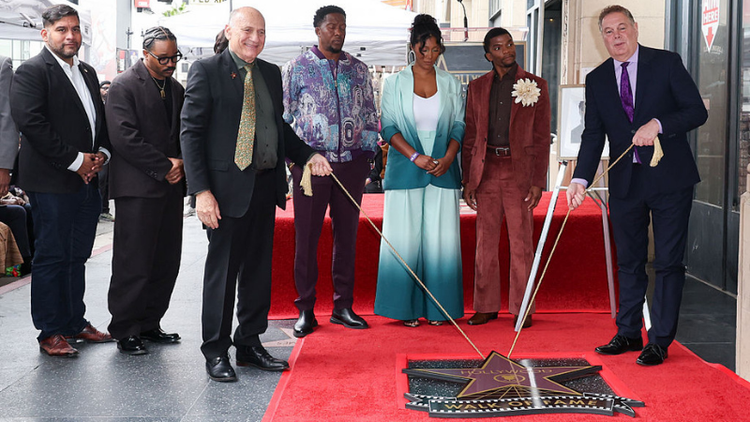
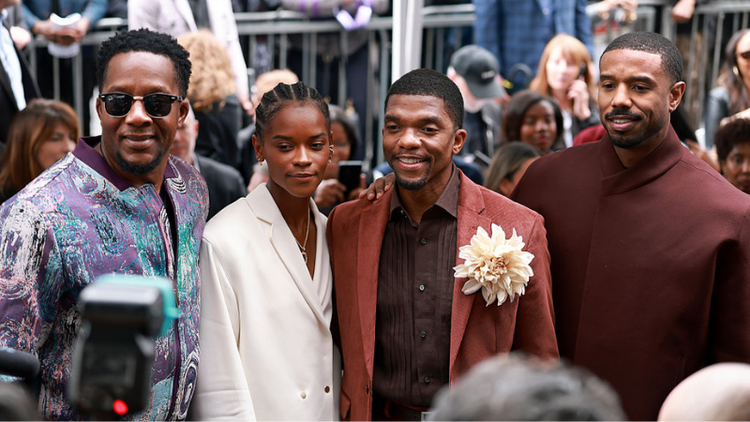
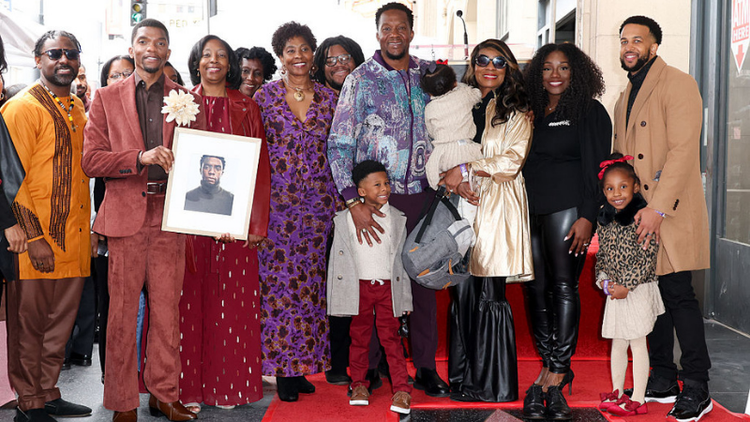
Speaking of which, Chadwick’s Hollywood Walk of Fame star was such a huge moment for your family, and seeing the two of you standing there together really warmed my heart. What did that day mean to you both?
Kevin: You know, it was a tremendous honor, of course, for Chad to receive it, but it was bittersweet that he wasn’t there to experience it. It makes me think about his Oscar nomination for [Ma Rainey's Black Bottom]. I got to watch the screener with him maybe a month before he passed. I was out in Los Angeles with him at his house. At the end of the film, I just looked at him and said, “This is your Oscar. This is your Oscar.” And he was nominated for the Oscar.
What I was going to say is that he missed knowing that his work had that impact. He missed that experience. So being at the Hollywood Walk of Fame... what a tremendous honor. We were happy to be there. We were happy to represent him and to represent our parents, who couldn’t be there because it’s just too far for them to travel as elderly people. It was an honor, and yeah, there was a lot of grief on that day.
Although Men’s Mental Health Month is every June, the conversations around emotional well-being and asking for help go far beyond just one month. What are some of the conversations you hope more Black men feel comfortable having openly?
Derrick: That it exists for us too. That we get depressed, that we have anxiety, that we grieve, that we have periods of sadness, that we might need therapy, that we might need counseling, that we have childhood traumas, that we have everything everybody else has, and that you don’t have to be a hero all the time. It’s okay to not be okay, but you have to recognize that you’re not okay and do something about it.
Kevin: As someone who has done a lot of therapy — and is currently in therapy — I think it has transformed how I feel about myself, how I feel about my position in the world, and how I relate to people. For Black men, I want them to know that you don’t always have to be strong.
I think our society and our culture push this narrative that Black men have to always be strong and always have the answers. You don’t. You can look around and ask someone with more expertise. If you don’t know it, someone knows it. Having grief, crying in public, and having the vulnerability to expose how you actually feel, and to do it in a healthy way, is important.
Last but definitely not least, what does brotherhood mean to each of you?
Derrick: It means commitment. It means loving unconditionally. Of course, it’s a bond. It means doing things the right way. Our father told us to do things in a brotherly way, and I think oftentimes, not even talking about siblings, we don’t treat each other as brothers. That’s where the breakdown comes in with us as a people. So I think brotherhood is actually bigger than being siblings, but for us, we are siblings, and it means a lot. It means having each other’s back. It means being each other’s sounding board. It means correcting each other in love. It means a lot, a whole lot.
Kevin: There’s something about having a shared history that goes beyond just the 54 years — since I’m the youngest — that we’ve had together. It’s beyond that because it’s epigenetic. It goes back. Our shared history is not just us. It’s our parents, our grandparents, our great-grandparents, and so forth. With that comes knowing the good and the bad, the triumph and the trauma, really knowing each other, having empathy, being able to hold space for the things we understand to be each other’s trauma, and handling that with care.