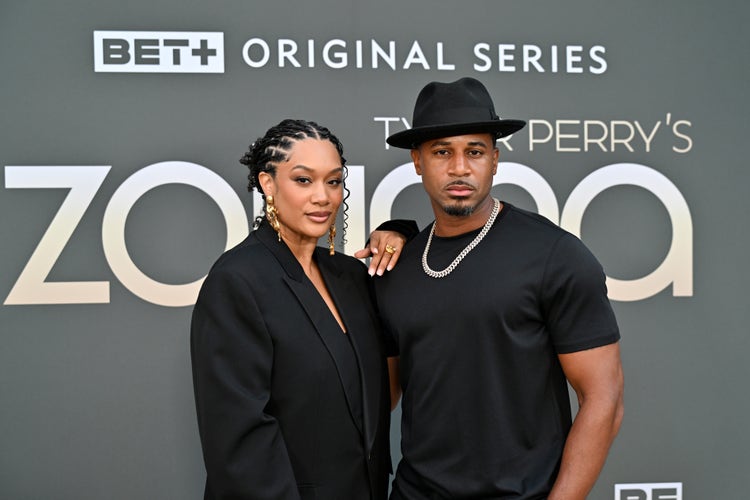
Zac and Fatima have become one of Tyler Perry’s most talked-about couples, and in Season 4 of “Zatima,” they face one of life’s biggest tests: stepping into parenthood while still navigating old wounds and complicated relationships. The series, a BET+ spinoff of “Sistas,” built a loyal following because of its raw, sometimes messy, but always honest portrayal of love and growth — and viewers see themselves in every high and low.
REVOLT sat down with Crystal Renee Hayslett and Devale Ellis, who bring Fatima and Zac to life. The two actors opened up about how this season stretched them in new ways, from embodying motherhood for the first time to digging deeper into emotional maturity and accountability.
The duo touched on their world beyond “Zatima.” Hayslett shared how her podcast, “Keep It Positive, Sweetie,” has become a space for healing and learning, while Devale reflected on his own platform with his wife, Khadeen Ellis, and the lessons that come from putting Black love front and center. At the heart of it all, though, is their commitment to telling stories that feel real on screen and off.
Season 4 of “Zatima” shows Zac and Fatima stepping into parenthood while still working through old wounds. What new layers of your characters excited you the most this season?
Crystal Renee Hayslett: I love navigating being a mother. I'm not a mother in real life, so getting to study my friends who are mothers, and then taking on those characteristics and doing something different that Fatima hasn't done yet, has been exciting to navigate. And then also growing as our characters. We’re maturing. I was talking to someone earlier, and he was like, “Just looking at Season 1 to now, how much you guys have grown as a couple has been amazing.”
Devale Ellis: Yeah, I would agree. I think the evolution of Zac would be his emotional maturity, being there, and being a provider for what Fatima needs emotionally, not just financially and physically.
Crystal, Fatima has been a fan favorite for her strength and vulnerability. How did you prepare to portray that evolution into motherhood?
Hayslett: I think everything that I poured into so many other people is now gonna be focused on my child. You know, a lot of times, as you see, I was taking on what Andi had going on. If Danni needed to talk to someone, I was there. Whatever Zac had going on. I was taking on everybody's stuff. But I feel like now I'm pouring all that into my pregnancy and making sure that my baby's good.
Devale, over the seasons, Zac’s journey went from complicated to deeply human. How do you approach balancing his flaws with his growth?
Ellis: Well, that’s a great question. Balancing his flaws [with] his growth. I try not to judge Zac’s character and understand that it's a process and understand that it may be a season where Zac doesn't have a lot of growth because that's just not the journey he's on, and I have to play the role the way it was written. So, if that means that Zac is gonna be insecure and a man-child for this season, I have to play with as much humanity as I can. I'm happy now that in Season 4 of “Zatima” and now Season 9 of “Sistas,” he's grown a little bit. So, we get a chance to see his growth. But I always try to remember the humanity in Zac, even when he's acting like a little kid.
The stakes are higher in Season 4. Was there a scene or storyline that challenged you emotionally or surprised you on the page?
Hayslett: It hasn't come out yet, but the final scene was really hard for me. We can't talk about that 'cause that’ll be a spoiler alert, but when you get there, you'll be like, “Ah.” That was the hardest scene for me to prepare for. And then when I was in it, the emotions just continued afterwards.
Ellis: I saw that scene that you had to do, and I see why. I can't even say it, but when I saw the cut afterwards, I was like, “Oh wow.” That's rough for any person to go through.
The show speaks directly to Black millennial and Gen Z audiences about modern relationships. What do you think makes “Zatima” feel so relatable to viewers?
Hayslett: I think honestly, it's us living out our flaws and faults in front of everyone. We’re not giving you the perfect fairytale love story, you know? And I fell victim to that by watching TV. I'm like, “I want that kind of love.” That ain't real. You know? So, I think that we are actually showing what it looks like to grow as couples, grow individually, and then also start to communicate and be able to build a family on a solid foundation.
Ellis: I would have to agree 1,000%. My perspective is this: [When] you go to therapy, people think, “Oh, you went to therapy one time; you should be fixed.” And when you watch it on TV, that's what happens. But in the real world, people go to therapy for years and still work on it. You're watching Zac go to therapy and still mess up. So, to me, I think people relate because it's honest. He went [to] a couple sessions; he don't got it all figured out.
Crystal, your podcast “Keep it Positive, Sweetie” is all about healing and growth. What inspired you to create it, and how do you choose topics or guests?
Hayslett: Yes, actually, Devale inspired me to do my podcast. He and his wife, Khadeen [Ellis], have “Ellis Ever After.” They inspired me to do it. I didn't want to. I'm just a private person and if you're going to do a podcast, unless you're talking about everybody else's business, you got to talk about yours. I wasn't ready to do that. And that goes back to therapy because there's a lot of things that I didn't know that I wasn't healed from. So, when it comes to topics, honestly, what we started doing now, is having a word for each season. Season 8 was “impact.” I feel like the conversation on a lot of podcasts kind of gets mundane. And what I was attracted to was podcasts that I could learn something from. And I was like, people are coming, they're changing, they're inspired but how are we giving them tools to really take. After the episode is done and they get up from their chair or get out of their car and move on with their day, what can they carry with them? So, we're very intentional about bringing on people that have a message that can teach us something to be better as a culture.
I just had Dr. Sebi's daughter on this season. She's teaching us about our health and how we can be just better stewards over our body. Beatrice Dixon from The Honey Pot Company on how women can take care of their privates, you know, and that internal health and the things that we've been doing that you may not even know that was harmful to you. So, things that can bring insight and also just help change us for the better.
You had Ciara on your show.
Hayslett: Listen, shout out to BET Media House because I was at BET Media House. I took the podcast there. I was right across the hall from Angie Martinez. Shout out Angie. Ciara went in there and I was like, “Don't bring nobody over here. When Ciara come out that door, we gonna grab her and I'ma interview her.” So of course, she was promoting her album, and they were like, “She gotta run over and do something else. We're only doing radio stuff right now.” So, we got a quick picture, and I sat back down and felt a little sad and defeated. I said, “Guys, it's okay. We're going to get her. It'll happen in God's timing.” Not even a couple months later, she's in Atlanta on my set.
Ellis: That's how it happens.
Hayslett: That's how it happens. Isn't it crazy? But it was all because of BET Media House for BET Awards this year that planted the seed.
What did that conversation with Ciara teach you?
Hayslett: Oh my goodness. I just love Ciara. She is, first of all, just a beautiful spirit. She taught me… one, don’t give up on love. Things to look for in a partner, how to keep that fire lit once you're together… two successful people with their own thing going on. The conversation taught me how to balance. And even afterwards, we exchanged numbers. She was like, “There's a synergy here. Stay in touch with me. Whatever you need, I got you.” She's really that girl's girl. And just to see someone that I looked up to, and we're around the same age… But since I was younger, to see how she's blossomed and then to actually meet her and say, “Hey, I got you.” It reminds you that Hollywood and this industry isn't all fake and phony. There are people that want to take you and lift you up and make sure they have your back. So, shout out Ciara. I love you, sis.
Devale, like Crystal mentioned, you also have a podcast with your wife called “Ellis Ever After.” It brings listeners into your world. How has sharing so openly about marriage and parenting shaped your relationship?
Ellis: Well, first thing is representation matters. And I think it's important for people to see positive Black love because a lot of us don't see it. We try to be as positive as we can. You know, everybody's idea of what positivity looks like changes. But I feel like Khadeen and I try our hardest to show people this is who we are. We're trying to love each other in our fullness, regardless of what people are saying about Black love. So, we feel like “Ellis Ever After” is our way of just sharing what we think love looks like to everyone. It also gives us the ability to hear ourselves. The best part about therapy sometimes is listening to yourself talk. And when you have a podcast and you listen to yourself, sometimes you go, “I didn't realize I came across like that. What triggered me to be so upset about that?” And then you start the work after you've heard yourself. So for me, “Ellis Ever After” has helped me become a better man, a better husband, a better father, because I can hear myself and say, “I don't like what I said. I don't like how I said it. I don't like how that might have come across. So let me see what's really hurting me inside that made me say it like that.”
You’ve successfully gone from the NFL to acting. What advice would you give to people looking to reinvent themselves?
Ellis: How you do one thing is how you do all things. So, if you lack discipline in one area of your life, whether it be working out, or food, or sleep, more than likely you're gonna lack discipline in the areas that you need on a daily basis. So, my advice would be just work on the small habits. Thoughts become words, words become action, action becomes habits, [and] habits become your lifestyle. So, if you want to have a great lifestyle, start with the small habits.
Tyler Perry shows often feel like a family. What’s the vibe on set like between takes?
Hayslett: Oh my goodness. When it comes to “Zatima,” it's family. I think Devale and I both went into this saying, “Hey, we're gonna set the tone.” We want people to feel welcomed. We want people to feel valued, from the production assistant to the director. And there's a lot of people that go between that. We want everybody to feel included. And we've seen it, like, when they wrap and we come back, they're like, “Oh, my God, we missed you guys so much. You're our favorite show.” Like the cameraman, they're laughing and they're behind the cameras. You don't really see that. They're all into it. It is so beautiful. Our cast is amazing.
Ellis: I got advice from two people who made me really focus on this. One was Will Smith. When we had the studio opening... Tyler said, “No interviews, don't ask nobody for no pictures or nothing. These are people like your people. Just go have a good time.” Everybody saw [that] there [are] stars there. There’s Denzel, there’s Will Smith, there’s Halle Berry, Spike Lee. I'm gonna ask questions. Will sat down and spoke to us and said, “Tyler, created this. This is great, but if you're a star here, you have a responsibility to make sure that when you show up to set, everybody enjoys their day. Because when you got there at 8 o'clock, people have been there since 5.” That was the first person. The second one was Crystal. Crystal worked as a PA. She worked in costuming. So, when we sat down and said we're gonna have our own show, the first thing she said was, “Devale, I want to make sure that everyone on our show knows that they're loved and respected. Which means if anybody that we cast or hire doesn't fall in line with that, it's a wrap.” And when she said that, I was like, “I'm with you, yo.” 'Cause she's been in this industry with this group for longer than most people. It’s been 13 years [that] you've been with Tyler?
Hayslett: Yeah, since 2012.
Ellis: Thirteen years? So, I'm gonna follow. If she says this is how it needs to work, I'm gonna rock with it. So, between Will and Crystal, they say we need to create this environment, let's do it, and it's working. So, I'm excited to be a part of it.
When you’re not filming or podcasting, what’s your go-to comfort TV show?
Hayslett: Right now, I am binge-watching “The Gilded Age.”
Ellis: Ooh, that's not bad.
Hayslett: It's so good and I find myself talking like them. It's so funny.
Ellis: I'm actually watching “Black Rabbit” right now.
Hayslett: What’s that?
Ellis: “Black Rabbit” is starring… What's my man name from “Ozark”?
Hayslett: Marty Byrde?
Ellis: Yeah, Marty. I can't remember his name right now, but yeah. It's a really good show.
It's based in New York. That's why I love it. It's about two brothers who have a restaurant. They're dealing with some issues, and it gets real dramatic, but it's very grounded in the acting. I like to watch things that are grounded because we do so much soap opera acting. You know it's different. It's very different from a grounded performance. I like to watch some shows that are very different, so I can expand my mind and see how it works.
What’s a personal goal you’re each working toward outside of acting?
Ellis: I want to create an environment in a space where my kids are free. I have four boys. So many young Black men grow up, and the first thing on your mind is you gotta go get the money. So, you're willing to do anything from a young age to go get the money. I wanna create a space where my boys don't have to think about money, and they think about being human first. And I think that so many of us don't get that opportunity because we live in a capitalist country where we've been disenfranchised for so long that we just grow up thinking we gotta hustle, but struggle. I don't want struggle for my boys. I want them to grow up and say, “Hey, I don't want to do TV, I don't want to do basketball, I might want to do missionary work. I just want to be a teacher.” And have the ability to do that work because they just want to be humans and not worry about all the BS. That's my goal in life. I'm not gonna stop until I get there.
Hayslett: The top of the month, I started fasting just to really hone in on my discipline because I'm a snoozer. I love the snooze button. I was like, “You know what? We're gonna start getting up at 4:30 every morning. You're gonna get in your word, you're gonna get your butt up and get to the gym.” I started doing that. Then, I went to Italy last week, and I realized how happy everyone was and how happy I am when I'm there. But I looked at everybody's lifestyles and it's a very minimalist lifestyle. You look back at Americans and it's like, “I need, I gotta have, I gotta have, I gotta have.” And it's like, you're talking about the hustle, and we've been conditioned to feel like we need so much when we have what we need. You know, it's really a want, but we’re like, “No, this is what I need.” Like, no I don't need that. This is what I want. And understanding it's okay to have the things you want, but it doesn't have to turn into greed or like your life depends on it, you know? So for me, I think this season in my life and what I'm focusing on in my personal life is more discipline, getting closer to God, and honestly just understanding that I have everything I need, and I lack nothing because we can get lost in this world.
Ellis: I like that.
That just gave me chills.
Ellis: I know, me too. I have everything already! Come on!