Key Takeaways
- Despite decades of influence, only a few Black artists have received the Grammys’ top honor.
- These wins marked turning points for Hip Hop, R&B, jazz, and soul in the mainstream.
- Each album captured a cultural moment that still resonates with fans and critics alike.
Plenty of incredible artists have gone their entire careers without winning Album of the Year at the Grammys. It’s one of the award show’s most coveted honors, largely because creating a full body of work takes real time and effort. For the many Black artists in rap and R&B, the challenge can be even tougher, as both genres have a long history of being misunderstood or undervalued.
Beyoncé, for example, was nominated 99 times before winning her first Album of the Year with COWBOY CARTER. Prior to that, she competed in the category four separate times. At the end of the day, it takes a special combination of talent, acclaim, and timing to win the award. The legendary Stevie Wonder managed to earn three in the ’70s, while Lauryn Hill became the first rap artist to win in 1999.
In honor of the Grammy Awards and the endless debates they inspire, REVOLT looked back at 12 Black music icons who earned Album of the Year. Check them out below.
1. Lauryn Hill
Lauryn Hill was the first rap artist to win Album of the Year in 1999, and considering we still talk about The Miseducation of Lauryn Hill all these years later, it’s safe to say she was well deserving of that award. “This is crazy because this is Hip Hop music,” the Fugees artist said during her acceptance speech. It’s also worth mentioning that, on top of taking home Best New Artist, Hill’s “Doo Wop (That Thing)” earned two awards.
2. Whitney Houston
It’s pretty rare for soundtracks to win Album of the Year. In fact, The Bodyguard: Original Soundtrack Album became just the third to do so when it won in 1994. It gave us “I Have Nothing,” a cover of Chaka Khan’s “I’m Every Woman,” and Whitney Houston’s unforgettable rendition of “I Will Always Love You.” To be fair, the late, legendary singer performed that last record so beautifully that we sometimes forget it was originally a Dolly Parton song.
3. OutKast
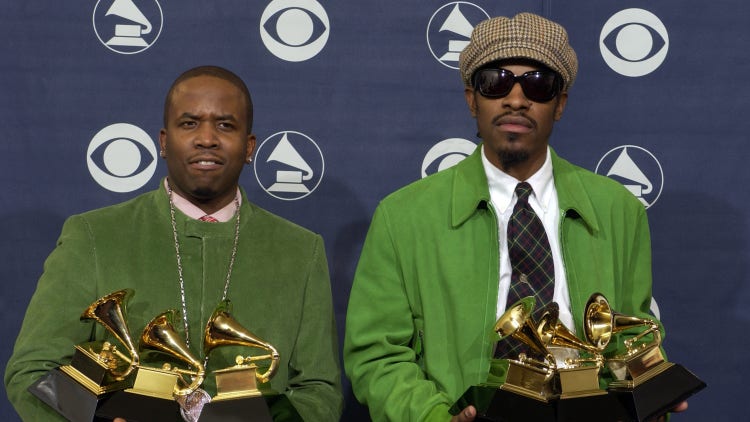
OutKast’s Speakerboxxx/The Love Below delivered a massive amount of music while still leaving listeners wanting more. Across its 39 tracks — including interludes and intros — we got gems like “Roses,” “The Way You Move,” and “Hey Ya!” However Big Boi and André 3000’s collaborative chemistry isn’t nearly as front and center, since the project is essentially two solo albums packed as one. Even so, the iconic rap duo won Album of the Year in 2004.
4. Stevie Wonder
Stevie Wonder was the first artist to win Album of the Year with three projects in a row: Innervisions (1973), Fulfillingness’ First Finale (1974), and Songs in the Key of Life (1976). People can debate the first two years, especially since he was up against giants like Roberta Flack and Paul McCartney, but Wonder’s magnum opus left no room for doubt. It gave us “I Wish,” “As,” and so many other beloved classics.
5. Beyoncé
As one of the most nominated artists in Grammy history, Beyoncé was more than due for an Album of the Year win by the time 2025 rolled around. What was a little more surprising, at least to us, was that COWBOY CARTER, her country-inspired LP, was the one to take it home (instead of, say, Lemonade or RENAISSANCE in the years before). “I just feel very full and very honored,” the singer said during her acceptance speech. “It’s been many, many years.”
It also felt good that the Recording Academy seemingly took JAY-Z’s words from the previous year to heart. “I don’t want to embarrass this young lady, but she has more Grammys than everyone and never won Album of the Year,” Hov said in 2024.
6. Quincy Jones
The 1991 Grammy Awards had serious competition in the AOTY category with Mariah Carey’s self-titled debut and MC Hammer’s Please Hammer Don't Hurt 'Em, but Quincy Jones ultimately claimed the title. Already decorated with multiple golden gramophones for his work with icons like Michael Jackson, the legendary producer's Back on the Block came out on top. And why wouldn’t it have? The 14-song effort housed “The Secret Garden (Sweet Seduction Suite)” and “Back on the Block,” plus over a dozen features from our favorites across rap, R&B, and jazz.
7. Michael Jackson
Michael Jackson won eight Grammys in one night, something no artist had ever done prior to the 1984 ceremony. Thriller arrived with “Wanna Be Startin' Somethin',” “Billie Jean,” and its title track, which we collectively revisit every time Halloween rolls around. He is the King of Pop, after all.
8. Lionel Richie
“I have to tell you, I am nervous,” Lionel Richie admitted during his acceptance speech after winning Album of the Year in 1985. His heart was clearly racing after Can’t Slow Down took the top prize, to the point where he ended things with a funny, last-second shoutout to his “homeboy association” — the friends he grew up with in Alabama — before exiting the stage.
9. Ray Charles
Having passed away in June 2004, Ray Charles’ first posthumous LP, Genius Loves Company, arrived just a few months later. The following year, it won Album of the Year over Kanye West’s College Dropout, Usher’s Confessions, and Alicia Keys’ The Diary of Alicia Keys.
10. Natalie Cole
At the 1992 Grammy Awards, Natalie Cole won Album of the Year for Unforgettable: With Love, a project built from covers of her father Nat King Cole’s classics. There’s something to be said for not trying to reinvent the wheel when the source material is already that good.
11. Herbie Hancock
Herbie Hancock showed that “the impossible can be made possible” at the 2008 Grammy Awards, where River: The Joni Letters took home Album of the Year. It marked his 40th full-length release, and as he noted in his acceptance speech, the only other jazz album to ever be nominated in the category had come out 43 years earlier.
12. Jon Batiste
Jon Batiste’s sixth album, We Are, won in the category at the 2022 Grammy Awards. It’s worth noting that a few years earlier, the Recording Academy expanded the number of nominees from five to eight, meaning he had a bit more competition than some of the winners mentioned above.
“It's more than entertainment for me; it's a spiritual practice,” Batiste said during his speech. “There's so many people that went into making this album: my grandfather is on the album, my nephew, my dad is here."