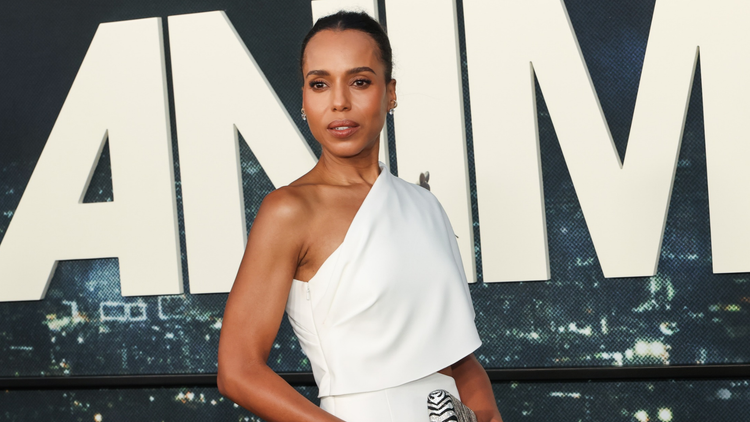
How far would you go to protect your family, especially when doing so means confronting secrets you’ve fought to keep hidden? That’s the dilemma Kerry Washington faces in Animals, the Netflix political thriller starring and directed by Ben Affleck.
The film follows Affleck's Mark Kimball, a Los Angeles mayoral candidate whose carefully crafted image as a devoted husband, father, and public servant begins to unravel when his family's world is turned upside down by a kidnapping. With his political future hanging in the balance and millions of dollars needed to resolve the crisis, Mark and his wife, Washington's Abigail Kimball, find themselves making decisions that could change their lives forever. But the story isn't simply another kidnapping thriller — beneath the suspense is a story about marriage, ambition, privilege, and the lengths people will go to maintain appearances, even when everything around them is falling apart.
For Washington, whom audiences have watched command the screen as Olivia Pope in "Scandal" and tackle emotionally demanding roles in projects like American Son and The Six Triple Eight, Abigail presents another opportunity to explore a woman navigating impossible circumstances. This time, however, the stakes are deeply personal, with a marriage and a family's future on the line. She offers her take on some of these themes in the exclusive conversation below, expressing how she respects that the film isn't "telling you what to think or how to feel," but just representing behaviors that exist somewhere out there in the world.
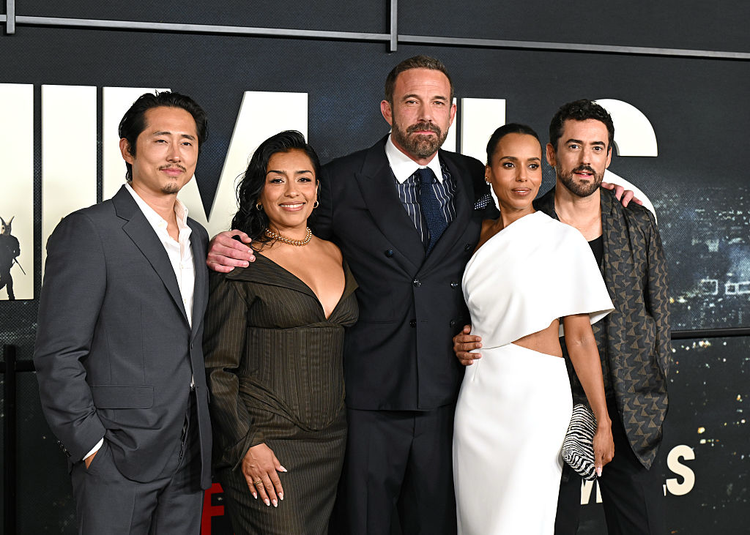
As the story moves forward with Mark fighting to preserve his political ambitions, Abigail must reckon with the consequences of choices that threaten the life they've built together. It's that tension between public perception and private reality that makes the story particularly interesting, especially in a world where power and influence can often determine whose version of the truth gets heard. The film also features Gillian Anderson, Steven Yeun, Luis Gerardo Méndez and Adriana Paz, bringing together the ensemble cast for a story where trust becomes increasingly difficult to come by.
REVOLT caught up with Washington to discuss the film's dynamics, the exploration of family and morality, and what happens when the life you've built is suddenly put to the ultimate test. Check out the full conversation below.
Abigail is unfaithful, and obviously this isn’t the first time we’ve seen you play a woman navigating infidelity inside the world of politics and power. But Olivia Pope and Abigail Kimball feel very different. At this stage in your career, what interests you about women who can be deeply loving and deeply flawed at the same time without asking the audience to either absolve or condemn them?
That's so beautifully said. I don't know that I would have articulated it that clearly. What moves me about your question is that what you're describing sounds like a real person. That's what draws me to flawed characters who are still lovable — [it's] that I feel like that's what humans are.
This movie keeps forcing its characters into choices where there really isn’t a clean moral answer: pay the ransom, call the police, or take matters into your own hands. As a parent yourself, which instinct do you think would win first in your mind between morality, survival, or simply getting your child home?
I think it's really hard to answer that in an interview, because I think that's one of the things that the film is about, is, like, when the unimaginable happens to you, who do you become? We don't really know until it happens. We don't really know until we're faced with the nightmare of the worst possible situation what we would do. Sometimes we surprise ourselves with how we feel in the moment.
There’s a really interesting contradiction in the film: this is a family with proximity to political power, yet Ramon’s immigration status determines when he is considered employable, disposable, or worth protecting. At a time when immigration has become such a politically charged language in America, what did you think the film was saying about the difference between the people politicians talk about and the people who actually become part of our lives?
I think one of the things I really respect about the film is that I think it's less saying something and more doing something, because it's not telling you what to think or how to feel, but it is, like, representing behavior out in the world, and then you get to grapple with that behavior. I think one of the things that the film does is what you're talking about. It puts these characters into our lives in such a real way that we have to come out of the stereotypes of, like, the Brentwood mom, the politician, the nanny, the maid, or the gardener.
The film really invites us into these private conversations... even the characters in the film aren't privy to each other's private conversations. Abigail wears one mask with her husband and one mask with the campaign manager. You see how we're navigating these private conversations, and as an audience, we're let into all of them. We get to know these characters and their inner lives, and in a way that sometimes in life we don't take the time to do. Sometimes in life we operate more on the stereotype or, even in a good-natured way, our idea of who somebody is. That idea can be based on the mask that they're presenting. But there is another version of somebody that might be closer to their truth.
There’s an uncomfortable idea running through the film that Abigail can be essential to Mark’s political image while her Blackness and their child’s identity can also be treated as a political liability. What did that contradiction unlock for you about the way interracial families can be embraced symbolically in politics but scrutinized very differently in private?
Well, I think it's really about the complexity. There’s a scene in the garage where Abigail’s talking to another Black character, where he says to her, "Don't let him use you as a pawn." There’s this idea that he’s able to present himself in his campaign as being a man of all the people. He has a Black wife and a brown child, and so maybe he's resonating differently with Black voters.
There’s another conversation in the film with an Asian character who says how Abigail is a liability. You wonder, like, which is true, because in that moment, he's also using that as a weapon to hurt her and to put her in her place. It’s like a chess move. So is that true in the polls, that she's a liability? Is it only true with some voters? You're invited to look past the stereotype, to look past the simplicity, [and] to lean into the complexity. That's what human beings are because we aren’t simple. Abigail is a Black woman, but she’s also a West Side Brentwood mom of privilege, and a woman who wants to be loved and be seen. All these characters are so multifaceted.
When Mark discovers the affair, one of the first things he wants to know is whether the other man is Black. That’s such a revealing question because suddenly race enters a moment that should ostensibly just be about betrayal. What did that reaction tell you about Mark and maybe about the racial dynamics that had always existed underneath their marriage?
First of all, that line was not scripted. There were lots of times where Ben [Affleck] and I would be doing scenes, and he would say, okay, let's improv here. We were very collaborative in a lot of our scenes together. He surprised me with that question in one of the takes of "Is he Black?" I knew that Abby's not answering would be enough of an answer. I knew that he was asking that question out of his own sense of... Can this woman ever love me? Am I somebody who's never going to get her full love because she really sees herself and wants to be with somebody who's Black? Will she love me in this white body? Even though it wasn't written, it came out of this rehearsal process where Ben and I really built out the backstory for these characters: how they met, what my family thought of him, when they met him for the first time, what his family thought of me, how we've dealt with the interracial thing before, [and] did I lose any friends over it? It was a very organic improv that felt very honest to the relationship and, in particular, honest to his fears that he's never going to be worthy of her love or able to be loved by her truly.
What animal did young Kerry Washington need to be to survive Hollywood, and what animal are you now?
I would say young Kerry had to be a dolphin. Like, nimble, very smart, likable, cute, travel in packs, and able to dive deep, but also come up for air and play. I still love dolphins, but I'm a little more still these days. There's a little bit more stillness for me now, a little more presence and stillness. I’d say maybe a hawk or an owl.
Before I let you go, I have to say how proud we are of you. So congratulations on Season 4 of "Reasonable Doubt." At a time when so many Black and brown-led shows are fighting just to make it beyond a first or second season, what does getting that fourth season mean to you as a producer?
I really want to get back to doing more directing at "Reasonable [Doubt]" because directing that pilot was such a magical experience for me. I feel really proud of "Reasonable Doubt" and proud of all the talent that has worked so hard to continue to have the show thrive. Everyone from Emayatzy Corinealdi to Meagan Good to Morris Chestnut — everyone is so good and so great. So fantastic, it’s magical.