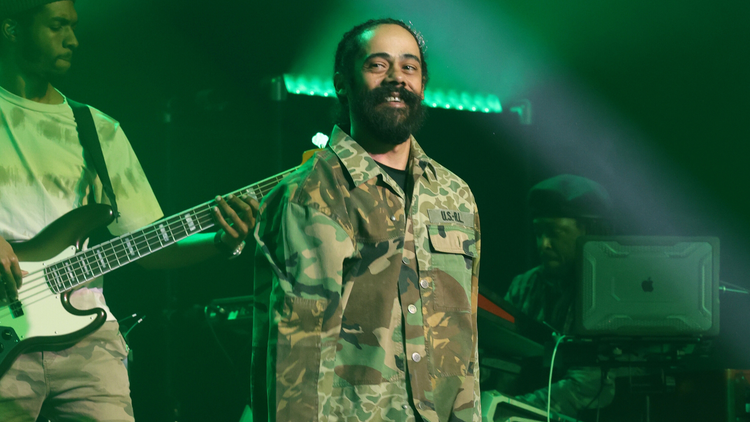
The Welcome to Jamrock Reggae Cruise has become more than a music festival at sea — it’s a movement. Over the years, the voyage co-founded by Damian Marley and his longtime manager Dan Dalton continues to honor the roots of reggae while paving the way for the genre’s next generation. For its 10th anniversary in 2025, the route included Miami, Montego Bay, and Ochos Rios. The lineup united Damian with his brother Stephen Marley for a stop on their “Traffic Jam Tour” and welcomed the third generation of Marleys — Skip, YG, Mystic, and Yohan — to carry the family’s legacy forward. Artists like Shabba Ranks, Sizzla, Demarco, and Ding Dong & the Raver Clavers were also invited to perform.
This milestone year also marked the 20th anniversary of Damian’s Grammy-winning album Welcome to Jamrock, the same name that inspired the cruise. Released in 2005, the record became a landmark moment in reggae and dancehall.
In an exclusive interview with REVOLT, Damian reflects on the cruise’s decade-long evolution, the moment he realized it was real, and why creating a full cultural experience remains just as essential as the music itself. He also opens up about seeing the next generation step into their own, the ongoing bond with his brothers, and how his father, Bob Marley’s, spirit still flows through every beat.
The year 2025 marked the 10th anniversary of the Welcome to Jamrock Reggae Cruise. Looking back, what was the most powerful or unexpected moment from building this experience for over a decade?
Well, if I had to choose one moment, I would say the very first sail. [That was] when we knew that it was really reality. It's happening. We're actually leaving the port in Miami. We're aboard the ship, and we're off to sea. That would still have to stand out as the most important moment.
The last date for you and Stephen Marley’s “Traffic Jam Tour” landed on the 2025 cruise. How did it feel to bring that moment full circle together?
Well, it's not really wrapping up, you know? 'Cause it's really an ongoing thing. We did a tour last year, we did another this year, and then, I mean, by January, we'll have more dates together as “Traffic Jam.” I wouldn't really say it's wrapping, really, you know?
The 2025 lineup also shone a spotlight on Skip, YG, Mystic, and Yohan Marley. As an uncle and collaborator, what excites you most about seeing the next generation of Marleys step onto that stage?
I've seen the growth, you know? Obviously, I’ve know all of these children [since they were] born, [since] pampers, you know what I'm saying? To see them become young adults, carrying on the legacy, carrying on the torch, and making their own way, also, forging their own identity… That's a wonderful thing to see. And as an uncle, it makes you proud.
What can fans expect from the cruise when they attend? Are there surprises in store?
Well, if I told you it wouldn't be a surprise. But 10 years, ongoing, people kind of know what to expect still, and they can expect the very finest in reggae music and entertainment. That is really what we try to strive for every time.
Beyond the music, the cruise features sunrise Nyabinghi drumming, authentic cuisine, and cultural activities. Why was it important for you to make the cruise a full Jamaican cultural immersion instead of just concerts?
I mean, just exactly what you said. We wanted to make it an immersive full experience. Growing up, I used to always go to Sun Splash [Reggae] Festival, which was the original, one of the first real, you know, feature-length reggae festivals, especially in Jamaica. And that kind of set the pace for all that you see going on now, all of the ones that you see still happening now. So, this vibe that we have on the boat is very, to me, kind of nostalgic of Sun Splash. It's the closest thing that could capture that energy, you know? That same Sun Splash energy back in the day. The camping out, this and that, the full cultural experience. It's our roots, it's our culture, and we wanted to express it with other people, share it with other people, really.
What inspired you to launch the Jamrock Reggae Cruise in the first place?
There's opportunity. I mean, there's other music cruises out there, and we thought that reggae music could go hand in hand with the culture of cruising. Going to the Caribbean, being in the sun, being on the sea, etc, etc. We thought it would work well with having reggae music on a cruise. Really what the challenge was for us was to have people believe in it. For a couple of years in the beginning, we were trying to get other partners on board, other people to see the vision. And that proved to be an obstacle at first because they thought that reggae music fans wouldn't have the disposable income to buy a cruise ticket. For some reason, they thought that. However, when we went on sale with the first cruise, we sold out pretty quickly. We obviously proved them wrong. That was really a big part of the challenge. But again, we're not the first music cruise, but we're the first reggae — full-out reggae cruise.
“The Marley Brothers Legacy Tour” was a huge moment. After decades of separate paths, what was it like to share the stage with your brothers every night and perform your father’s music together again?
It was great. We always do it from time to time, as a one-off concert where all five of us will be on stage at once. And then over the years, we always performed with each other. It might not be all of us on stage at once, but you'll have instances where I'm on stage with Julian and Steve might be on stage with Ziggy, etc., etc. You know what I'm saying? And we're still very close-knit as a family, still. So, we're still always a part of each other's lives. But obviously it was a special tour being that we have a full-length tour that we're all doing together, which we had done once previously in 2004. So, you know, it's again, 20 years later, really, to do it again and whatnot. But, I mean, of course, it's always a good time when it's a family moment. It's always a good time when you're on stage with your brothers.
You’ve released some powerful singles across the years — “Banner,” “Wisemen,” and “My Sweet Lord.” How do these songs reflect where you are creatively?
Well, I wouldn't really know how to put that into words. I mean, obviously, it's a manifestation of where I am now, you know what I'm saying? We don't really force music; we do what we feel or what we're inspired to do, you know? I have many songs that are not released, so I can't necessarily say that those three songs are a full representation of where I am creatively, but again, with us, it's nature.
You were only 2 years old when your father passed, yet his influence clearly lives in your work. How do you keep his teachings alive while carving your own path as an artist?
Well, to tell you the truth, I don't even think about that. I think when it comes down to my father, his legacy lives on in perhaps nearly all of the Jamaican music that you hear now, you know what I'm saying? So, I mean, his influence goes way beyond just me as his child. He’s influenced generations. But again, that's nature. It's not something that we sit down and consciously think about. He is a part of who we are, and we live our lives. And just naturally, because of that, you hear him.
Your family’s legacy is unmatched in music. What lessons have you learned from them that still guide you today?
It's really just the morals and the togetherness — the principles. It's not necessarily something to do with music. The people that we've grown to become, the family values, and sticking together. It's the same philosophy… Rastafari, our faith. All of these things contribute to the people that we are.
You’ve worked with everyone from Nas and JAY-Z to Bruno Mars, Mariah Carey, and Wizkid. Any more collaborations or projects you've signed onto?
Well, not surprisingly, I'm doing some work with my brother Steve right now. We have a bunch of tracks that we're getting ready to release in the near future. But outside of that, not really, no.
From Distant Relatives, your joint album with Nas, to all those collabs, you’ve often fused reggae with Hip Hop and other genres. What draws you to that kind of experimentation?
Well, really, just being a fan of different genres of music is what inspires me to work with different genres. And being creative, you know? The definition of being creative is trying new things. So, I just try new things. You don't know if it will always work. I mean even to put the album Distant Relatives together; it's not every song that we tried worked out. Of course, what you heard [were] the ones that did work. And again, nature. We just try to be as natural as possible, not try to overthink things, not try to force, just try to be ourselves, just musically and in real life, you know what I mean? Just try to be yourself at all times, don’t try to force it.
Artists like Valiant and Chronic Law have also signed on to perform at the cruise. How do you feel about the direction reggae and dancehall are taking today?
I [don't] think it's for me to say. I think each one has the right to choose their own direction. I mean, they're trying new things, young people are trying new things, which is expected. The genre seems to be flourishing right now. So, they're doing their jobs well.
Looking back on your career, what’s one moment that still gives you chills when you think about it?
Oh, wow. I guess it's a couple of them. Probably winning the Grammy for the first time was kind of a big deal. Sailing off on a cruise for the first time was a big deal. You know, when I heard that “Welcome to Jamrock” was blowing up on American radio, that was a big deal.
What’s a lesson you’ve learned about music, family, or life that your younger self would be surprised to hear?
Wow. [During] the pandemic, they said that my job is non-essential (laughs). My younger self would be surprised to hear about that one.
For tickets and more information on the Welcome to Jamrock Reggae Cruise, visit here.