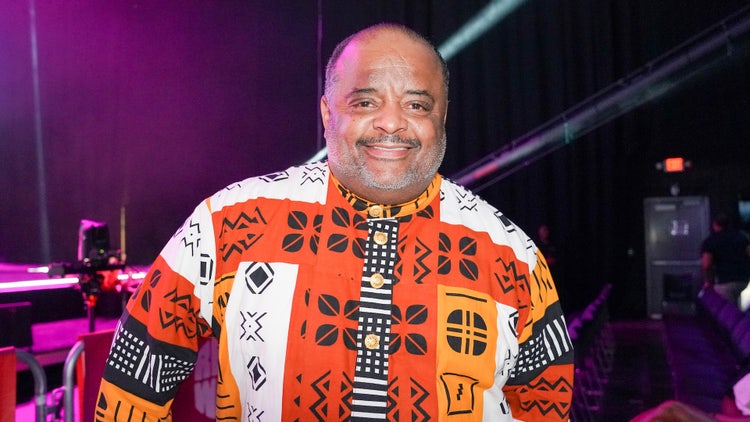
Roland Martin has never been afraid to speak plainly about power. The veteran journalist and Black Star Network founder spent decades pushing conversations about race, politics, and progress into the mainstream. After already accomplishing so much, he shifted his focus to something closer to home: The survival of Black media itself.
This exclusive conversation with the legendary journalist and commentator began with an Instagram post by Isaac Hayes III about economic unity, a message that immediately resonated with Martin. For him, the problem isn’t creativity or ambition; it’s fragmentation. “One of the greatest issues that we have right now,” he began, “is that we rarely see consolidation. That literally makes no sense whatsoever.”
Martin believes that while Black creators drive culture, the infrastructure around that creativity remains fragile. What’s missing, he insisted, is cooperation — a collective strategy to scale ownership before the industry collapses under its own competition.
Martin’s vision of progress is structural, not self-centered. “Somebody asked me once, they said, ‘Roland, if you had an option between doing a $500 million deal only for you, or 10 of you could do $50 million each, which one would you take?’” he recalled. “I say $50 million. That’s 10 different families. That’s 10 different lineages. That’s the ability to be able to build and create wealth for 10 different lines.”
He sees that mindset as the key to rebuilding a sustainable Black media economy. “There are people who want to be the only one in the room,” he said. “They want to eat everything. They want to be the only one that’s actually doing something. That’s fine, but that’s also the problem. All of us can eat. All of us can succeed. All of us can actually be great.”
Martin pointed to the Telecommunications Act of 1996, which reduced the number of Black-owned radio stations, and to cord-cutting’s impact on Black television. “We are moving towards a day where Black-owned media could be extinct,” he warned. “The question is, what does it look like in 2030, 2035, 2040? Is it a collection of individuals or companies that have the scale to be able to compete?”
For Martin, the answer lies in collaboration: Mergers, partnerships, and shared investments that turn creativity into infrastructure.
The Black tax and the cost of fragmentation
His argument isn’t theoretical. Martin cites the 2000 sale of BET to Viacom as a vivid example of how undervaluing Black audiences has long limited ownership.
“When Mel Karmazin looked at BET, they were getting $1,500 for a 30-second ad, MTV was getting $8,000,” he said. “Same ratings — sometimes, BET’s ratings were actually better. That’s the Black tax. If BET was getting fair market value for their ads, Bob and Sheila Johnson could’ve sold one-third of the company and still been majority owners.”
He paused before connecting that story to the present. “So, when you add that to what’s happening now — Black newspapers closing, radio declining, television shrinking — it’s clear: We can’t afford silos. We need consolidation to survive.”
When the discussion turned to digital platforms, Martin’s tone shifted from analysis to frustration. He’s seen too many examples of Black creativity enriching white-owned spaces.
“Black people are America’s tastemakers,” he said. “We set the trends. Only Black people could take construction boots and turn them into Timberlands, a multi-billion-dollar fashion business, but we don’t own it.”
He applies the same logic to social media: “We made Twitter pop. We made TikTok pop. We made Clubhouse worth $4 billion in nine months, but we don’t own anything.”
That’s why he supports Isaac Hayes III’s Fanbase, a Black-owned platform designed to give users both creative and financial control. “Fanbase raised $10 million. Clubhouse had $100 million,” he noted. “If Rihanna took 10 percent of her followers and moved them there, the valuation would jump past $500 million overnight.”
The math, Martin says, is simple, but the mindset isn’t. “White supremacy has been so powerful that Black people instinctively think something Black-owned is second class,” he said. “We will give white companies grace to grow but expect perfection from our own.”
He backs up his beliefs with action. “I run Fanbase ads every day at the end of my show,” he stated. “I can’t talk it if I don’t do it. A lot of people talk the collective; they just don’t act in it.”
Centering Blackness and not chasing validation
For all his talk about ownership, Martin didn’t equate independence with isolation. Instead, he framed it as clarity of purpose. When a former publicist once encouraged him to “go mainstream,” he turned down the advice.
“If I never get bigger or more well-known than I am right now, I’m good,” he expressed. “My mission is to center Black people to where we’re not an add-on. We’re not part of the conversation. We are the conversation.”
That mission powers the Black Star Network, his digital platform that hosts “Roland Martin Unfiltered” and other original programming. Over time, the channel’s “State of Our Union” broadcast became a recurring counterpoint to the president’s annual address. It’s a space where Martin invites Black leaders to define the nation’s priorities on their own terms.
During the 2025 edition, held as President Donald Trump delivered his speech to Congress, Martin welcomed Rev. Dr. William J. Barber II for a powerful address of his own. “We were No. 5 on all of YouTube that night,” he made clear. “Not ABC, not NBC. We were number five.”
At the peak of that stream, 250,000 people were watching live. “Imagine if 100,000 of y’all showed up every day,” he said. “That changes the economics overnight. That means more people get hired. That means we can do more shows. That means we can have more reach.”
According to Martin, that’s the difference between visibility and viability — building the scale needed to grow without diluting the message. “We can literally build the capacity ourselves, and others are going to come watch what we do,” he explained. “We can still be doing what we’re doing, centering Blackness, and still speaking to everybody else, but where we are the central storyline.”
For Martin, media and politics aren’t separate arenas. They’re extensions of the same fight for power and self-determination. “What we’re witnessing right now,” he explained, “is a wholesale effort to defund Black America.”
He listed examples without missing a beat: The attacks on Black Lives Matter in 2021, the “critical race theory” panic in 2022, the backlash to “woke” in 2023, and the push against DEI in 2024. “They’re targeting every infrastructure we built. Economic, academic, legal,” he insisted. “They’re even using civil rights laws that were written for us against us.”
His prescription is both data-driven and grassroots. “In places where we are a major population, we’re voting at 40 to 45 percent of our capacity,” he said. “We need to be at 70 percent. That’s how you change stuff. You have to have micro-level organizing, precinct by precinct, block by block, church by church. Boots on the ground can’t just be line dancing; they’ve got to be mobilizing.”
Despite the weight of the conversation, Martin circled back to gratitude and clarity about his role. “People always say, ‘Man, you could be bigger,’” he recalled. “I’m like, they can come watch here. I don’t need to chase that.”
He measures success in impact, not recognition. “You’ve got The Root 100, you’ve got Ebony Power 100, you’ve got NAACP Image Awards — I’ve been on all of them,” he stated. “That’s fine. But that’s not what drives me. What drives me is when I walk through an airport or I’m in a grocery store and somebody says, ‘Hey, my grandma makes me watch you.’ That’s validation.”
“Fox Broadcasting was built on Black people. Tubi was built on Black content,” he said. “We’re great at building other people’s platforms. The next step is building our own.”
Martin’s own business decisions reflect the same philosophy. “We’re flipping BlackStarNetwork.com into a full-fledged news portal,” he said. “We’re launching a midday show, a business show, [and] a health show... But that takes investment.” He makes it clear that growth alone isn’t the goal — sustainability is: “I want an ecosystem that can last. That’s the real legacy.”