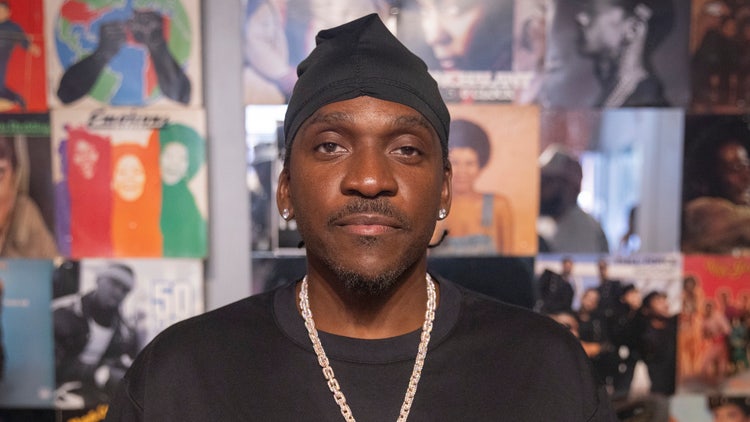
Few rappers have maintained a lane as razor-defined as Pusha T. From the moment he stepped into the spotlight as one half of Clipse, his vivid depictions of street life and unflinching penmanship made him one of rap’s most respected voices. As a solo artist, the Virginia emcee sharpened every element of his game, turning bars, beat selections, and even statements into precision tools.
Pusha T’s solo discography isn’t bloated with filler or rushed ideas. It’s a tightly coiled body of work that mirrors his brand: luxury laced with edge, drug-themed bars delivered with clarity, and no compromise in sight. Even in between albums, he delivered surgical strikes like “Drug Dealers Anonymous,” “Lunch Money,” “Sociopath,” and “Coming Home” with assists from JAY-Z, Lauryn Hill, and more, further solidifying his legacy. Working alongside Kanye West, Pharrell Williams, or operating entirely on his own, Push treated his approach to each release as one of the highest forms of art and creativity.
Below, we revisit Pusha T’s solo drops to trace the arc of a career that’s defined by sharp turns, sharp beats, and a sharper ear for timeless lyricism.
1. Fear of God
Pusha T’s solo run officially began with Fear of God, a mixtape that merged street parables with the sleek production style he adopted after joining G.O.O.D. Music. Tracks like “My God” and “Raid” (featuring Pharrell and 50 Cent) paired opulence with ominous undertones, while freestyle cuts like “Blow” and “Can I Live” kept him tethered to his mixtape roots. At its core, the project was a bold step forward — not just in sound, but in identity.
The title itself was inspired by personal loss and Malice’s spiritual awakening. “I lost eight of my friends to incarceration,” Pusha said at the time. “The fear of God really came over me.” That theme of duality between good and evil, or sin and redemption, ran deep throughout. With help from Rick Ross, Kevin Cossom, and Ab-Liva, Fear of God offered a sharp, confessional glimpse into a solo artist forging a new path under heavy weight.
2. Fear of God II: Let Us Pray
After the momentum of Fear of God, Pusha T delivered his major-label debut with Fear of God II: Let Us Pray, an expanded and refined version of the mixtape that further stamped him as a solo act. Now armed with retail backing and new material, Push sharpened the lineup with standout additions like “Trouble on My Mind” featuring Tyler, The Creator and “Amen” with Kanye West and Young Jeezy. The production leaned grand, courtesy of The Neptunes, Shawty Redd, Bangladesh, and others — a deliberate contrast to the relative minimalism of his Clipse days.
Several tracks carried over from the mixtape, including “My God,” “Raid,” and “Alone in Vegas,” but the EP stood on its own as a statement. Pusha’s rhymes were as menacing and controlled as ever, pairing vivid imagery with cold delivery. With cameos from Meek Mill, 50 Cent, and French Montana, Let Us Pray gave Pusha his first taste of industry solo success without compromising his core message.
3. Wrath of Caine
Serving as a street-level appetizer ahead of My Name Is My Name, Wrath of Caine found Pusha T fully leaning into what he called “street Hip Hop” that “has no boundaries.” Released for free via LiveMixtapes and DatPiff, the tape showcased gritty lyricism over production from Kanye West, The Neptunes, Jake One, Harry Fraud, and B!nk, among others. The standout single, “Millions” featuring Rick Ross, was an ode to dope boys and excess, while “Blocka” brought in Travis Scott and Popcaan for a sinister, dancehall-tinged banger that hinted at broader experimentation.
Despite its brief runtime, the tape packed a wide range of collaborators — including Kevin Gates, Wale, French Montana, and Troy Ave — and still managed to keep Push at the center. More than a throwaway prelude, Wrath of Caine was a reminder that even in between major-label drops, Pusha had the lyrical hunger and clarity to outshine the competition with ease.
4. My Name Is My Name
Pusha T’s official solo debut, My Name Is My Name, arrived with heavyweight expectations and delivered with surgical focus. Executive produced by Kanye West, the album was a cold, elegant distillation of Pusha’s brand: Luxe minimalism, layered drug metaphors, and a voice honed to slice through every beat. Tracks like “Numbers on the Boards” and “Nosetalgia” (featuring Kendrick Lamar) showcased his lyrical sharpness over stark, arresting beats, while deeper cuts like “S.N.I.T.C.H.” and “King Push” pulled from both paranoia and pride.
The album’s guest list, including Rick Ross, Future, 2 Chainz, Big Sean, and Chris Brown, never diluted the product. Instead, each appearance amplified the narrative of a man standing on principle, ambition, and legacy. Pulling inspiration from “The Wire” and The Devil’s Advocate, Push framed the project as a high-stakes moral reflection. My Name Is My Name was effectively a manifesto.
5. King Push – Darkest Before Dawn: The Prelude
Originally intended as a warm-up for the long-promised King Push album, Darkest Before Dawn turned out to be one of Pusha T’s most conceptually cohesive solo offerings. Clocking in at just over 30 minutes, the project paired ice-cold lyricism with bold, often eerie production from Kanye West, Timbaland, Q-Tip, Metro Boomin, and more. Singles like “Untouchable,” “M.F.T.R.,” and “Crutches, Crosses, Caskets” found Pusha in peak form — cynical, controlled, and entirely uncompromised.
Rather than dilute his message with filler or trend-hopping, Push kept the vision focused and brooding, weaving in features from The-Dream, A$AP Rocky, Kehlani, Jill Scott, Beanie Sigel, and longtime comrade Ab-Liva. The result was a short film-worthy album that sharpened his image further, placing him in a lane few rappers could occupy with this level of consistency. As a prelude, it was haunting. As a standalone statement, it stood tall.
6. DAYTONA
What was supposed to be King Push was reborn as DAYTONA, a sleek seven-track statement produced entirely by Kanye West during an iconic period of G.O.O.D. Music drops. At just 21 minutes, the album wasted no time — every bar was deliberate, and every beat was sample-heavy and searing. From the cold-blooded confidence of “If You Know You Know” to the Drake-baiting closer “Infrared,” Push sounded completely in command, wielding brevity as a weapon. “DAYTONA represents the luxury of time,” he explained. That discipline showed in full.
With only two guest rappers (Rick Ross on “Hard Piano” and West himself on “What Would Meek Do?”), the spotlight rarely shifted. Tracks like “Come Back Baby” and “Santeria” elevated street poetry into something operatic, balancing menace with elegance. Released during the historic Wyoming Sessions era, DAYTONA was hailed by critics as a career peak and earned a Grammy nomination for Best Rap Album.
7. It’s Almost Dry
It’s Almost Dry became Pusha T’s first album to debut at No. 1 on the Billboard 200. It was especially notable for showcasing two contrasting production styles from Kanye West and Pharrell Williams. Ye leaned into chopped-up soul, while Pharrell opted for stripped-down percussion and icy elements (ex. the hair-raising “Neck & Wrist” with JAY-Z). The opener, “Brambleton,” immediately made waves for its autobiographical lyrics, while “Let The Smokers Shine The Coupes” and “Just So You Remember” brought theatricality to his signature street narratives.
The closing track, “I Pray For You,” reunited Pusha with (No) Malice, creating a Clipse moment that felt earned rather than nostalgic. Throughout the album, Push delivered his verses with total control, treating every song like a coded message wrapped in elegance and menace. His nomination for Best Rap Album at the Grammys was both career affirmation and proof that lyrical sharpness, when paired with focused production, can still cut through in a crowded rap landscape.