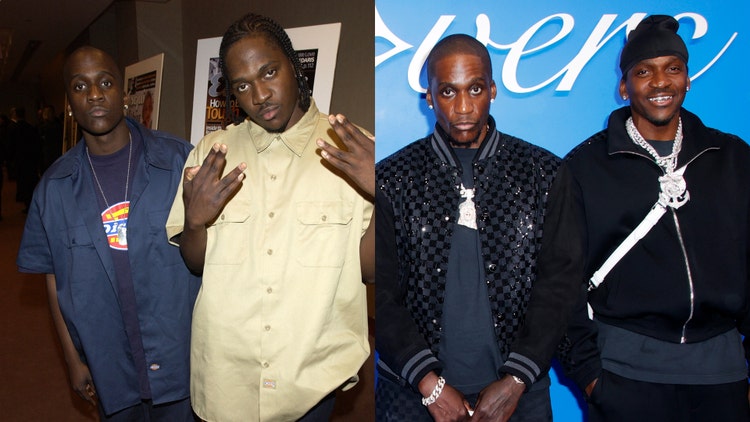
From shelved debuts to spiritual rebirths, this list breaks down every Clipse project and reveals the brilliance, pain, and brotherhood that made them legends. The Virginia Beach duo, made up of brothers Pusha T and (No) Malice, never dropped an album without intention. Their chemistry — dark and lyrical, cold and calculated — transformed street rap into a cerebral art form.
Guided by Pharrell Williams and The Neptunes, Clipse developed a style that inspired a new wave of lyricists, fashion-forward artists, and introspective street poets. Across a slew of classic albums, a deeply personal split, and a cinematic 2025 reunion, the group maintained one of the most respected runs in Hip Hop. Pusha’s icy aggression paired with Malice’s layered introspection created a dynamic no other duo has replicated. As you’ll see below, their catalog is tight, purposeful, and forever legendary.
1. The lost beginning: Exclusive Audio Footage
Clipse’s journey began with Exclusive Audio Footage, a full-length debut album recorded for Elektra Records that never saw an official release. Entirely produced by The Neptunes, the project captured the raw, unpolished hunger of two brothers with a story to tell. Tracks like “The Funeral,” “Got Caught Dealin’,” and “Dinnertime” were stark narratives reflecting street life in Virginia with ominous messaging.
The label, unsure of how to market the duo’s sound, ultimately shelved the album. Although never officially released, the album leaked in full years later and gained cult status. Listeners marveled at how fully formed Clipse sounded even before their debut — their lyricism already potent, their chemistry undeniable. The project remains a foundational piece of their legacy, foreshadowing the refinement and gravity that would define their future work.
2. The groundbreaking debut: Lord Willin’
After breaking free from Elektra, Clipse signed to Arista through Pharrell’s then-newly formed Star Trak imprint, leading to the release of their official debut, Lord Willin’. The project exploded into the Hip Hop consciousness behind the unstoppable force of “Grindin’,” a minimalist Neptunes beat made of woodblock percussion and eerie air pockets. As a fun fact, the group revealed to “The Breakfast Club” that “Grindin’” broke in Philly first — largely thanks due to the work of DJ Cosmic Kev.
The album was both a lyrical showcase and a sonic evolution. Tracks like “Virginia” further captured the duo’s regional identity, while “When the Last Time” and “Cot D**n” revealed their ability to craft infectious hooks without compromising depth.
Lord Willin’ was certified gold and critically acclaimed, establishing Clipse as elite lyricists with a distinct voice in Southern (yes, Southern) rap. The Neptunes’ full-album production proved both innovative and influential, blending off-kilter funk with raw storytelling. The album elevated Virginia Beach’s status in Hip Hop and redefined the sound and scope of “coke rap.”
3. Masterpiece in the shadows: Hell Hath No Fury
Hell Hath No Fury is often considered the crown jewel of Clipse’s discography — a bleak, uncompromising statement forged in frustration. After a drawn-out legal battle with Jive Records following the breakup of Arista, Clipse found themselves stalled for years. The result was an album born from rage and resilience.
The album’s production, again helmed by The Neptunes (although Pusha would give much of the credit to Pharrell alone during a “Drink Champs” appearance), turned even more skeletal and sinister. Tracks like “Mr. Me Too,” “Keys Open Doors,” and “Ride Around Shining” dripped with paranoia and icy opulence. Even the hooks were confrontational. The album featured some of their most cerebral writing, complete with a lion’s share of double entendres and coded narratives.
Critically, the album was hailed as a masterpiece. Pitchfork gave it a rare near-perfect score, and it landed on countless year-end lists. Its influence still reverberates within the culture long after its arrival.
4. Internal shift and “final” bow: Til the Casket Drops
Clipse’s third studio album, Til the Casket Drops, arrived with expanded sonic ambitions and signs of inner transformation. While The Neptunes still provided much of the production, the duo collaborated with DJ Khalil and Sean C & LV to broaden their sound. Songs like “I’m Good” and “Popular Demand (Popeyes)” aimed for mainstream appeal, but deeper cuts like “Life Change” and “Freedom” offered insight into their diverging paths.
Pusha T remained razor-sharp and street-focused, but Malice was shifting. This “tension” played out on wax: The chemistry was intact, but the energy changed. Critics offered a mixed reception, noting the album’s strong verses but uneven cohesion.
Despite standout moments, Til the Casket Drops lacked the singular intensity of its predecessor. Still, it remains a worthy chapter — a transitional document marking the end of their first era. The cover art, designed by KAWS, further signaled Clipse’s influence beyond music.
5. Diverging paths: Solo careers and spiritual turns
Following the release of Til the Casket Drops, the Clipse brothers stepped away from the group. Pusha T aligned with Kanye West’s G.O.O.D. Music and quickly made a name for himself as a solo powerhouse. His projects — Fear of God, My Name Is My Name, Daytona, and It’s Almost Dry — were critically acclaimed, timeless examples of his surgical wit and refined drug-rap persona.
Meanwhile, the renamed No Malice experienced a spiritual awakening. Renouncing his past lifestyle, he released the Christian-themed album Hear Ye Him, which maintained his lyrical integrity while expressing newfound faith. He published a memoir, participated in the documentary The End of Malice, and made occasional guest appearances, always staying true to his reformed path.
The two remained respectful of each other’s journeys. While Clipse was dormant, their influence deepened through the cult-classic We Got It 4 Cheap mixtape series with Ab-Liva and Sandman — revered projects that inspired the next wave of street rappers with dense, layered lyricism.
6. The resurrection: Let God Sort Em Out
After years of speculation, Clipse returned in 2025 with Let God Sort Em Out, their most mature and cinematic album yet. Sparked by the death of their parents, the reunion was deeply personal.
Produced entirely by Pharrell, the album blended gospel elements, operatic flourishes, and skeletal boom-bap to create a unique yet familiar soundscape. “The Birds Don’t Sing,” “So Be It,” and “POV” immediately stood out thanks to lines balancing confession and conviction. Malice, largely moved by his father’s encouragement, found renewed purpose.
The album’s visuals, largely filmed inside Louis Vuitton’s Parisian headquarters, matched its scope and symbolized their elevation. Calculated features kept the focus on brotherhood, healing, and legacy. Critics praised the album for its introspection and cohesion, cementing it as an essential rap record.
7. Verses that echo: Features, deep cuts, and re-up rarities
Beyond their albums, Clipse left fingerprints across Hip Hop through features and freestyles. Their verse on Birdman’s “What Happened to That Boy” helped define modern coke rap (it also kickstarted one of the craziest feuds in rap history). Kanye West tapped them for “Use This Gospel,” and Nigo brought them back together for “Punch Bowl.” Each feature was sharp, deliberate, and memorable.
Their legendary We Got It 4 Cheap mixtapes served as lyrical bootcamps. We Got It 4 Cheap, Vol. 2’s “Ultimate Flow” and “What's Up” are textbook examples of unfiltered, elite-level bars.
These non-album contributions built their reputation as peerless lyricists, and they kept the Clipse name ringing even during their hiatus. For purists, these songs are not bonus material. They’re essential chapters in the duo’s evolution.
8. Lasting legacy: The cold precision of Clipse’s catalog
What separates Clipse from most rap duos is their precision. Their discography is compact but potent, each album a statement. Pusha T’s flair for vivid, streetwise lyricism contrasts beautifully with Malice’s moral compass, creating a duality that remains unmatched. That honesty, coupled with Pharrell’s daring production, elevated Clipse above trends. They approached luxury street rap with a thoughtful edge, pairing tales of furs and Ferraris with reflections on guilt and religion.
Their influence shows up in Griselda, Freddie Gibbs, Tyler, the Creator, and others who view Clipse as both blueprint and benchmark. From BAPE to Louis Vuitton, their fashion legacy runs parallel to their musical one.
Clipse stayed selective and intentional with their releases. Each project stands as a landmark, which is why their name continues to carry weight.