Key Takeaways
- Gingerbread houses and decorated trees trace their origins to 19th-century Germany and 16th-century Latvia, respectively.
- Jonkonnu and Black Santa Claus highlight the cultural imprint of Black communities on holiday traditions.
- The evolution of Christmas reflects a blend of global customs, from ancient rituals to modern celebrations.
December marks that time of year again — when the streets fill with snow, children bake cookies for Santa, and families and friends travel the world to spend time together. But originally, Christmas marked the celebration of the birth of Jesus of Nazareth, a central figure in Christianity whose teachings remain the foundation of the faith.
Over time, Christmas traditions have grown to include twinkling lights, building gingerbread houses, gift exchanges, church services, festive meals, and the beloved arrival of Santa Claus. But where did these traditions come from, and who helped shape how we celebrate today? To answer that question, let us explore the history of Christmas and how different cultures have helped shape the traditions we celebrate today.
When did Christmas celebrations begin?
The earliest known documentation of Christmas being celebrated on Dec. 25 dates to 336 A.D., during the rule of Roman Emperor Constantine. While Jesus’ birth was honored by early Christians in various ways before that, the Roman Church eventually formalized the holiday on this date - a decision that coincided with existing winter solstice festivals and seasonal observances in Europe.
In the United States, Christmas took hold as a formal holiday during the 19th century. By the 1830s, Southern slaveholding states, including Alabama, Louisiana, and Arkansas, were the first to declare it a state holiday. During this period, known as the antebellum era, hallmarks of Christmas celebration began to mirror what we recognize today: exchanging gifts, singing carols, decorating homes, and gathering for festive meals. Let’s dive deeper into some Christmas traditions that still exist today.
1. History of twinkling lights
Americans began using Christmas lights in 1882, when Edward H. Johnson, a friend of Thomas Edison, created the first strand of electric lights and installed them in his parlor window. The strand was made up of 80 red and blue lights, which were powered by a generator. However, Christmas lights didn't gain widespread popularity until the 1930s, when they became more affordable for the average American family.
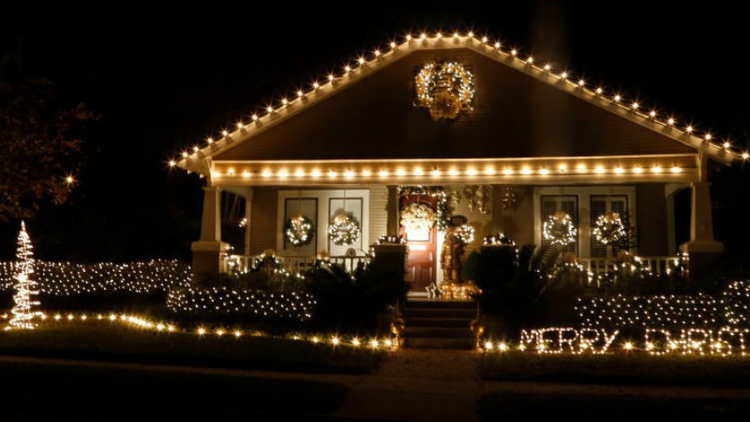
One of the houses on Highland Street, in the Heights, decorated on the route of Lights in the Heights, Thursday, Dec. 11, 2014, in Houston. The annual Lights in the Heights route this year is Omar and Highland from Studewood to Florence.
2. Gingerbread houses
The custom of decorating gingerbread houses traces back to the early 19th century in Germany. This custom gained popularity after the fairytale of Hansel and Gretel was published in 1812.
The Grimms’ original fairy tale includes the line: “When they came nearer, they saw that the house was built of bread, and roofed with cakes, and the window was of transparent sugar.”
Inspired by the story, German bakers began to craft small, decorated houses from lebkuchen, spiced honey biscuits. Now the modern tradition of making gingerbread houses has become a family event at Christmas markets around the world.

3. Black Santa Claus
The Santa Claus character originated from St. Nicholas, a fourth-century monk from present-day Turkey known for secret gift-giving. The modern image of Santa was developed in the late 1800s by illustrator Thomas Nast and later solidified through advertising — especially Coca-Cola campaigns during the 1930s that immortalized Santa’s red-and-white suit.
For decades, department stores exclusively featured white Santas, despite serving racially diverse communities. That began to change in 1936 when tap-dancing legend Bill “Bojangles” Robinson became Harlem’s first Black Santa at a Christmas Eve celebration for underprivileged children. It was a moment of representation for Black children rarely reflected in mainstream holiday imagery.
By the 1940s, major department stores in Harlem and Chicago followed suit, hiring Black Santas to serve local communities. During the 1960s, the image of Santa even became tied to the civil rights movement — appearing in boycotts encouraging Black consumers to support businesses offering fair hiring practices and respectful service.
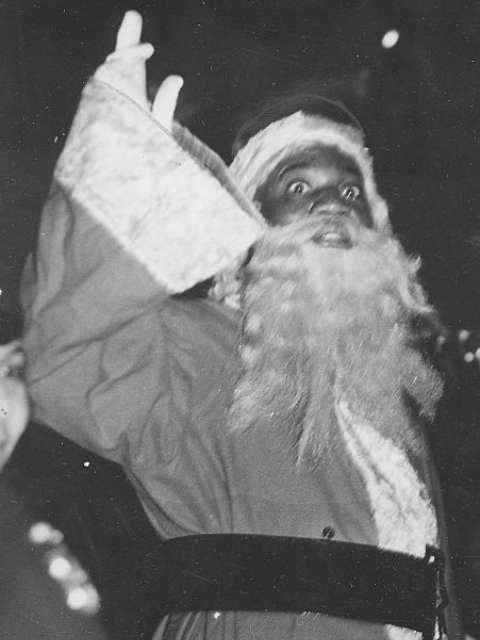
Bill Robinson, Bojangles. The entertainer Bojangles in a Santa Claus costume waving to a crowd, 1937.
4. Jonkonnu, also known as John Canoe
Rooted in West African masquerade celebrations, Jonkonnu involved enslaved performers dressing in handmade costumes — adorned with ribbons, feathers, and bells — while dancing and singing from house to house during the holiday season. The traveling shows blended music, satire, and theatrical expression, often exchanging performances for food, coins, or gifts. Jonkonnu is still practiced, particularly in Jamaica and other Caribbean nations like the Bahamas, though it has transformed over time. It is also kept alive in communities in the United States, such as in North Carolina, through historical re-enactments and cultural events.
5. Christmas trees
The first recorded decorated Christmas tree appeared in 1510 in Riga, Latvia (a country tucked between Estonia and Lithuania, with Russia along its eastern border). There, members of a merchants’ guild trimmed a tree with artificial roses — symbols of the Virgin Mary — danced around it in the town square, and then ceremonially burned it. By the 1800s, German settlers introduced the Christmas tree to the United States, where the small tabletop tradition quickly grew into full, floor-standing evergreens. By 1851, Christmas trees were being sold commercially in America, harvested straight from nearby forests.
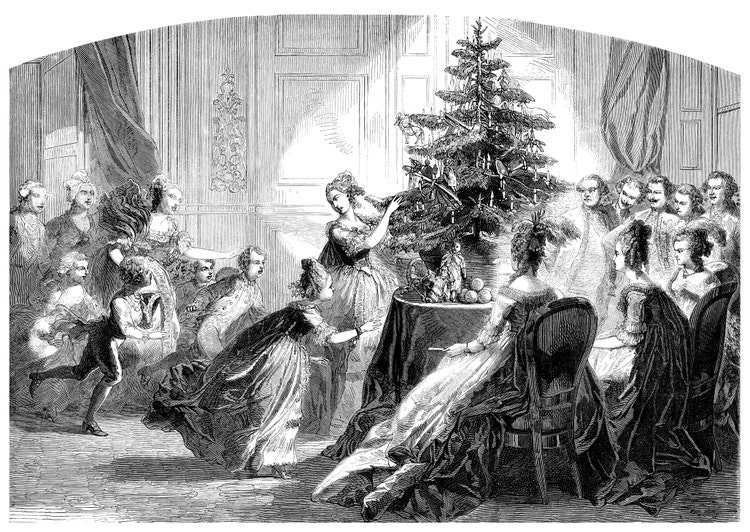
Family celebrating christmas 1863 - stock illustration
As we look back at the origins of Christmas — from the birth of Jesus, to the glow of Christmas lights, the emergence of Black Santa Claus, the vibrant traditions of Jonkonnu, the construction of gingerbread homes, and even the early Christmas trees shaped by German customs — it’s clear that this holiday is a beautiful tapestry woven from the contributions of many. Black communities, German settlers, Caribbean traditions, and countless others all played a role in shaping how we celebrate Christmas in America today.
And that’s the true magic of this season: different histories, different people, and different stories all coming together to create something joyful, familiar, and deeply meaningful.
For the Christmas season, may we celebrate with gratitude — surrounded by family, lifted by love, and grounded in the shared traditions that connect us all. May your home be warm, your spirit be light, and your holidays filled with peace and togetherness.