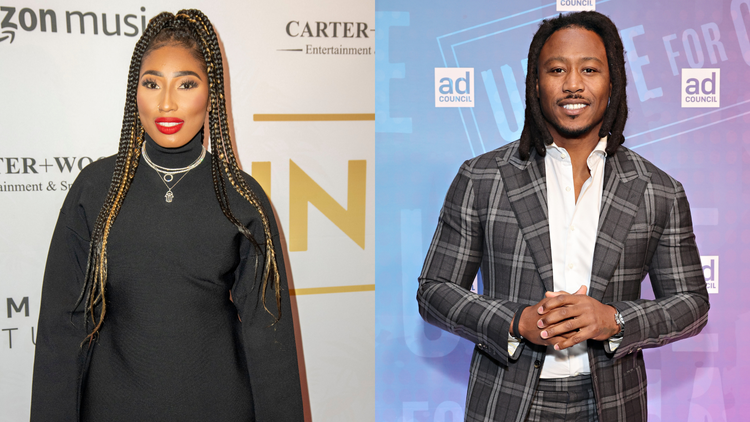
Brandon Marshall attends Ad Council's 70th Annual Public Service Award Dinner at The Glasshouse on December 05, 2024 in New York City.
There are two sides to every industry, especially when it comes to anything related to pop culture. For entertainers, from athletes to musicians, they have to understand the business side just as well as the performance side. On “POPLAW,” hosted by attorney Desiree Talley, listeners are educated on both, as guests dive into different topics where culture, law, business, and everything in between intersect. In this episode, Talley connects with her friend and former NFL wide receiver, Brandon Marshall, who made waves in the culture with his transition from athlete to successful entrepreneur.
During the discussion, Marshall candidly shares his experiences as a businessman and the lessons he’s learned along the way. With about 13 NFL seasons under his belt, Marshall has leveraged his sports expertise to build the fitness and wellness training facility House of Athlete, as well as launch a podcast, “I Am Athlete.” But that is not all. With the power of relationship building, Talley and Marshall also reflect on how their friendship was a catalyst for landing a major REVOLT contract for the sports star. From the gridiron to the boardroom, the sports media mogul emphasizes the importance of resilience, knowledge, and having the right people on your team as primary keys to adapt and dominate the challenges of business.
Here are five gems that Marshall dropped in this episode that can empower others to make their own game plays both in and outside of sports. Tune in to the podcast episode here!
1. You have to be dynamic in business
While many people may think they need to get a college degree to learn about the inner workings of businesses, Marshall used the NFL industry as his classroom. He explains on the show how he leveraged his resources and access to gain the knowledge that he uses today when making deals. The Pittsburgh native decided to speak up and make a seat for himself at the table. All in all, taking initiative led Marshall to secure a deal and be more involved in business meetings to better prepare himself as an entrepreneur in the future.
“[In] 2014, I realized that I was in one of the best businesses or industries in the world,” he began. “So, I'm like, damn, I don't have to go back to school to get my degree in business... Let me take notes and pay attention here. You have an owner, you have a general manager, [and] you have head coaches. You have a system in place, philosophy, meeting cycles, onboarding process, how we onboard new teammates or new coaches, offboarding process, etc., etc. So, I literally would have a couple of notebooks on all my head coaches, all my owners, and all my general managers. So, [in] 2014, I was like, ‘I’m missing opportunities to get reps.’ So, what I did was call my agent and I was about to negotiate my third deal... I said, ‘I actually want to be on every single call, and I want to go into the meeting with you,’ because I want to see.”
2. Connections and relationships can make or break a deal
Later in the episode, Talley and Marshall reflect on how they met. While both attended an advertising conference in May 2024, they connected on both a professional and personal level. Starting with Marshall asking the question, “Are you okay?” It marked the beginning of a real friendship for the creative storytellers. Talley was able to open up about happenings in her life, and Marshall gained a better understanding of who Talley was outside of her career. That encouraged Marshall to share more of his story, and together they developed a plan to work together after their second meeting in Cannes, France. Talley and Marshall's connection was the catalyst that later led to a dinner with REVOLT reps and secured a huge deal for the House of Athlete founder.
He explained, “That's a special thing about life and then also business: the relationships. When you connect with people on that level, it just goes farther, which was also a learning lesson for me as well, because I'm such a producer, put your head down and work, and sometimes I miss [out] on the connection and the relationships. And so that was a moment where I was like, ‘Oh no, she's a real person.’ And this is something that we could potentially lean in and build on forever. And it was outside of business. I wasn’t even thinking about REVOLT when you [started] opening up and sharing your story.”
3. The power of Black women is getting things done
Negotiating contracts and deals can be difficult. Finding the right balance to meet the needs of all parties can take months, even years, to figure out. Marshall explained how coming to an agreement for his partnership with REVOLT took multiple attempts, but in the end, he proved that believing in yourself and your dreams will attract the right partners to invest in them the right way. He praised Talley for her role in helping to push the deal to the finish line.
“The reason why this is big is because as an entrepreneur, when you invest everything, you’re putting your everything into this vision, and not everybody can understand it,” Marshall said. “People are going to call you crazy... You just gotta find a way to get up every single day until it works. You’re not out of the game until you’re out of the game… When I talk about this deal to people, I’m like, ‘No, Desiree is the one that got this deal done.’”
The former NFL star continued, “I was ready to give up. And I just needed that... So, when we sat there at that table... it was so smooth and so easy. And I was like, ‘Damn, Des, appreciate you. I'm never going to forget you ever. Can’t! No way! Right now, matter of fact, ChatGPT it, let's make sure we put Desiree in part of our equity pool [laughs]. It ain't worth much now, but in three to five years, right? That matters! That’s what we [mean] when we talk about he relationships... It was tough, but that’s the power of a woman, [especially] a Black woman, right? Sometimes, when you just get men in the mix, like, we just can't get it done. You stepping in and being able to navigate through them, like, ‘No, this is what we need to do. This is how it should look.’ Boom, the deal gets done like that.”
4. The best negotiation is a fair one
The conversation further explored the intricacies of entrepreneurship. Marshall explains how he is very passionate about sports and business. But he acknowledges that on the business side, you have to be objective, be confident in what you are selling, and not take things too personally. When it comes to negotiations, everyone within a deal is looking out for their own best interest long-term. So while you may have a perspective on how you would like a business contract to be, the mental health advocate understands that the middle ground in business is better than trying to come up on top selfishly.
“You gotta take the emotion out of money,” the University of Central Florida graduate explained. “I do like the transparency, I do like the realness when I look at what I want to be perceived as, as a businessman is... he’s fair, but the motherf**ker knows his s**t. And don’t come [to] play. But he’s fair and he does great business… It’s all about a fair deal. In business, there's sharks, there’s savages, and it's [a] dog-eat-dog world. I just don't want to do business that way. For me, it’s alright, what's a fair deal? How are you going to win? How am I going to win? Let's put everything out there... This is the art of negotiating. We're just looking at the numbers and you’re like, ‘Ah, this can’t work.’ And it’s like, that doesn’t mean we can’t get the deal done. There needs to be some give and take. Let's figure out what fits and what works.”
5. Making millions of dollars is not the main goal
The dialogue concludes with Marshall being transparent about his creative vision and what he hopes to accomplish in the future. The podcaster wants to continue building a platform that prioritizes athletes' voices and experiences. With much success gained over his career, Marshall is less impressed by the dollar amount and more focused on the influence that can be achieved with his creative ideas. Within media, your digital footprint can now open a lot more doors than a decade ago. So, Marshall expresses his viewpoint on demonstrating leadership, highlighting wellness, maintaining authenticity, and being “of service” to the professionals who join House of Athlete.
“So, $3 million is not going to move me,” he stated. “I already touched that. I [have] already seen that. That's not going to change my life, and that doesn't impress me. You know, buying watches, jewelry, cars — that’s not what I’m here to do. First of all, it's not even about me; it's about impact and what we're going to do with, you know, the influence. Like right now, collectively, all the guys that train here, 300 paying pro athletes right now, that reaches 500 million people. Meaning, from a social or digital footprint… Their culture currency, social currency, is more valuable than the money they can pay here... I'm creating a destination for the athletes, and we have to feel protected.”
Watch the full interview below!