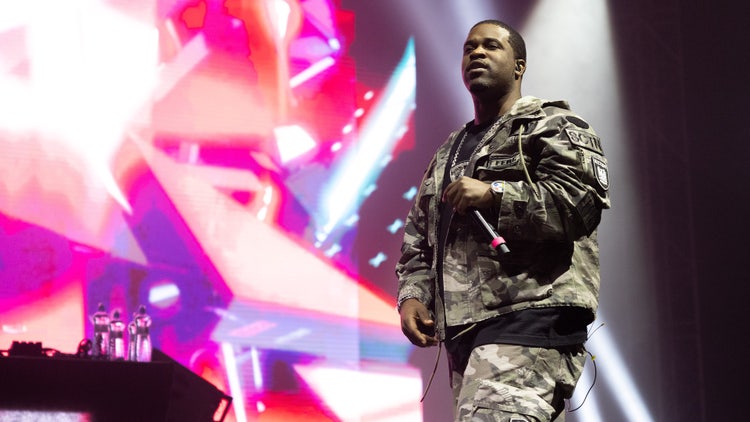
Harlem’s FERG (still very much tapping into that A$AP energy) blessed the masses with FLIP PHONE SHORTY – STRICTLY FOR DA STREETZ VOL. 1, a 12-track offering that’s loud, local, and built around a concept that’s bigger than nostalgia. Released via Trillagan Island, the project frames the “flip phone” as a whole mindset — less scrolling, more motion, more coded conversations, more real-time linkups.
“I got me some flip phones because I didn’t wanna be drowning myself with the internet s**t and being on social media all day,” he explained during a conversation about the project with HOT 97. “When I'm outside, I’m present, but when I’m back in the crib, that’s when I go back and check everything, and that's how I stay focused.”
That framing matters because it helps explain why the tape feels so intentionally street without being one-note. FERG swings between Uptown flex talk, city-specific roll calls, cartoonish punchlines, and throwback party cues that nod to multiple eras at once. Even the features read like deliberate scene changes and not random look-at-my-contact-list moments, as the project slides from Harlem to the Bay, to Atlanta, and even across the Pacific, while keeping the same kinetic pace.
Here are the biggest takeaways that jumped out as the tape’s clearest gems.
1. Features are used like “scene changes,” not random placements
The guest list is stacked, but what makes it interesting is how each feature shifts the texture. Denzel Curry shows up as a technique booster on both “FOCUS ON ME” and “YOUNG OG,” bringing that locked-in rapping energy. French Montana leans into his usual brand of flexing on “UPTOWN BABY.” “FLIP PHONE ANTHEM” goes full cross-regional (and global) with Awich and Gucci Mane over Taavi Haapala’s production. Even the weirder moments serve a purpose: Hunter BDM’s appearance on “DEM BOYZ” helps keep the tape’s street-cypher feel intact instead of too polished.
2. Taavi Haapala quietly acts like the project’s sonic backbone
If you’re looking for a producer-centric angle, Taavi Haapala is the through-line worth highlighting. He’s credited as producer across multiple tracks, including “FISHER PRICE,” “P.O.L.O.,” and “CEE-LO LIFE VOICEMAIL,” helping keep the tape cohesive even as it jumps between styles and feature palettes. He also handles three major key roles on “FLIP PHONE ANTHEM” (producer, mixing engineer, and mastering engineer), which is a subtle signal that this record’s “ringtone-era” bounce is being treated like a finished, intentional centerpiece.
3. “Flip phone” isn’t just a title — it’s the tape’s main metaphor
The project treats “flip phone” like a password and a way of moving through the world: Quick calls, quick links, and quick pivots. Even the interludes and hooks lean into that idea of communication as power, and not just convenience. “Flip Phone Shorty” becomes a character, not a prop. When Awich drops a real-world meetup point (“Meet me at 255 Canal”), it’s the tape spelling out the theme in plain English.
4. It’s very intentionally NYC-coded
This is one of those projects where the geography is part of the presentation. You get Manhattan specificity (Canal Street), plus Uptown pride that reads like a stamp, not a slogan. On “UPTOWN BABY,” French Montana drops a line that draws an actual boundary around the vibe (“Harlem and Bronx only”). Even when the tape travels (more on that later), it keeps circling back to New York as home base, and as the place where the codes, slang, and decisions originate.
5. FERG’s calling back to his foundational era
The mythology check-in shows up loudest in the way FERG (and his collaborators) frame him as Trap Lord/Harlem folk hero, with A$AP-era references used as identity markers. CeeLo’s voicemail is basically a roll call of nicknames, titles, and artifacts, namechecking “Trap Lord,” “Hood Pope,” and “Polo-nious Monk,” plus a very specific flex item fans will clock (“The Yams piece”). Not quite memoir rap, it’s more like FERG refreshing the origin story for anybody who’s been outside since the early A$AP run.
6. There’s a clean “Young OG” mission statement
“YOUNG OG” is the tape’s clearest thesis, because FERG turns the phrase into a mantra and then lets Denzel Curry sharpen it into lineage talk. FERG repeats the title like a stamp (“I’m the youngest OG”), as if he’s trying to make it undeniable. Then Curry makes the “OG” part about continuation, not just status: “We finished what Rocky and Purp started.” That one line ties the tape back to the A$AP family tree without turning it into a history lecture.
7. Street talk, but with cartoon/toy imagery and sports metaphors
One of the most notable takeaways here is how often FERG dresses street language in playful, pop-cultural packaging. On “BALL,” for example, he’s stacking jewelry talk with Saturday morning references (“Wrist on Flintstone”). “DEM BOYZ” goes even harder into snack/toy-world imagery, with luxury and childhood icons cleverly mashed together (“Cookie monster mink”). And on “P.O.L.O.,” he’s flipping nameplay into a catchphrase.
8. The tape nods to earlier club energy (and even some Memphis history)
Even with the “strictly for the streets” framing, the project keeps a party engine under the hood. “SHOOT THE CLUB UP” makes the intent obvious by interpolating Three 6 Mafia’s “Tear Da Club Up.” Meanwhile, “FERG STRONG” taps another throwback chant that instantly reads as crowd-ready: “Whoop, whoop, there it is.” It’s a smart balance: The tape can talk street and still remember that Harlem rap has always loved a hook that moves a room.