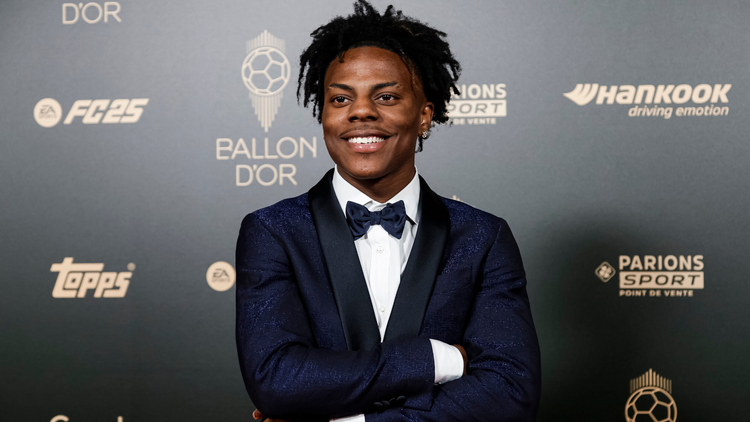
By the time he was only 21 years old, IShowSpeed had managed to do something that entertainment, sports, and media institutions have spent decades trying to engineer: he built a global audience that moves in real time with him — with no league, studio system, or co-sign required.
Born Darren Watkins Jr., the Cincinnati native didn’t just rise through the ranks of content creation; he detonated through them, turning what started as bedroom gaming streams into a cultural force that stretches across continents, industries, and generations of fandom.
There was once a rigid blueprint for visibility, especially in sports and performance spaces where athletes were expected to follow a system of playing in little leagues, becoming a household name in high school, and then a big shot in college before entering the big leagues. If the stars aligned, you were drafted into professional stardom. Brand deals, endorsements, and all things in-between followed that formula for years. But Speed represents a generation that no longer waits to be chosen.
As REVOLT previously explored in its feature on the streamer, he is “what happens when talent skips the gatekeepers,” a living case study in how charisma, athleticism, and digital ownership can outpace legacy pipelines. With over 50 million YouTube subscribers and billions of reported cumulative views across platforms, the rising star has built an audience ecosystem that not only matches his peers but, in some moments, outpaces the reach of traditional sports broadcasts.
For context, his subscriber count alone eclipses the population of several countries. But the numbers only tell part of the story. What makes Speed compelling isn’t just scale, but it’s his progress. His career moved at the speed of the internet itself, powered by marathon livestreams, explosive reactions, musical drops, and a willingness to turn everyday curiosity into spectacle.
He has raced cheetahs, streamed inside the pyramids of Egypt, and faced off against elite athletes. Plus, during his widely watched “Speed Does Africa” tour, which spanned 20 countries, he pulled concurrent livestream audiences reportedly reaching 200,000 viewers at a time. Those are figures that television networks spend billions trying to capture. Speed did it with a phone, a Wi-Fi signal, and an audience that feels less like spectators and more like co-pilots.
REVOLT framed this shift as a new archetype, defining him as the “new-age athlete” — not defined by league contracts or stat sheets, but by endurance, performance, and global engagement. Speed has effectively turned his life into a sport, and one where spontaneity is the competition and virality is the scoreboard. His athleticism may not live inside a stadium, but his stamina, risk tolerance, and showmanship mirror those of elite competitors.
And yet, his origin story remains deeply DIY. There was no scouting combine for what he does. No agent discovered him. In 2016, he simply uploaded gaming videos to YouTube as a preteen. A few years later, he was livestreaming NBA 2K and Fortnite sessions, building an audience through raw, unscripted energy. The appeal was immediate because he was reacting with his fans, not performing for them. That direct line of engagement became his superpower, transforming casual viewers into a fiercely loyal community.
Ownership sits at the center of Speed’s empire. Unlike traditional athletes who rely on teams, leagues, and networks to distribute their image, he controls the pipeline. Audience equals leverage and leverage equals revenue. While exact figures remain private, industry estimates his net worth in the tens of millions, fueled by brand deals, platform monetization, music releases, and appearances on global stages like wrestling rings and international festivals.
His presence in music, including viral singles tied to global sporting moments, further blurs the line between entertainer and athlete. It’s less about category and more about impact. Speed doesn’t live in one vertical as he ricochets between them, embodying a borderless version of fame native to Gen-Z consumption habits. That same kinetic energy powers partnerships like PepsiCo Foods’ Flavor Swap campaign — the company’s first creator-led product line. It’s a social-first activation built on remix culture and fan participation.
The concept is simple but engineered for virality, where they explore unexpected mashups of iconic chip flavors across different chip formats. The 2025 Streamer of the Year’s personal pick, the Ruffles Cheddar & Sour Cream flavor fused onto Doritos, feels on brand for someone whose entire career thrives on collision and surprise. The rich, creamy flavor combo, positioned as fuel for his marathon gaming sessions, immediately drove conversation online as the campaign rolled out.
In many ways, the partnership mirrors Speed’s larger ethos, which is to take something familiar, flip it, amplify it, and let the audience experience the remix in real time. Whether he’s livestreaming across continents, redefining what athletic performance looks like in the creator era, or turning snack culture into an interactive spectacle, one thing remains clear: IShowSpeed isn’t following a playbook. REVOLT spoke to the streamer about the campaign, his passion for wrestling, and keeping his authenticity no matter the brand deal he signs.
Read up!
How do you translate your raw, unscripted energy into a structured campaign without losing what fans love?
I go based on what I enjoy and love. I stay true to my emotions and always be real with myself. As this campaign came about, I chose my favorite snacks as a kid that I would go to the corner store and purchase, and just combined the two together. The Ruffles Cheddar & Sour Cream Doritos is something I might’ve come up with as a kid, so this serves as one of those moments for me.
You’ve built audiences that expect you to be “on” at all times. When the camera becomes your livelihood, how do you protect the version of yourself that isn’t performing?
I would say I’m obviously the same, but when I’m off camera, especially with my mind continuing to go and think of the next ideas or streams, I’m such a busy person because I’m doing so many things. I will say, I’m still the same ole me (laughs).
When your life is constantly being filmed, there’s no real off switch. What has that level of visibility forced you to learn about boundaries?
As a streamer, you have to throw away the boundaries that you set on people because you’re filming live. I’ve learned that there’s a line you need to draw, and some things are personal or not meant to be online, so I will say I did learn that being in this streaming world.
Have there been moments mid-stream where you realized, “I’m exhausted, but millions are watching, so I have to keep going”? What does that internal negotiation feel like?
There’s been a lot of times, even before streaming, where I’ve been like, “Oh my God, I’m so tired, and I’ve blogged almost every day.” You just have to push through it — once I’m in the mode, I’m not tired anymore, and you have to push through it. Sometimes I slap my face so I can wake up and spark that stream. Just push through it.
REVOLT spotlighted your rise in an article about what happens when talent skips traditional gatekeepers and builds their own lane with their athleticism. When you see your journey framed that way, how does it feel knowing you’re being viewed as a trailblazer for this era of creators?
I would say that I’ll probably inspire the new generation of athletes by reminding them [that] just because you’re an athlete doesn’t make you a machine. You can still express yourself and do so many other things. These days, it’s like you’re an athlete and just that. It’s still good to be yourself even as an athlete. If you liked a certain game that you played when you were a kid, you could still be open about it and try other things. Your main focus would be your sport, but it’s always good to be open and do a lot of things.
Receiving a Ghanaian passport is symbolic and not just honorary. Did that moment make you reflect on legacy, diaspora, and what it means to be claimed by a place beyond the U.S.?
It was a weird feeling because my mom is Ghanaian, even though she wasn’t born there. It just felt like I was going back and claiming it, and to see how they showed love [to] me coming back opened my eyes as they welcomed me with open arms and even gave me a passport. It was crazy.
Africa is so often depicted through struggle and poverty in Western media. When you were streaming your trip, were you intentional about showing the beauty, culture, and everyday life that people don't always see?
My intention was to show the city, and that’s just what it is there. I wasn’t trying to be picky and choosy. This is just the actual country and the actual cool things. I like to do cool things in other countries, so I showed all the cool and fun activities to do there. It was beautiful, and Africa is truly beautiful.
You entering WWE feels like the natural evolution of your energy being live, physical, unpredictable. What does wrestling give you that streaming doesn’t?
It taps into a whole other mindset that I let go of when I was 9 years old. It’s like I get to live my other dream of being a WWE wrestler. I enjoy myself, and I just continue to be myself. I’m reliving another dream, and that’s how my life is — just reliving my other dreams.
Who was your first wrestling hero, the one who made you believe performance and athleticism could coexist?
My favorite was Rey Mysterio because I love high-flyers, and I loved how he had the mask on. He also fought the bigger guys, and I was a smaller guy growing up, so people loved pushing me over because I was small. He would do all these backflips and all this crazy stuff, so I just fell in love with him.
You have a fun chip mix when it comes to the chip flavors for your campaign. If you could describe your 2026 using different chip flavors, which would you use and why?
I’d go with something more spicy and hot. So, I would choose Flamin' Hot Cheetos, and then something cool, so I’d choose Cool Ranch from Doritos.