World Wrestline Entertainment didn’t evolve in a straight line. The company moved from regional TV to national boom years, then into the louder, faster, more character-driven eras of the late ’90s, and later into a global content machine built around premium live events, social media, and worldwide touring. Each shift demanded new kinds of stars — people who could sell a persona, carry stories, and deliver in the ring under real pressure.
Black wrestlers have been central to that evolution in every lane. Some broke “first” barriers that forced the company (and its audience) to expand its idea of who could hold major gold. Others changed WWE television by bringing new styles, new charisma, and new energy into the mix. These are powerhouses, elite athletes, sharp talkers, and performers who could do comedy one minute and turn serious the next.
The names below are in no particular order and were shuffled across eras on purpose because the impact isn’t only tied to timeline. It’s tied to how these performers moved the needle.
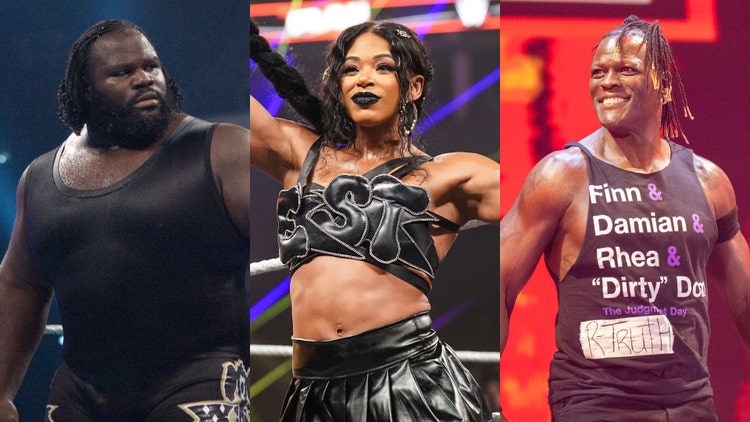
1. Bianca Belair
Belair helped define the modern women’s main-event standard: Athletic, polished, and built for big moments. She’s the type of WWE star who can anchor a division, carry a long title run, and still feel fresh because her style is so physical and distinct.
2. Mark Henry
Henry made “monster” feel legitimate in a way WWE can still borrow from today. His strongest run leaned into pain, dominance, and menace without needing gimmick fluff. He helped prove a powerhouse could be a world-title-level attraction, not just an obstacle.
3. Rocky Johnson
Johnson represents early WWE-era visibility that mattered. He brought credibility and presence at a time when the company’s national identity was still forming, and his success helped open doors for Black talent in an era with far fewer real chances.
4. MVP
MVP helped modernize the “talker with purpose” role with sharp promos, clean presentation, and a clear point of view. Later, his work as a manager and stable leader showed how a great voice can elevate multiple careers at once, not just his own.
5. Jacqueline
Long before the women’s division got the spotlight it has today, Jacqueline delivered toughness, range, and real in-ring value. She helped normalize the idea that women could bring intensity and credibility, then backed it up with championship-level performances.
6. Kofi Kingston
Kingston’s journey mattered because it built over time in front of the audience. His rise to the top didn’t come from a sudden push — it came from years of excellence, connection, and momentum that fans could track. He turned belief into a title win and shifted expectations.
7. Junkyard Dog
JYD was proof of concept as a Black babyface could be a massive crowd favorite and a true drawing card. His connection with audiences helped challenge old assumptions about who could be marketed as a top-tier hero in mainstream wrestling.
8. Bobby Lashley
Lashley brought “real athlete” energy that WWE leans on in every era, as he was someone who looked believable the second he walked out. His best work blended dominance with control, the kind of presence that makes a main event feel like a fight.
9. D’Lo Brown
Brown helped shape the in-ring baseline for an era that started demanding more speed and more movement. He delivered consistently, made opponents look good, and helped show that midcard workrate could carry entire episodes of TV.
10. Booker T
Booker’s impact lives in his adaptability. He could be serious, funny, cocky, humble, then flip the switch and go in the ring. He helped bridge major eras and proved that charisma plus skill can survive any creative direction.
11. The Godfather
Few wrestlers show WWE’s shifting tone better than The Godfather. His success across multiple character phases reflects a bigger contribution: He helped prove reinvention can extend a career, and he became a recognizable piece of WWE’s pop-era identity.
12. Tony Atlas
Atlas brought star-level physical presence in an era where WWE leaned hard into larger-than-life bodies. His significance also ties to representation: he helped break major ground for Black champions in the tag team scene during a time that rarely offered that platform.
13. Ron Simmons
Simmons brought authority, full stop. In WWE, his leadership roles and faction presence made him feel like a serious force in any segment. He helped set the template for a no-nonsense enforcer type that still shows up in stables today.
14. R-Truth
Truth has one of the rarest skill sets in WWE history: Comedy that actually lands and crowd control that never slips. He helped prove entertainment value isn’t “less than.” WWE built entire stretches of TV around his timing, reactions, and character instincts.
15. Jade Cargill
Cargill was a star built for the camera, for marketing, and for the kind of big-match presentation WWE sells globally. Her arrival also signals how WWE keeps widening its idea of what a top women’s star can look like.