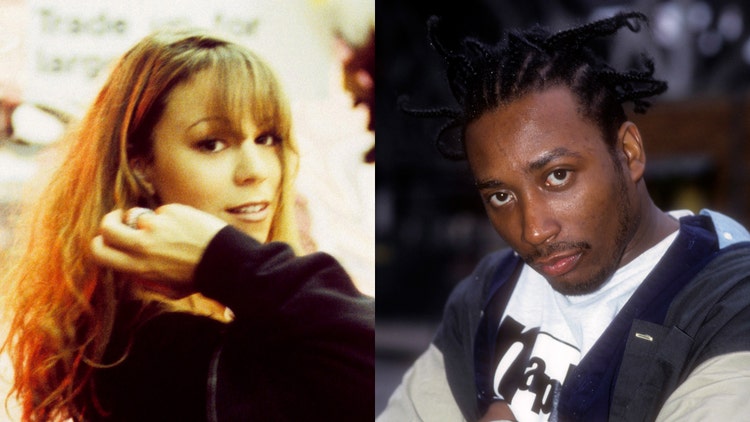
When Mariah Carey released Daydream, she was already one of the most successful pop artists of her era — but not yet free. Under the watchful eye of Sony Music executive (and then-husband) Tommy Mottola, she was still perceived by much of the industry as a carefully packaged balladeer. But Carey had long harbored a love for Hip Hop, and with “Fantasy,” she saw the opportunity to bridge two worlds. The original version, which sampled Tom Tom Club’s “Genius of Love,” was an infectious pop record that shot straight to the top of the charts. But it was the remix featuring Wu-Tang Clan’s Ol’ Dirty Bastard (ODB) that changed everything, both for Carey and pop music at large.
No simple rap feature, the collaboration was a moment of creative rebellion and a joyful risk that helped kick open the door for generations of cross-genre hookups. The story behind “Fantasy (Remix)” is as unpredictable and boundary-breaking as the song itself.
Mariah Carey’s vision: How “Fantasy” marked her Hip Hop crossover
Mariah Carey’s love for rap ran deep. “I had a love of Hip Hop music since I was a kid,” she recalled in A&E’s Ol’ Dirty Bastard: A Tale of Two Dirtys documentary. But in the early ’90s, her image remained largely controlled by record label expectations. “I was surrounded by record company people that really wanted me to be in one specific lane,” she told PEOPLE. “Which was a very successful lane for me. But…”
That “but” was decisive. Carey was inspired by the recent “Anything (Remix)” by SWV, which featured members of Wu-Tang. She set her sights on Ol’ Dirty Bastard — arguably the most unpredictable member of the crew — to bring a raw edge to the “Fantasy” remix. Her label balked. According to a Paper Magazine retrospective, Mottola was vehemently against the collaboration. But Carey overrode those concerns. “Certain people were like, ‘I could do that. What is that? What is he doing?!’ And I’m like, ‘No, no, no, no, no. Just trust me, we’re good,’” she told Genius.
Carey called in her trusted A&R, Cory Rooney, but she ultimately drove the vision. She wanted ODB on the track, and she wasn’t taking no for an answer.
Ol’ Dirty Bastard joins “Fantasy”: Studio chaos and pure genius
Getting Ol’ Dirty Bastard into the studio was its own odyssey. Rooney recalled the ordeal to Billboard: ODB showed up three hours late, clearly intoxicated, and spent the first hour screaming at a woman on the phone — only to whisper, “I love you,” and then resume yelling. At one point, he demanded Moët and Newports before recording. When the team could only produce Heinekens, he smashed a bottle on the studio floor.
ODB finally got into the booth... barely. He reportedly laid down one line, then fell asleep for hours. “Y’all better have your s**t set and record it right, cause I’m not doing it twice,” he was said to have warned engineers.
Despite the chaos, what came out of those sessions was magic. “When he gets to the ‘me and Mariah’ section, I’m flipping out,” Carey remembered. “I can’t even believe what this is.” She told PEOPLE that she listened in on the speakerphone “jumping up and down on the bed, so happy.”
ODB’s performance was both wild and weirdly poetic. “Me and Mariah go back like babies with pacifiers,” he rapped in his opening line, equal parts absurd and unforgettable. The remix felt like a party where no one was checking the guest list. It was proof that pop and Hip Hop could meet on equal terms, without one overtaking the other.
Inside the “Fantasy (Remix)”: ODB, Rye Playland, and Mariah’s directorial debut
Directed by Mariah herself, the video for the “Fantasy (Remix)” was filmed at Rye Playland in New York, the same location as the original version. But this time, the tone shifted. The whimsical fairground vibe remained, but now ODB was there, shirtless, in a wig, riding a roller coaster, hijacking the spotlight.
Carey had a very specific vision for his scenes. “In the pop version, the clown, he’s leading you through the video,” she said in A Tale of Two Dirtys. “So, I said to ODB, ‘What do you think about that clown if now you’ve tied him on this pole and you’ve clearly taken over the moment?’ And he was like, ‘Yo, that’s peace, that’s peace, that’s peace.’”
Behind the scenes, the mayhem hadn’t let up. ODB reportedly demanded another $15,000 just to appear in the video, then took the company credit card and went on a spree for Louis Vuitton luggage, Tommy Hilfiger, and Timberlands. “He kind of caused a ruckus in the mall,” Carey said in an interview. Back on set, he finally put on jeans and Timbs... and nothing else. “The video was a miracle,” Rooney later reflected. “A real miracle.”
The cultural impact of Mariah Carey and ODB’s “Fantasy (Remix)”
When the remix dropped, it changed the pop-rap collaboration landscape overnight. The original “Fantasy” debuted at No. 1 on the Billboard Hot 100, making Carey the first woman to do so. But the remix became a cultural landmark in its own right, receiving massive airplay on urban radio and becoming a staple of ’90s mixtape culture.
Over the years, the song has been widely acknowledged as a blueprint for future collaborations between pop and rap artists. Beyoncé and Slim Thug, Rihanna and Jeezy, Katy Perry and Juicy J — all owe a debt to the risk Mariah took in 1995. And her courage didn’t go unnoticed by fans or critics. “We were riding in the limo and every club, every car was bumping ‘Fantasy.’ Mariah put her sunglasses on, and tears came down her cheeks, because she couldn’t believe her record was getting played all through the hood,” Rooney recalled to Billboard. “That was the beginning of her not turning back to pop.” Rooney added that Carey wanted to be known as a respected artist like Mary J. Blige.
The legacy of “Fantasy (Remix)”: Ol’ Dirty Bastard’s iconic moment
Long after its initial release, “Fantasy (Remix)” remains a genre-blurring masterpiece and a beloved, chaotic memory. “Every single part of it was genius,” Carey said of ODB’s performance. “The way he performed, he was free. He did stuff so spontaneously, in the moment.”
That sentiment echoed in “Wu-Tang: An American Saga,” where an offered a dramatized version of the remix’s creation. While fictionalized, the portrayal nodded to the real-world impact of the collaboration, treating it as a pivotal moment in time for both parties.
ODB, in his own interview, described the experience with his usual blend of mischief and philosophy. When asked about the Mariah feature, he called it “very lucrative” before revealing plans to work with the likes of Prince, Lenny Kravitz, and Red Hot Chili Peppers. “Whatever comes to mind, I’m gonna do,” he expressed. “As long as it’s got to do with money, I’m gonna do it.” That promise ended up feeling bittersweet, as he would later pass away in 2004 at just 35 years old.