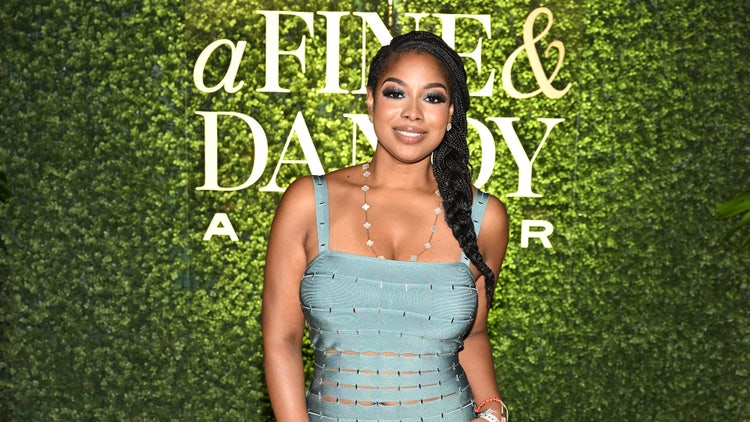
Dr. Jatali Bellanton’s interest in money started at home. Watching a mother figure struggle financially pushed her to learn everything she could about how money works. That curiosity would eventually lead her through investment banking, forensic accounting, financial education, and neuropsychology.
As Dr. Bellanton progressed into financial education, she began noticing that people knowing what to do with money did not necessarily mean they also believed they could build wealth, felt comfortable investing, or knew how to handle the emotional responsibilities that came with becoming the family breadwinner.
In this exclusive conversation with REVOLT, Dr. Bellanton spoke about financial fear, family pressure, sudden wealth, and the habits that can shape someone’s relationship with money. She also discussed her investment in Redemption Bank, revealed that Brilliant Minds Unite is becoming Borderless Prosperity, and explained why she began putting more of her resources behind Black storytelling. Check it out below.
For those who are being introduced to you, how did you go from working in investment banking to forensic accounting to financial education and eventually neuropsychology? What connected all of those worlds for you?
I think my origin, really, is just having a mother figure who's bad with money. Watching her financial struggle just made me be like I don't want to be that person. I want to learn everything I can about finance and money. That led me to learn about finance.
Eventually, I had a paid internship opportunity, and I interviewed for a lot of companies, different fields. I remember seeing the stock market and Wall Street, and I was just like this is insane. They have so much energy.
They look like they're having so much fun. I want to do this. As a kid, when I eventually got to the part to do that, I was like this is insane. This is chaos. I don't like it. It's stressful. I'm losing money in seconds... As a child, being 15, 14 years old, seeing that the first time, and then at 16 1/2, being a graduate of high school and being qualified to be a paid intern, that was really my start with finance.
In a lot of my lanes, even neuropsychology, my focus is mental and financial health. It's creating my first finance curriculum, being in a position to notice that a lot of youth, in my experience, didn't believe that they could become millionaires. They had poverty mindsets, especially in inner-city communities. Meeting that majority, I just wanted to know: How can I help Black and brown people think better and have better relationships with money, or understand a mindset as to why someone would live check to check, or understand a mindset as to why they would have survivor's guilt, or how to help them with survivor's guilt, how to put their families on budgets.
People don't realize, even putting your family on budget, that is a mental health aspect of money. When you think about it, a lot [can be] stressful if you're trying to get to a certain goal and your family every two seconds is like, "I have an emergency, I need help, I need help." You're the breadwinner, so guess what? They expect that you're supposed to help.
Can somebody know all of the right things about money, understand credit, budgeting, and investing, and still repeatedly make bad financial decisions, and why?
Okay, so the answer is yes. Sometimes it's habit, right? Sometimes it's not just habit; sometimes, mentally, you don't realize you're repeating mistakes, but it's usually out of fear, in my experience, right?
What behavior do we often dismiss as someone simply being financially irresponsible that you might recognize as fear, trauma, insecurity, or learned survival behavior?
One of them for me is I'll find people who will own like 50 pairs of Jordans, but never bought a pair of Jordan shares. Sometimes they're using money as a coping mechanism.
And outside of using it as a coping mechanism, sometimes they're like, "Oh, I can own this." And sometimes they're like, "I could probably sell this, you know, clean it up and sell it when I'm done." But realistically, how many people actually want to go and sell it online? And how much profit are you retaining? Because if you use certain websites and companies, you'll learn that you're only getting a certain percentage, right? Because they're going to get a 30% cut, 40% cut. How much are you actually banking? So you have those kinds of conversations.
Or sometimes they'll think like, well, at least if I ate this meal... like I had one client one time tell me, I was like, "Hey, you just spent $3,000 on food this month. You don't even have $500 in stocks. Can we change the ratio?" And she's like, "Well, with stocks, you just own it for a very long time. There's no immediate gratification. But at least when I go out to a fancy dinner, I go on a vacation, I have instant gratification." That was a very honest and vulnerable moment for her, right? She's letting me know she likes instant gratification.
There's also a danger in telling people that changing their mindset will change their finances when they're dealing with low wages, discrimination, unequal access to capital, and the racial wealth gap. What can psychology actually fix and what can't it fix?
I think it can help you to make smarter or tighter budget and money decisions. That's one aspect -- because when you don't know that you're overspending, when you don't realize that you're using money as a coping mechanism, when you don't understand that it's okay to put your family on a budget and put yourself first, you might continue making that cycle of mistakes.
So psychology, in that space, is at least helping you acknowledge the problem or understand the problem.
What happens psychologically when someone's income changes much faster than their relationship with money does? When I say that, I'm thinking about an artist getting a major advance, an athlete with an NIL deal, or even someone becoming the first big earner in their family.
Oh, "I made it. I made it. I want to help everybody."
So, psychologically, that in itself can be poisonous because, respectfully, if you made a million-dollar contract and you go and buy three different people in your family houses, there's still a mortgage on that house that they still have to pay. And even if you pay the house flat out, it's like, you do realize that there's property taxes, and sales tax, and there's still different things that are going to have to go into it.
The biggest thing I always notice is that there's this desire to help a lot of people, or sometimes the crabs-in-a-barrel mentality where they're like, "I just made this money. I can't do nothing with this. I don't want to go anywhere. I don't want to do anything."
People often confuse having a high income with being wealthy. In practical terms, when does money actually become wealth?
I think wealth for people has different definitions. Different people will define wealth for themselves.
Some people, if they're able to pay their mortgage and all their bills and still have money left over, that is wealth. They're happy. You know, they're like, "Oh, I live in a great neighborhood. Everything's paid, and I'm still able to bring some money and save some money..."
I wanted to ask you about Redemption Bank. What does building and investing in a Black-owned financial institution accomplish that financial literacy alone cannot?
One, I think it's great to be able to bank Black, you know, being able to have someone banking your values... But for me, my investment in Redemption Bank was important because I felt like it was the first time I was watching a bank that wasn't just discussing Black only or white only or whatever. There was a lot of unite and conquer.
There were a lot of caucasian people... There were other Black and brown investors on the table. There was some Asian... I saw the [beautiful array of color].
And for me, it made me excited to invest in it because I feel like for us to move forward, especially economically, we need to be able to invest together. We need to be able to grow together and trust each other financially. And we need to also be in opportunities and spaces where we can do these things.
And to find a bank where I truly saw this rainbow coalition of investors, and I saw them having, you know, yearly events where they met up, and they were having meetings, and billionaires are opening up their homes to other investors like, "Hey, come over. We're going to do a dinner here. We're going to do a raise here," I just really thought it was a beautiful concept to watch unfold. And then it became not just a concept, [but] reality.
Kids Who Bank grew into Brilliant Minds Unite. What does that organization look like today?
So, Kids Who Bank has turned from Brilliant Minds Unite to now Borderless Prosperity.
So, even that last name is going to be gone... very completely gone soon. And what it's evolved into is a space [where there's] representation of Black and brown people who are wealthy or financially savvy teaching youth. Our professors come in... and they come from backgrounds like Morgan Stanley, and Goldman Sachs, and UBS, and different platforms and companies, or even formerly Credit Suisse First Boston, and they're teaching youth... One, you get to see representation, see people who look like that and who know finance, who are teaching them the basics.
Two, they also realize that they could start with as little as one or five dollars, and that also brings a lot of hope for them. And then three, I think it also created a space where now we're international and we're doing things borderless because we're doing things in 10 different countries.
So we have investments in 10 different countries, but we're also doing and educating in 10 different countries, including Kenya. We're about to start doing workshops there. We have things in Ghana, the list continues. So for me, it's evolved into ensuring that our youth are being taught worldwide.

You've previously touched on volatility and crypto. Given that there are scams in that world as well, how do you teach someone to recognize the difference between investing and gambling on an asset they don't understand?
So, one, you have to do research.
Most things have data, something to make you feel like you're going in the right direction. I like to say sometimes you're not only investing in the company; you're investing in the founder itself. Does this founder have a proven track record? Are they showing you a good feasible business plan? Do they have data-backed information? Are they able to tell you, "Hey, this clothing company, we sold $3 million last year, $1 million the year before, we're growing at this rate"?
And able to show you how many purchase orders they have, so you're like, "Oh, I'm going to invest in this company. They have this [many] purchase orders..." In those moments, I have data, I have proof, and I have things to show you that will make you more comfortable. But sometimes people just jump in because a celebrity said, "Those are my favorite sneakers." And then they just start buying it.
You were an executive producer on Hoops, Hopes & Dreams.
I was. I was... I am in the phase of my life of funding the storytellers and dreamers, like I like to say.
How does telling that story about basketball, Martin Luther King Jr., and Barack Obama connect with the empowerment work you've spent your career doing?
I feel like there's so many times we've heard about this attack of DEI in our stories. And I think it's really important that when we reach a certain level of success, that if someone else is not going to fund the positive stories that show us in a good light, that we do it ourselves.
And so I'm very big right now on ensuring that if someone else is not telling our stories, that I'm going to do the best that I can within my capabilities to do so. The same way Redemption Bank, when I became an investor, I brought in a few other investors, and I was screaming it from the mountaintops, "This is one of my favorite companies right now that I'm investing in. You guys should look twice."
And some of my friends did look twice, and they joined in. And now look, we're one year in. And so that's been a very big asset and benefit.
Your phrase “Money is not my God” has become part of your brand. What does that actually mean for someone whose professional life revolves around building and teaching wealth?
So when I used to speak at conferences, people used to be like, "How did you leave the security of your 9-to-5 in corporate finance, making a certain amount of money, to become an entrepreneur?" And I just was like, "I'm purpose-driven."
And I knew God was telling me it was time to step away. I wanted to be a hands-on mom. And also, just in my spirit of spirit, it's time to go. And I wanted to do something to give back.
After everything you've learned from finance, psychology, investing, and teaching, if you could change one thing about the way the next generation of Black people thinks about money before they ever earn their first paycheck, what would it be?
This country, this continent was built by people who look like me and you. And so if you're a Black and brown person, if you have a history of being a person of diversity and culture, I want you to understand that this world belongs to you, too. You deserve a seat at the table.
You don't have to fight to prove yourself in that space because you deserve to be here. But to get the piece of pie, you do have to work hard. And that's okay. You can work hard. You can work towards your wealth. Just know that you deserve the wealth and that you deserve that seat at the table.
You're not an imposter. You don't have to have Imposter syndrome or any of those weird things. Just know that you deserve to be here, and your work ethic has brought you to the table.