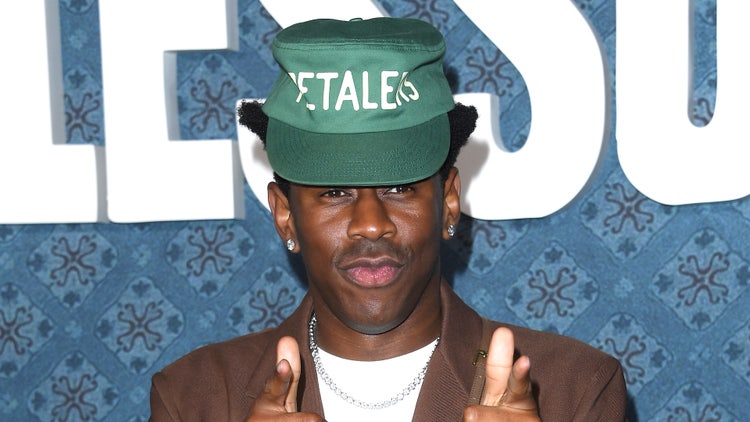
There’s a new Tyler, the Creator album out, and he’d like you to stop overthinking it.
Instead of a surprise drop built around intricate lore or a high-concept narrative, DON’T TAP THE GLASS arrived with a simple directive: Dance. Run. Drive. Move. Anything but scroll. Across 28 brash, body-rocking minutes, Tyler traded the introspection and layered emotion of 2024’s CHROMAKOPIA for a sweat-soaked, no-skips house party. There’s a reason the only real rules laid out on the album’s website and in the opening track, “Big Poe,” are, “No. 1, body movement, no sitting still, No. 2, only speak in glory, leave your baggage at home, No. 3, don’t tap the glass.”
With that said, the message goes deeper than just a club banger. Tyler is rebelling against something much bigger — call it cultural surveillance, meme-ification, or just the self-conscious paralysis of the internet age. As he explained in a note shared on Instagram the morning of the album’s release: “I asked some friends why they don’t dance in public, and some said because of the fear of being filmed. I thought, d**n, a natural form of expression and a certain connection they have with music is now a ghost.”
To fully understand DON’T TAP THE GLASS, you have to start with that instinct: A reclaiming of joy, motion, and vulnerability. And you have to play it loud.
What DON’T TAP THE GLASS really means
The album’s title — and its repeated refrain — was borrowed from aquarium signage, the kind that discourages visitors from disturbing the fragile creatures inside. Tyler flipped that symbol on its head. In his world, the glass is what separates performer from audience, celebrity from gawker, real joy from viral clips. Don’t tap it. Don’t stare. Don’t record. Just participate.
That ethos extended to his private, no-phones listening party: “300 people. No phones allowed. No cameras. Just speakers and a sweatbox,” he wrote. “It felt like that pent up energy finally got released… This album was not made for sitting still. Dancing. Driving. Running. Any type of movement is recommended to maybe understand the spirit of it.”
It’s not the first time Tyler’s fought against passive consumption. DON’T TAP THE GLASS dropped on a Monday, skipping the industry’s typical Friday drop (he also did this with CHROMOKOPIA). The goal? Curb lazy weekend listening and encourage deeper engagement.
But for all its meaning, this album never feels heavy-handed. Tyler is asking for presence, not reverence.
The sound of movement, not stillness
Sonically, DON’T TAP THE GLASS is one of Tyler’s most kinetic records yet. From the Italo-disco synths of “Sugar on My Tongue” to the sludgy G-funk of “Sucka Free,” the record pulled influence from New Orleans bounce, Midwest club music, West Coast rap, and early-2000s party anthems.
Pharrell Williams appeared on the booming opener “Big Poe,” bringing a talkbox-style verse that recalled Chuck D and vintage Neptunes in equal measure. Tyler even flipped Busta Rhymes’ “Pass the Courvoisier Part II” on the same track, setting the album’s anything-goes energy from the jump. Later, Daisy World and Madison McFerrin added glossy depth to “Don’t You Worry Baby,” a woozy track that leaned into full Neptunes homage without veering into straight imitation.
Throughout the album, Tyler’s production is tight, textured, and bursting with analog flavor. As stated before, it’s music built for human movement, not timeline consumption.
Big Poe, big confidence
While CHROMAKOPIA saw Tyler working through the complexities of identity, grief, aging, and family history, DON’T TAP THE GLASS feels like a release — like the version of Tyler that doesn’t need to over-explain himself anymore. It introduces a new alter ego, Big Poe, a character who delivered the record’s opening manifesto and served as a symbol of Tyler’s present-tense confidence.
Even the visuals echo this stripped-down attitude. In the music video for “Stop Playing With Me,” Tyler danced solo in a red fit between two massive speakers. No elaborate sets. No costumes. No characters. Just movement, mischief, and a perfectly timed Clipse cameo (and yes, that was LeBron James). It’s one of the most carefree visuals Tyler’s dropped in years (not that he hasn’t given us that feeling with the somewhat recent “THAT GUY” clip).
He’s not in the mood for comparisons. When someone tweeted a “CHROMAKOPIA vs. DON'T TAP THE GLASS” poll the same day the new album dropped, Tyler replied politely asked us all to cut that s**t out.
What is everyone saying about the album?
Tyler’s message clearly landed. Across social media and early write-ups, the response has been less about ranking the album and more about soaking in its energy. It’s rare to see a major artist release something so unguarded, and even rarer to see fans engage with it on those same terms, with less pressure to interpret and more permission to move.
That’s what makes DON’T TAP THE GLASS so refreshing. It doesn’t beg for interpretation. It doesn’t want to be compared to IGOR or Flower Boy or CALL ME IF YOU GET LOST. It wants to get played at full volume, in motion, with your body doing the talking.
Even the final track, “Tell Me What It Is,” manages to fold in Tyler’s signature vulnerability (“Why can’t I fall in love?”) without dragging down the record’s pulse. It’s a cool-down, not a comedown.
The last word: Full volume only
DON’T TAP THE GLASS is a lot of things: A rejection of passive listening, a celebration of movement, a love letter to funk and bounce and sweaty spaces. But more than anything, it’s a reminder that joy is still worth protecting — and worth participating in.
Tyler doesn’t want your thinkpiece. He wants you to feel something. Just don’t tap the glass.
And for the love of music, turn it up.