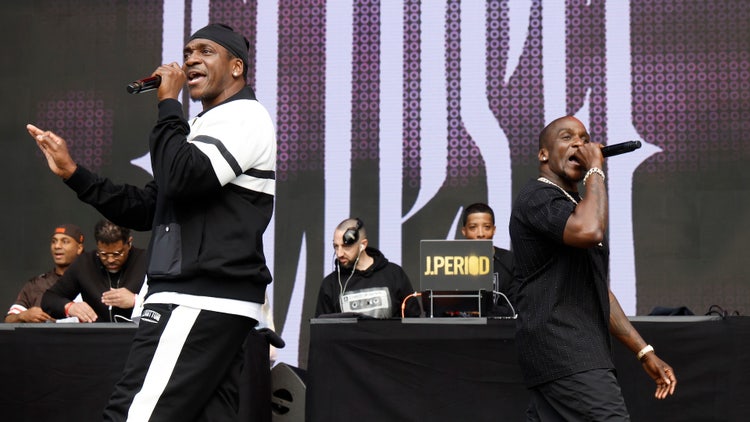
When Clipse released their long-awaited fourth studio album, Let God Sort Em Out (fifth if you count Exclusive Audio Footage as an official LP drop), the project landed like a sermon and a scar — part reflection, part wound that never fully closed. This isn’t necessarily a feel-good reunion. Instead, it sounds like two brothers stepping back into the light with everything they’ve carried through the dark. Pusha T and Malice haven’t changed just for the sake of change. They’ve evolved in opposite directions, with one leaning deeper into status and sharp-tongued confidence. At the same time, the other is focused on morality, faith, and accountability. That very dynamic creates a level of tension that runs through every track.
With Pharrell Williams handling all production and guest verses from Kendrick Lamar, Nas, Tyler, The Creator, and others, the album delivers both high-level lyricism and heavy emotional weight. It’s filled with verses about family loss, spiritual conflict, and the aftershocks of the drug game that made them legends. And yet, despite all that pain, they rap like men still standing tall.
After a few initial listens, here's what stuck out the most.
1. The distance between Pusha T and Malice is part of what makes their chemistry work
This isn’t about recreating the old dynamic. Pusha T continues to rap like a precision-tuned villain, weaving metaphors from high finance and luxury life. Malice stands in contrast, weighing sin and salvation with the caution of someone who has seen the worst outcomes. It’s that divergence that adds depth throughout. “If I didn’t give you both sides, I wouldn’t be me,” Malice explained on “P.O.V.” It’s clear that what separates them also defines the strength of their bond.
2. The ghost of family loss haunts the album
From the opening lines of “The Birds Don’t Sing,” grief sits at the core of this project. Clipse reflect on losing their mother and father, and the memories aren’t sanitized. Pusha relives overlooked final conversations. Malice describes the pain of discovery and the echo of unspoken words. These recollections surface again throughout the album, with recurring references to absence, legacy, and remembrance. It’s grief that essentially shapes the emotional backbone of the entire album.
3. The duo’s “culturally inappropriate” phrase is like a weaponized mantra
The phrase “This is culturally inappropriate” is sprinkled throughout the album like a warning label and a wink. It surfaces at moments when the lyrics hit a nerve — when violence, decadence, or blasphemy crosses an invisible line. It becomes a challenge to norms, a rejection of false morality, and a way to reframe Push and Malice’s contradictions as intentional. The phrase doesn’t just speak to the content of the album; it reflects how the world might try to receive it.
4. Drug rap is (still) treated like sacred literature
Clipse return to the subject matter they’ve always mastered — cocaine, street economics, and survival — but with a sharper, more reflective tone. Pusha T raps like a man auditing his past, mixing high-level drug talk with business terms like “F.I.C.O.” and “E.B.I.T.D.A.” Malice, on the other hand, approaches the same world with caution and moral weight, giving his verses the feel of a spiritual reckoning. Together, they both recount the game and document it like gospel, with detail and precision that elevate the narrative beyond surface-level bravado.
5. Pharrell’s production on Let God Sort Em Out might be his most cinematic to date
The soundscape across Let God Sort Em Out stretches from ghostly elements to orchestral violence, making each track feel like a scene in a larger film. Pharrell enlists Voices of Fire, gospel piano, and string arrangements to create a rich, emotional backdrop. Beneath the grandeur lies a clear nod to classic Hip Hop as well — especially in the percussion. Boom-bap drums, chopped loops, and gritty textures recall golden-era sensibilities, reimagined through Pharrell’s space-age lens.
6. Clipse turn Hip Hop’s vanity mirror into a confessional booth
Throughout the album, vulnerability slips through the cracks of the bravado. Pusha admits to co-signing artists he didn’t believe in. Malice questions whether redemption is ever truly final. Even their critiques of the rap industry feel rooted in self-examination. This is not a full embrace of guilt, but a willingness to sit with contradiction. Many of the most revealing lines come not from boasting, but from self-assessment.
7. God is everywhere — and so is judgment
Spirituality drives the album’s tone, language, and title (the last of which is only a piece of a much darker statement). Malice references scripture and preaches caution, while Pusha T threads moral ambiguity through verses filled with divine imagery. Death is often mentioned alongside questions of purpose, consequence, and fate. Rather than preach, they pose riddles. Even the most luxurious scenes are shadowed by reminders that the price of power is rarely clean.
8. Carefully chosen features strengthen the album’s message
Kendrick Lamar delivers one of the album’s most cutting verses on “Chains & Whips,” a blend of introspection and menace reminiscent of “Nosetalgia.” Tyler, The Creator brings a chaotic contribution that speaks to the album’s darker palette, while Nas contributes a reflective closer filled with generational wisdom. None of these guests feel out of place. They extend the album’s themes and add perspective without diluting its direction.
9. Clipse still sound light-years ahead of their peers
In an era of quick content and algorithm-chasing rap, Clipse stand firm in their craftsmanship. “So Far Ahead” spells it out plainly, and the album backs it up with consistency, control, and conviction. Instead of chasing charts or co-signs, they’re delivering a master class. The lyricism is dense but digestible, the flows are sharp without being showy, and the production never feels passive. Every detail reminds listeners that time away has only sharpened their edge.