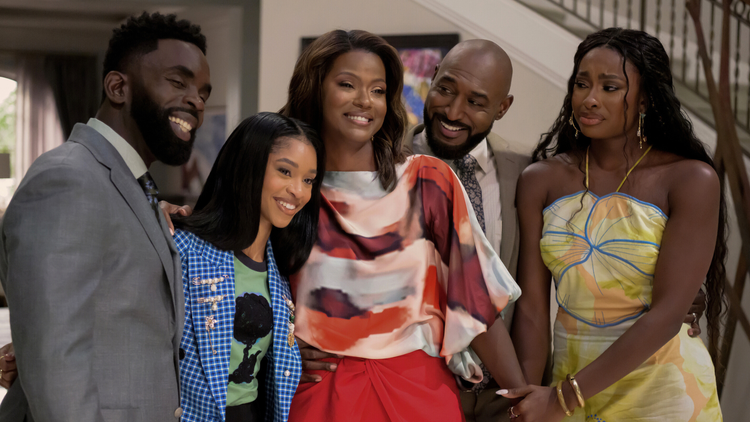
Across its four seasons, “Bel-Air” hasn’t just revisited a classic — it’s rebuilt it with emotional intelligence, cultural specificity, and a depth rarely afforded to Black characters on television. As the series entered its final act, its lens shifted toward something equally intimate and expansive: the evolution of Black womanhood, the wisdom of reinvention, and the legacy of creating space for stories that hold beauty and bruises in the same breath.
Season 4 premiered with a three-episode rollout, starting off the show’s concluding chapter with the same thematic richness it had been building all along.
If the first season reintroduced us to these characters and the second and third stretched their interior lives, then Season 4 feels like a reclamation, which is a season where every woman in the Banks orbit steps deeper into her truth, even if it disrupts the comfort of those around her.
Hilary, played by Coco Jones, once preoccupied with the optics of influence and romance, now moves through the world with a steadier emotional compass — one shaped by grief, healing, and new love. Jones brings a grounded maturity to her performance, showing a version of Hilary who isn’t running from heartbreak but rather growing through it. Her arc becomes a meditation on choosing purpose over paralysis and discovering how to hold joy and fear in the same hand.
Viv, played with quiet ferocity by Cassandra Freeman, enters her own season of reclamation. She is a woman who has lived multiple lives, from being a mother, artist, partner, and professor, and now stands at the crossroads of reinvention and responsibility. The final season’s exploration of pregnancy later in life invites conversations about medical bias, autonomy, and the societal pressure placed on women to move through life on an “acceptable” timeline. Viv’s storyline isn’t just about expanding her family; it’s about expanding her freedom.
Ashley, played by Akira Akbar, is navigating a similar restructuring of self, even though she’s the youngest. She moves through freshman year with an emerging sense of identity and independence, gently pushing against the expectations of the Banks name. Her journey mirrors the emotional truth many young Black girls face, which is the tension between honoring family and honoring self.
But the heartbeat of this final season exists behind the scenes, too.
Showrunner Carla Banks-Waddles closes the “Bel-Air” chapter with a creativity sharpened by collaboration and surrender. Her decisions around narrative, character expansion, the introduction of OG cast members, and the cultural responsibility of portraying Black teenhood all shape the emotional arc of the show’s farewell.
What the series achieves in its concluding chapter is a mosaic of womanhood, which is intergenerational, imperfect, joyful, honest, and deeply rooted in possibility. Below, the women of “Bel-Air,” along with the showrunner, open up to REVOLT about healing, purpose, pregnancy, camaraderie, cultural responsibility, and what it means to close out a series that redefined a classic for a new generation.
Hilary is grieving while still trying to honor love in a way that feels forward-moving rather than paralyzing. After becoming a fiancée yourself, how did your own joy, stability, or new perspectives inform the way you played her healing?
Coco Jones: I did take a lot of my personal life and used it as fuel for Hilary’s relationship with Lamarcus, and a little bit was too on the nose for me (laughs). I’m like, “Who is stalking me?” (laughs). To have deep love means you’re going to grieve, and it’s a sign of something real. I kept thinking to myself, like, “What would I do if this was really me?” The Capricorn in me would jump in and say this has to be purposeful, and I love portraying Hilary in that way, and I hope those who are going through something similar can find themselves in this storyline.
“Bel-Air” leans heavily into evolution — characters growing, stumbling, and shedding layers. As a showrunner, what’s something you personally outgrew for the series that changed the way you lead, write, or even make decisions?
Carla Banks-Waddles: One of the things I learned about this process, especially with me being a Virgo and a bit of a control freak, [is that] I’ve evolved by letting go and learning how to surrender a bit more specifically in this creative process in television, because it’s a collaboration and requires other voices and input, so you have to release control. When you surrender, there’s so many talented people around you to trust them, and it gets better in a way I couldn’t imagine having held on so tightly to it.
One of the beautiful themes in “Bel-Air” is women embracing pregnancy and motherhood later in life. What inspired you to bring that storyline into the show’s world, and what conversations did you hope it would spark?
Banks-Waddles: A few things... We spoke about her pregnancy [at] this age and it being called a geriatric pregnancy — horrible term for that (laughs). We need to reimagine that word. Her and Phil are very different parents, so telling that story of what it looks like and being joyful, but nervous, and the fears, so being able to tell what this new baby at this stage of life brings out of them. For Viv, which her storyline shows medical racism, and it was a theme we wanted to explore, so something about this pregnancy and the stories of how Black women are not listened to in the medical space. It allowed us to touch on a lot of stories many have faced.
You’ve slowly rounded out beloved faces from the original cast. What did you feel you still needed to honor or correct in “Bel-Air”?
Banks-Waddles: Having [Janet Hubert] in Season 4 felt like something we had to do. Sometimes the plan doesn’t always come together, but we talked about on the first day of the writers’ room, how we can have her in this season. Once we did commit to Aunt Viv having a baby and how she wasn’t in love with traditional health care or medicines, it did feel like a doula character made sense for her, so having [her] in that role felt organic because we do like to bring back the OG cast, but we don’t want them to feel wedged in. We want it to feel like it makes sense and is organic to the storytelling. It was so poetic to have OG Aunt Viv deliver baby Nicky with our Aunt Viv.
Viv represents the woman who has it all from career, love, motherhood, even welcoming a child later in life. What do you hope women see in Viv’s journey about the timing of life and refusing to let society dictate when your story is “supposed” to unfold?
Cassandra Freeman: Culture is a funny thing. Culture is a prescription to say this is how you’re meant to live your life. If you’re an artist, you know you’re not meant to follow anyone else’s prescription on how to live your life and you need to sit in the driver’s seat and say what you’re compelled to do next. That is Viv now. She wasn’t like that in the previous seasons, but she’s choosing what she wants to do, even choosing to share when she’s pregnant. You got to be a deep person to get that from this storyline, but I’m all about putting myself in the driver’s seat. You have to be the center and when you don’t feel good, it’s because you’re not centering yourself. Self and God, love, and the universe is important.
Ashley is stepping out of “little sister” territory and into self-discovery. What’s a moment where Ashley finally chooses herself, even if it feels uncomfortable for the family around her?
Akira Akbar: She has a lot of moments like that this season — I feel like the stuff that happens at school, she’s like, “I’m not going to own up to the Banks lifestyle, but I'm going to do my thing.”
As women in completely different stages of life, onscreen and off, how have each of you supported one another in navigating these chapters with honesty, vulnerability, and humor?
Jones: I feel so much love and support from both of these women in different ways. Cassandra is always going to do a remix of my songs and is always going to post my music and compliment my successes. She’s such a huge cheerleader and like my real mom in that way. Akira is my little sis, and I learn so much through her eyes and lens. How she laughs at everything and not carrying this pressure — I want to be more free, playful, fun, and smiley. I’m inspired by them to see what’s possible and how to grow within my life.
Audiences see Will explaining “Blackcess” to people in “Whitecess” sweaters in one of the episodes. What’s one thing you’re tired of explaining to white people in real life?
Freeman: This is because I’m a spiritual person, but I don’t like anything with the word Black on it like it’s a surprise. Black excellence is not a surprise. It’s the only reason why we are here is because of Black excellence, and resilience, and spirituality. We are the blueprint of what it means to recreate and still thrive. Just think, everyone on this call is here because we were trafficked — our people were trafficked. We are the blueprint of what it is to forgive and what it means to still recreate. I don’t like the term Black excellence because we just are excellent. I hate Black opulence because we are rich. The greatest rich you can have are the things you can’t touch and things that come from God that are eternal. All that pisses me off. Even with this show, I hate that 99% of the journalists are all Black because white people don’t want to pay attention to this show, just because some Black people are in it? I’m tired of all of it.
There’s a real absence of shows authentically representing Black teenhood today, from the awkwardness, the complexity, and the nuance. When you look at the landscape, what responsibility did you feel to fill that gap, and what do you hope teen audiences feel seen by?
Banks-Waddles: I have two teenagers, and I have a son who is the same age as Will on the show, and he watches it with his friends, and they seem to love it. They say we’re getting it right, too. There’s something about Jabari and Olly’s swag, but also their vulnerability to the roles of Will and Carlton. The depictions that we see of young Black boys on television and sort of having to lead with that bravado and not being able to show a different side without being labeled weak — I think Jabari and Olly were able to bring vulnerability in these roles as they aren’t afraid to discuss their feelings, and role modeling that is an important part of the show.
Watch the conversation with the cast below!