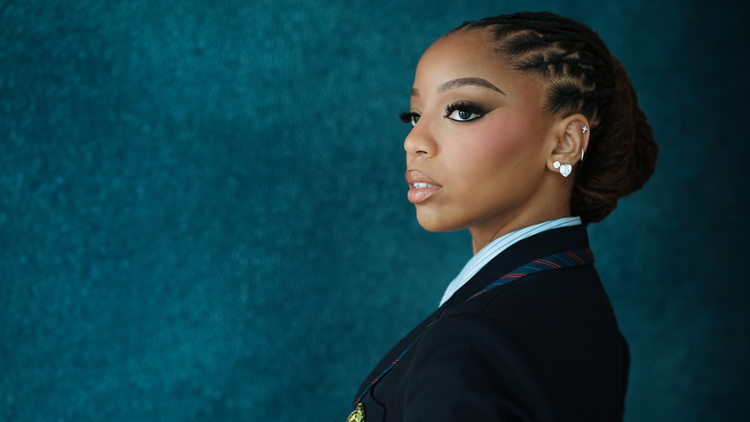
Chlöe Bailey has leaned more into her clapback era, and honestly, we aren't mad at it.
The Grammy-nominated singer and actress recently found herself defending her appearance after posting a carefree, bare-faced video from a late July vacation. It should have been an innocent glimpse of Chlöe enjoying her life, but strangers on the internet used the moment as an invitation to dissect the singer's face, body, hair and everything in between.
The superstar then began to receive unnecessary comments on X, formerly known as Twitter. Ultimately, Chlöe decided to give the haters a taste of their own medicine. Now, some people will say that celebrities should ignore negative comments. They are rich, famous and successful, so why should they care about what random people online think? But, celebrities are also human beings. Having millions of followers does not suddenly remove someone’s feelings, insecurities or breaking points.
If people can spend all day tagging an artist in insults, that artist should be allowed to respond. The Strung actress has been dealing with this for years, and it appears she is no longer interested in pretending the comments don't exist or allowing people to believe her silence means they can say whatever they want without a response. As the discourse intensified, she quote-tweeted a heckler on X, teasing sarcastically, “It turns me on when y'all talk s**t about me.”
Her peers came to her defense amidst the harsh comments, with Stella Quaresma from the group FLO asking fans to “stop being horrible to Chlöe." At a certain point, constantly setting expectations for the person being attacked while offering none to the attackers becomes its own form of gaslighting. Online haters expect artists to absorb unlimited disrespect and then accuse them of being sensitive when they finally react.
Chlöe’s clapbacks are entertaining, but the circumstances behind them reveal something more troubling. Social media has created an environment where emerging talent, particularly young Black women, are not allowed to grow in public or simply exist. Her 2023 debut album, In Pieces, reached No. 119 on the Billboard 200. Instead of discussing the project as the beginning of her solo catalog, the internet reduced its performance to a punchline, prompting her to respond to haters and show love to her supporters on stage.
The "Swarm" actress' sophomore project, Trouble in Paradise, arrived in 2024, but the conversation surrounding her career had already become less about her development and more about whether people could declare her a failure. That is a ridiculous standard for any artist, especially one still defining her individual voice after years of being part of a duo with her sister, Halle Bailey.
Some of today’s most celebrated musicians needed multiple projects to find the sound, image and audience we now love and associate with their success. The snap-judgement nature of social media, however, has nearly erased the development era. New artists are expected to debut with the cultural impact, visual language, fan base and commercial performance of veterans who have been working for decades. Now, we can agree that sometimes an artist does hit the scene before going into any sort of development, but the Praise This star is a different case.
There is no patience for the experimental single, the imperfect performance or the rollout that does not connect with every fan. Creative decisions are clipped, reposted and judged without context. If the numbers do not explode, the artist is labeled a flop. If the music performs well, they are accused of being an industry plant or a sellout. If they experiment, they are told they lack identity. If they maintain a familiar sound, they are called unoriginal.
It’s an unfortunate cycle in a space where it seems people like Chlöe are set up to not win. There is no winning because, for some people, the goal is always to see them lose. A fan has asked why the rising pop star has an “abnormal amount of haters,” to which she said, “Because I'm great [and] I am learning slowly that I intimidate a lot of ppl unfortunately.” She continued her thought in the quote tweet with, “I sing, dance, act, play piano, produce, engineer, I got booty [and] a cute face, [and] I’m kind. There’s nothing to pick on.”
For the negative side of the internet, confidence is only celebrated when people have already decided you are worthy of it. When a young Black woman says she is talented and more before the public has unanimously crowned her, that self-assurance is often interpreted as delusion or arrogance. Chlöe should not have to wait for social media to validate abilities she has spent most of her life developing. Audiences want her to be confident but not so confident that it makes them uncomfortable. Sexy ... but only in a way they consider tasteful.
They demand originality while comparing her to Beyoncé, her sister and nearly every other Black woman who can sing and dance. They attach her to some incomprehensible standard instead of truly seeing and appreciating what she brings to the table. They demand vulnerability but will turn that vulnerability into a meme before the interview is even over. When Chlöe began embracing a more sensual image, critics claimed it felt forced. She addressed that criticism directly in a 2023 conversation with Latto, explaining, “When I perform, that's when I feel the most confident and the most sexy. It's nothing contrived or forced about it. That's just passion coming out."
It is her body, her performance and her decision. Instead of recognizing her evolution, people projected the identity of the child they remembered from YouTube. Then, they were upset when the grown woman in front of them refused to remain inside that box. We have watched similar patterns surround Normani. Before she could release her debut album, DOPAMINE, years of delays that were simply part of her journey transformed anticipation into ridicule. Every appearance became an opportunity for people to ask where the album was, as though she was not navigating adversaries and both of her parents receiving cancer diagnoses.
FLO has faced the same scrutiny. The British trio broke through with “Cardboard Box” and was quickly compared to Destiny’s Child, TLC and other major girl groups that came before them. Also, there were so many hurtful comments on their performances, vocals and appearances. That is why it felt particularly meaningful to see FLO defend Chlöe during a livestream amid the latest wave of criticism, to which the “Have Mercy” singer responded with a photo of them all at an event.
Chlöe, Normani and FLO are not identical artists, nor should they be. What connects them is how quickly the internet judged each act as a finished product instead of recognizing that artistic identity is built over time. There is also a major difference between commenting notes of criticism versus notes of cruelty. Criticism is saying that a song did not connect with you, an album lacked cohesion or a rollout could have been stronger. Cruelty is dogpiling on someone, going out of your way to repeatedly invade someone’s comments to mock their body, face, sales, relationships and perceived failures. One is an opinion about the work, while the other is an attempt to make the artist feel small. Unfortunately, the internet has blurred that line to the point that being mean and disrespectful is highly normalized.
If social media existed in its current form during earlier eras, many legendary artists might not have even survived their first album cycle. Every misstep would have become a trending topic, every experiment would have been framed as desperation and every commercial disappointment would have inspired a week of jokes from people eager to announce the end of a career that had barely begun. Growth requires room — space for artists to try something, "fail," adjust and try again without every decision becoming a viral character judgment. Black women should not have to be flawless to be supported, respected or given a chance to grow — and just because they are artists doesn't mean they aren't human. The internet should learn how to engage with their work without treating every moment they don't like as an invitation to write someone off or insult them.