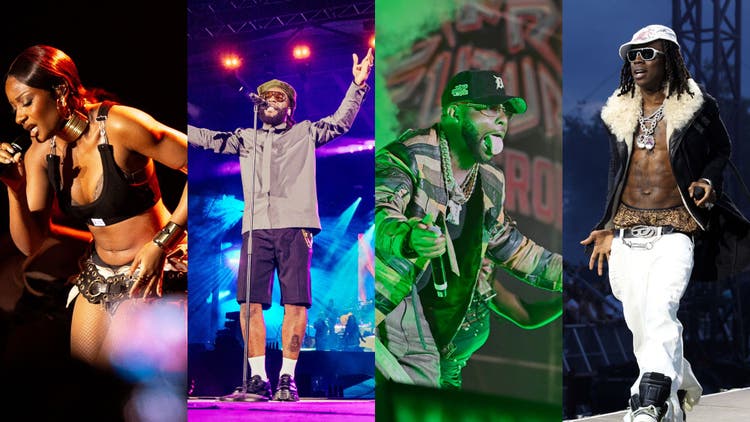
If you’ve ever caught yourself singing along to a song in a language you don’t speak, welcome to the club. That’s the magic of music, especially African music. From Lagos to Dar es Salaam to Accra, artists across the continent slip their native languages into verses and hooks like it’s nothing — and somehow, we get it. We might not know the grammar, but the feeling? Yeah, we understand that.
This list is a shoutout to the artists who don’t dilute where they’re from, they double down on it. Whether it’s Davido dropping Yoruba into a club banger, Diamond Platnumz gliding through Swahili, or Efya lacing soul songs with Twi, these stars are teaching the world their languages, one hit at a time.
1. Wizkid
Wizkid weaves Yoruba into his music so seamlessly, you don’t even realize you’re picking up the language. The Grammy Award-winning singer is not out here breaking it down word for word, he just tells his story. Take his hit single "Ojuelegba" for example. The song is named after the Lagos neighborhood where he grew up, and even if you don’t speak Yoruba, you can feel every bit of his come-up in the way he sings it. There’s no crash course or dictionary needed, just vibes, emotion, and a real sense of home in the music.
2. Davido
Davido isn't just giving us hits, he's giving us a taste of Yoruba and Nigerian Pidgin with every catchy hook. From "FIA" to "Funds," the Afrobeats superstar makes sure his roots are heard loud and clear, sliding Yoruba phrases into his music like it’s second nature. And it is. He's not out here translating for the world, he's inviting us in.
3. Burna Boy
When Burna Boy sings, it feels like you’re in Lagos with the windows down. He mixes Yoruba, Pidgin, and English without missing a beat. His 2018 hit "Ye" might be his most iconic example, a cultural reset where you hear language, pain, pride, and power all in one breath.
4. Rema
Rema’s music is like a language mix-and-match, Yoruba here, some Nigerian Pidgin there, and a proud dose of Edo, his native tongue, from Benin City in Edo State, Nigeria. In “Dumebi,” the 2019 hit that kicked off his career, he leans into Nigerian Pidgin with lines like “Dumebi don go carry belle.” Then there’s “OZEBA” from his second studio album HEIS, the title means “trouble” in Edo. With that one word, Rema taps straight into his heritage, letting the world hear where he’s from without needing subtitles.
5. Tiwa Savage
Tiwa Savage brings Yoruba to the forefront of her sound like it belongs there, because it does. In 2017’s “Ma Lo” with Wizkid and Spellz, one of her biggest hits, she flows between Yoruba and Nigerian Pidgin effortlessly, pulling you in whether or not you catch every word. Then there’s “Standing Ovation” with Olamide, where she leans fully into Yoruba, letting the language carry the energy of the track.
6. Ayra Starr
Ayra Starr is bringing Yoruba to the TikTok era, one catchy hook at a time. In 2023’s “Sability,” she blends English, Nigerian Pidgin, and Yoruba like it’s second nature, tossing in lines like “Oni reason why dem dey call me oloyin” — “oloyin” means “sweet” in Yoruba. She’s not just repping her roots, she’s remixing them for a new generation.
7. Stonebwoy
Stonebwoy is known for his Afropop, reggae, and dancehall sound, and is often called the “King of Reggae and Dancehall in Africa.” But the Ghanaian singer never lets us forget where he comes from. Whether it’s the spiritual bounce of “Putuu (Freestyle) [Pray],” the highlife revival in “Sobolo,” or the gritty fusion of Twi and Pidgin English in “Ekelebe,” he uses language as both a lyrical anchor and a cultural statement. Even with his global appeal, he keeps his roots front and center, reminding the world that no matter how far his sound travels, it’s still grounded in home.
8. Diamond Platnumz
Diamond Platnumz is one of Tanzania’s biggest stars, and he proudly puts Swahili front and center in his music. In his 2020 hit “Jeje,” he sings like everyone already understands the language, and by the end, you just might. The chorus, “Your body jeje,” uses the Swahili word “jeje,” which means gently or slowly. He switches between Swahili and English with ease, while keeping the song catchy.
9. Black Sherif
Black Sherif spits like he’s got something to prove, and he does it in Twi, unapologetically. In “Second Sermon” and even in the remix with Burna Boy, he pours out raw emotion in his native language, turning pain and hustle into poetry. Then came “Kwaku the Traveller,” the viral hit that had everyone quoting, “ Of course I f**ked up, who never f**ked up, hands in the air.” Born and raised in Ghana, Black Sherif reps his roots proudly, blending Twi and English in a way that feels personal and powerful.
10. Soul Bang’s
Straight from Conakry, Guinea, Soul Bang’s has carved out his own lane as one of the country’s most celebrated artists. Known as the “R&B Boss,” he’s not just a singer — he’s a cultural ambassador. His track “Fe Raba,” where he pours his heart out in Soussou, is a perfect example of how he uses his music to showcase Guinean identity. But that’s just one of the many languages he sings in; Soul Bang’s also blends French, English, Poular, and Malinké into his work, creating a sound that feels both local and global.
11. Efya
Ghana’s own Efya has a voice as smooth as a Sunday morning, and she brings her native language Twi into soul music like it was made for it. In “Best In Me,” she sings straight from the heart, slipping in Twi like a quiet reminder of where she’s from. You hear it again in “One of Your Own” with Bisa Kdei, where English and Twi move together so naturally. Efya always keeps her roots close and makes sure you feel every word.
12. Juma Jux
Tanzanian R&B star Juma Jux knows how to make Swahili sound like love. In “Sugua” with Diamond Platnumz, a standout from his 2019 The Love Album, he keeps it smooth and fully Swahili, giving fans a feel-good hit that took off across East Africa. Then there’s “God Design,” where he blends Swahili lyrics like “ Siamini, niko na wewe leo,” meaning “I believe, I have you today,” with English and Pidgin-style lines. Whether he’s singing about love or destiny, Jux keeps his language and his roots at the center of the music.