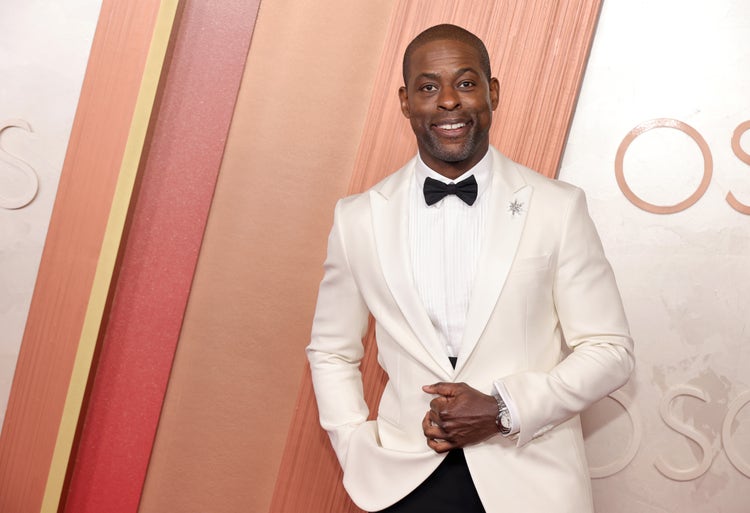
Sterling K. Brown isn’t new to storytelling that cuts deep. But in “Washington Black,” the Emmy-winning actor brings more than just emotional range; he also brings leadership.
As both the star and executive producer, Brown helps steer the vision of this historical epic that refuses to stay rooted in pain. He plays Medwin Harris, a once-traumatized Black refugee who now serves as a community leader in Nova Scotia.
Enter Ernest Kingsley Jr. as Wash, a young boy forced to escape the brutal plantation life in Barbados, only to discover his own voice and future through love, mentorship, and imagination. Together, their on-screen bond becomes the heart of a story that spans continents and challenges the typical narrative of Black survival.
When REVOLT linked up with the duo, the conversation got real. Read up below!
What does it take to be a “leading man” nowadays, and how has your definition evolved over the years?
Sterling K. Brown: Well, that's interesting, man, because in the back of my mind, I still sort of think of myself as a journeyman actor. There’s been a joke for a long time. Whoever's hot at your time – like, they could get Bokeem Woodbine, they could get Mekhi Phifer, they can get Omar Epps. Like, “Brown, don’t get too big for your britches... ‘cause there’s another top brother right around the corner that we can bring in!” (laughs). But I think there has been a shift over the last couple of years... So, what does it take? I think one of my gifts is relatability. I try to be in and amongst the people because I feel like the people. My wife, [Ryan Michelle Bathe], always asked me, “When are we going to put a gate around the house?” I’m like, “The day we put a gate around the house is the day that you become comfortable with not being amongst the people.” Being amongst the people is something that energizes me and it sort of keeps my feet very firmly planted on the ground. So, relatability. What I would love to be able to do with my career is be somebody that every man... that [all] people can relate to.
Ernest, what’s something you learned about manhood while playing Washington?
Ernest Kingsley Jr.: One thing I’ve learned is being a man and the pressures of societal masculinity and what it should look like. It’s like you’re carrying many masks, and you’re meant to carry yourself in a certain way. While playing Wash, I saw someone who takes his masks off and lets people see him; in doing so, he strengthens others. It reminded me I can, too.
What’s one script you passed on and still think about to this day?
Brown: That’s a good one. So, most of the time that a pass happened, it was because it conflicted with something else, right? There was a point in time when I was going to be in The Harder They Fall, and then this thing called COVID-19 happened. Then I had to sort of redo the schedule and whatnot. Shout out to Jeymes Samuel -- he made a wonderful, wonderful film, and I hate that I didn't get a chance to be a part of it. I almost had a chance to be in this movie called The Color Purple... I can carry a tune. But then something happened production-wise, and it conflicted. So there hasn't been anything that I was like, “I don't get it,” or, “I don’t have a desire to do it,” [but then] later saw [it] and was like, “Oh, man, I could have done something with that.” My instinct is normally that it wasn’t for me. Even if it turns out to be something that was really good, it’s like no -- that was for that actor to do that thing, and it wasn't for me.
What’s the last role or moment in your life where you truly felt terrified but knew you had to leap anyway?
Kingsley Jr.: I’ve been terrified this past week due to promoting the series – it’s been amazing. Obviously, it's been a whole new ballpark for me and there have been moments where I’m like, “Wow, this is huge... this is amazing,” but I feel a bit out of my depth. I did have a moment where I had to do something, and I was like, “Ah, terrified. I don't know if I can do this.” But then I realized, wait, I’m terrified... and then I leapt into it. That’s the lie about fear sometimes -- where people feel it’s telling you not to do something. When you think about what’s beyond that terror, there’s so much beauty.
Brown: I’ll share a real moment that got me and my wife. We were in Australia, and I was working on a film called Voltron. The whole family was there, and I lost my son on the beach. My 9-year-old son was playing with the soccer ball, and he got ahead of us and then, like, went too far. He didn't know where the hotel was. Then the sun went down, and the police were on the beach, and they had told people to leave the beach. So, everybody had left the beach to go to this walkway, but my son didn’t. Ty, for about 45 minutes, we couldn’t find the boy. I would run up and down the beach like... “Did he go back this way? Did he go further this way?” I’m asking Australians if they saw a little Black boy or whatnot. Even my oldest son, who doesn't get stressed about anything, would text me and ask if we found him yet. Then, he went to go find him and he was the person who found him. He was on the beach in the dark area. He just figured he'd stay where it was dark and wet, and me and his mom were like, “Why wouldn't you go to the light?” (laughs). He was totally fine, but that was the last time I was terrified.