Key Takeaways
- The Studio Museum in Harlem reopened in November 2025 with a major exhibition featuring alumni from its artist-in-residence program.
- The museum’s new building reflects Harlem’s architectural spirit and includes expanded space for community events, education, and large-scale art.
- The institution continues to support Black artists and youth through residencies, exhibitions, and educational programs rooted in cultural preservation.
From the Harlem Renaissance to Dipset, Harlem has been generous with its contributions to the canon of Black art. It’s no wonder the Studio Museum in Harlem — hailed as a nexus for artists of African descent — is in the center of this iconic neighborhood.
Take the A, C, 2 or 3 train, then walk to 125th St. between Seventh Avenue and Lenox Avenue. Once you see the American flag overlaid with the Pan-African colors, you know you’ve arrived. A gray, modern building designed to capture the spirit of Harlem stands before you. Welcome to the Studio Museum in Harlem.
The Studio Museum opened its doors to the public for the first time in 1968. The project was led by Charles E. Innis, a businessman formerly at Dun & Bradstreet Corporation. He also served in the Army National Guard at its Harlem-based 369th Artillery Battalion, famously known as the Harlem Hellfighters. Alongside Innis, worked a group of artists, activists, philanthropists and Harlem community members who shared the goal of creating a space for artists in Harlem and expanding the artistic canon. The institutional support helped establish contemporary Black artists during a time when artists involved in the civil rights and Black Power movements were expected to create realistic and recognizable people, scenes, posters and slogans — art that could be used directly as tools for organizing.
The museum expanded the bounds of Black art while centering the experiences of Black people. The mission was to prioritize artists working with nontraditional materials, provide opportunities for young people and offer exhibition space. Tom Lloyd, a community organizer, activist and pioneer credited with creating a new style of sculpture involving light and technology, was the first artist to receive financial support, resources and materials as part of the artist-in-residence program.
Once the residency was underway, the film unit quickly followed. This program provides free filmmaking lessons and resources for local students in Harlem and other parts of New York City. These were the first of many programs created to support Black artists and students. From 1968 to 2005, several directors succeeded Innis, including Edward S. Spriggs, Courtney Callender, Mary Schmidt Campbell, Kinshasha Holman Conwill and Lowery Stokes. Each left an impact through introducing new artist programs or overseeing building changes and renovations.
In 2005, Thelma Golden became director and chief curator after previously serving as a curatorial intern and deputy director for exhibitions and programs. In 2018, the cultural institution’s doors shuttered, and reconstruction began. During that time, the museum partnered with the American Federation of Arts, MoMA, MoMA PS1 and the Metropolitan Museum of Art to exhibit its resident artists and archival works.
The new building was designed with the spirit of Harlem incorporated as a foundational principle. From the street, visitors encounter masonry-framed windows reminiscent of those commonly found in Harlem apartments. Inside are galleries of various sizes with abundant wall space for large-scale works. Beyond them is a staircase that recalls the stoops of Harlem brownstones. The designers, Adjaye Associates and Cooper Robertson, wanted to ensure ample space for community members to watch lectures and performances or simply gather. At the top of the building is a roof offering stunning views of Harlem and beyond.
Since the 1970s, Studio Museum in Harlem has supported dozens of Black and Afro-Latinx artists through its residency program, which has launched the careers of some of the most prolific Black artists of the past 60 years. Notable names include Kerry James Marshall, Kehinde Wiley, David Hammons, Wangechi Mutu, Sanford Biggers, Lauren Halsey and William T. Williams.
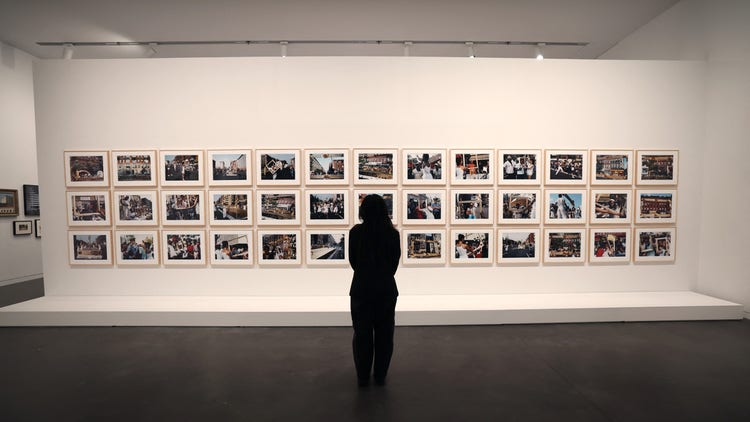
The Studio Museum reopened on Nov. 15, 2025, and unveiled its “From the Studio: Fifty-Eight Years of Artists in Residence” exhibition, which will be on view until February 2026. Alumni of the residency reflected on their time in the program when creating new work for the exhibition. Together, these artists’ perspectives create a visual narrative that speaks to the impact of the residency and the museum itself. “To Be a Place,” an archive of how the Studio Museum came to life, also debuted at the same time and is on view until August 2026. This exhibition documents nearly 60 years of history through media, historical documents and ephemera. Celebrating the museum’s early beginnings, the “Tom Lloyd” exhibition explores 20 years of Lloyd’s art practice. Alongside his electronically programmed light sculptures are works on paper and documents that reflect his efforts to transform New York’s art world. “Tom Lloyd” is on view until March 2026.
The residency program isn’t the only program that supports artists. Students enrolled in high school or GED programs can apply to the Expanding the Walls program, a free, eight-month, photography-based program to learn in-depth photography skills. Emerging artists can apply to win the annual Wein Prize, a $50,000 award given to an artist to support experimentation and excellence in contemporary art. Additional programming includes children’s story time, public art-making workshops inspired by current exhibitions, and gallery talks led by museum educators. Finally, there is an Open House for New York City public school visual arts educators, sharing resources that can be incorporated into classroom curricula.
As pushback against Black arts continues to intensify nationwide, we are fortunate to have an institution that has withstood the test of time and continues to support Black artists. We live in a moment when the government is attempting to delegitimize, vilify and erase Black people’s contributions to our society and the art world. Consider the comments made about the Smithsonian exhibition “From the Deep: In the Wake of Drexciya with Ayana V. Jackson,” which explored James Stinson and Gerald Donald’s Afrofuturist vision of Drexciya — an imagined underwater kingdom populated by the children of pregnant women thrown overboard or who jumped into the ocean during the Middle Passage. The critically acclaimed exhibition, on view from 2023 to 2024, was criticized by the Trump administration in August 2025 and held up as an example of something “unacceptable” and labeled “anti-American propaganda.” Following those statements, a letter was sent to the Smithsonian demanding that the museum submit its current and future exhibition plans, social media strategies and other programming.
The Studio Museum’s impact on Black art cannot be overstated. In this climate of anti-intellectualism, it is critical that institutions like the Studio Museum continue to push Black art forward and create space for community to gather, learn, and create together.
You can visit the Studio Museum in Harlem from Wednesday through Sunday, 11 a.m. to 6 p.m., at 144 W. 125th St., New York.