Key Takeaways
- Hip Hop’s presence on the Hollywood Walk of Fame remains limited, highlighting a broader story of cultural recognition.
- Some honorees received their stars posthumously, underscoring the lasting impact of their contributions.
- The timeline of star awards reflects Hip Hop’s evolving relationship with mainstream institutions.
The Hollywood Walk of Fame stretches across several blocks of Los Angeles and honors thousands of entertainers who have shaped popular culture. But Hip Hop, despite its longstanding reign of global dominance, occupies only a small fraction of that space.
The select group of rappers who have earned stars represent far more than individual success stories. They chart rap’s long road from neighborhood stages to Hollywood’s most visible sidewalk. Each one helped expand the culture’s reach, pushing rap from a local art form into a worldwide industry and creative force.
Their presence among film icons and pop legends underscores how deeply Hip Hop has transformed entertainment itself. These stars are not just markers of fame; they are proof of persistence, innovation, and cultural power. Together, they reflect a genre that refused to stay in the margins and finally claimed its place in the heart of Hollywood.
1. Queen Latifah
In 2006, she became the first Hip Hop artist to receive a star on the Walk of Fame. Family and friends joined the ceremony, as Latifah’s career stretched from rap to acting and producing, marking a milestone for rap’s presence in Hollywood.
2. Pharrell Williams
Skateboard P received his star in the Recording category. Among those present were talk-show host Ellen DeGeneres and the Virginia icon’s family. This recognition stamped his evolution from producer to cultural staple and reinforced rap’s creative branching into mainstream entertainment.
3. LL Cool J
LL was honored with the 2,571st star. Attendees included luminaries like Queen Latifah, who shouted him out during her own star induction ceremony. His ceremony celebrated his role as an early bridge between Hip Hop and Hollywood and set an additional precedent for rap crossing into film and TV.
4. Pitbull
Yes, he counts. Pitbull, who was awarded his star in the Recording category, was blessed by the likes of Lil Jon, Luther Campbell, and motivational speaker Tony Robbins. His achievement emphasized rap’s growing international reach and crossover into global pop culture.
5. Ice Cube
Cube received his Walk of Fame star (the 2,614th) in the Recording category. Guests included fellow Hip Hop pioneers like Dr. Dre and John Singleton. The moment recognized a towering figure in rap who helped forge the sound and edge of West Coast rap and then expanded into film.
6. Missy Elliott
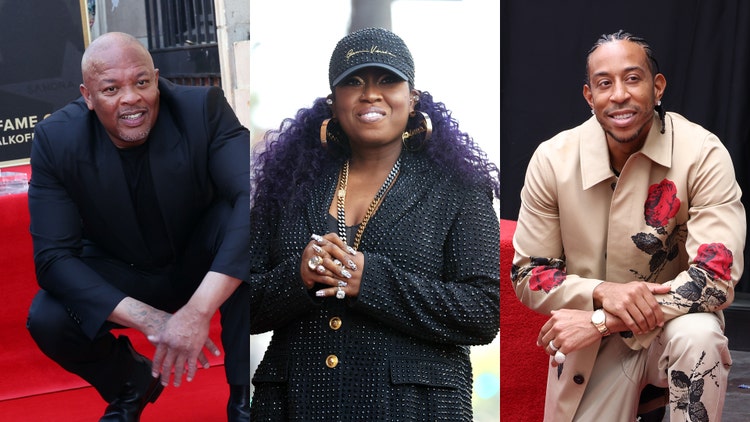
The moment Missy accepted her star, it felt long overdue. Surrounded by Ciara, Lizzo, and Mona Scott-Young, she celebrated a career that blurred the line between innovation and imagination. Similar to Latifah, her ceremony solidified how rap’s women changed not just sound, but visual storytelling itself.
7. Salt-N-Pepa
Long before their star was unveiled in 2022, Salt-N-Pepa already broke barriers for women in rap. With MC Lyte and Roxanne Shanté cheering them on, the trio’s ceremony paid tribute to an era that truly kicked the industry door open for women.
8. DJ Khaled
When DJ Khaled hit the Walk of Fame, he brought an entourage worthy of his signature catchphrase. JAY-Z, Fat Joe, and more all stood by as he turned gratitude into spectacle. The honor cemented his place as a master collaborator and amplifier of Hip Hop’s biggest moments.
9. 50 Cent
Curtis Jackson’s ceremony drew his inner circle — Eminem, Dr. Dre, and “Power” star La La Anthony — for a celebration that felt part reunion, part coronation. His star symbolized a journey from Queens hustler to multimedia mogul, proving that resilience and reinvention are rap’s real currency.
10. Ice-T
Few rappers have bridged art forms like Ice-T, whose own star honored both his music and acting legacy. Joined by Chuck D, Mariska Hargitay, and Dick Wolf, he represented a generation that brought raw truth to the microphone and the screen with equal power.
11. Ludacris
With heavyweights like Vin Diesel, Tyrese, and Larenz Tate flanking him at his 2023 ceremony, Ludacris stood as a symbol of Hip Hop’s cinematic evolution. He even had his own video crew provide a dope recap of the special moment.
12. Cypress Hill
Hollywood Boulevard filled with cheers when the B-Real-led Cypress Hill received their star in 2019. Joined by Xzibit and George Lopez, the group celebrated a legacy rooted in identity and advocacy. Their recognition marked a breakthrough for Latino artists in Hip Hop’s global story.
13. Dr. Dre
Dr. Dre’s ceremony was a full-circle moment, with Snoop, Eminem, and Jimmy Iovine praising the producer who shaped modern rap. His star wasn’t just about beats — it was about vision, mentorship, and the empire that grew from Compton to the world.
14. Tupac Shakur
Nearly three decades after his death, Tupac’s posthumous star drew crowds of fans, family, and collaborators. Allen Hughes, Big Boy, and his sister Sekyiwa “Set” Shakur spoke on his enduring voice and activism. The ceremony served as a reminder that Tupac’s impact still feels alive.
15. Snoop Dogg
In classic Snoop fashion, his ceremony became both roast and sermon. Dr. Dre, Quincy Jones, and Jimmy Kimmel took the mic, but it was Snoop’s own speech — thanking himself for “believing in me” — that went viral. His star mirrored his charm.
16. Nipsey Hussle
When Nipsey received his posthumous star in 2022, Los Angeles turned out in full force. Lauren London, Roddy Ricch, and Kareem Grimes honored his legacy as both artist and activist. His star became a community tribute and proof that impact can outlast tragedy.
17. Busta Rhymes
Busta’s induction brought energy few could match, with Spliff Star, Swizz Beatz, and rising artists paying homage. His speech mixed gratitude and pure charisma, sealing his reputation as one of Hip Hop’s most electrifying performers — and now, a permanent part of Hollywood history.