Key Takeaways
- Eight permanent galleries explore history from the Great Migration to modern social justice movements.
- An inaugural temporary exhibition celebrates Harlem’s neighborhoods, residents, and cultural legacy.
- Visitors can explore the fourth-floor museum through timed admission, with free entry for children 12 and younger.
Harlem has long been a center of Black political organizing, culture, and community action. Now, the neighborhood has a new institution dedicated to preserving that legacy. On Saturday (Nov. 14), the National Urban League opened the Urban Civil Rights Museum, marking the first of its kind in New York and the country's first dedicated to the movement in the North.
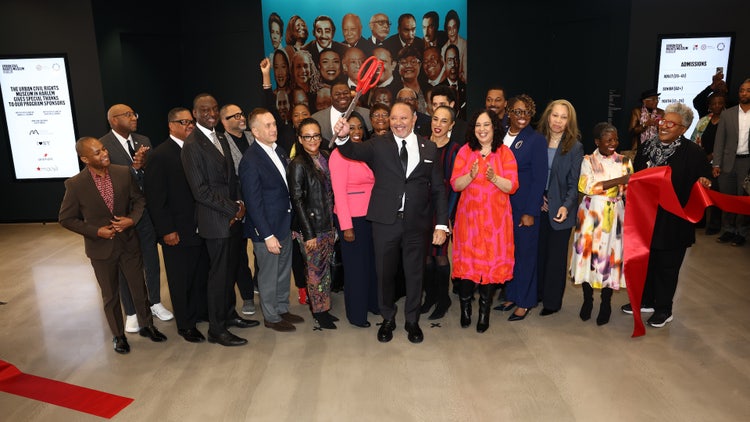
President and CEO Marc H. Morial and Jennifer Scott, the museum's executive director and chief curator, joined elected officials and community leaders for a ribbon-cutting ceremony. Located on the fourth floor of the Urban League Empowerment Center at 117 West 125th Street, the museum is the latest addition to the building, which also houses the National Urban League's headquarters.
Rather than centering only resistance to segregation in Southern states, the museum highlights campaigns for fair housing, employment, public education, and equal treatment across Northern cities. “For too long, the story of civil rights in America has been told as a Southern story,” Morial stated in the announcement, pointing to Harlem's central role in the broader fight.
Eight permanent galleries span more than four centuries, examining early Black life in Northern cities, the Great Migration, the Harlem Renaissance, and contemporary activism. Visitors encounter multimedia displays, historical materials, and accounts from residents whose experiences shaped Harlem's organizing traditions.
The inaugural temporary exhibition, “Thriving! Harlem as Homeplace,” focuses on neighborhoods, local landmarks, and personal memories. It includes Harlem-born artist D. Lammie-Hanson's “Dared to Be Black and Shining,” a work depicting members of her family and the neighborhood of her childhood.
Scott added that the museum draws on stories shared by Harlem families and neighbors, aiming to help visitors see civil rights as an ongoing responsibility rather than a finished chapter. Beyond the exhibitions, the space features a café and gift shop and offers educational and community programming.
Urban Civil Rights Museum visitor and funding details
The museum's launch received public and philanthropic support. According to the National Urban League, New York Gov. Kathy Hochul's administration provided more than $110 million toward the wider Empowerment Center and museum, while Sens. Chuck Schumer and Kirsten Gillibrand secured $4 million in federal community development funding.
The museum opens Wednesday through Saturday from 10 a.m. to 5 p.m. and Sunday from noon to 5 p.m. Timed-entry tickets are available online, with standard admission for adults ages 25 to 61 priced at $20 and free entry for children 12 and younger.