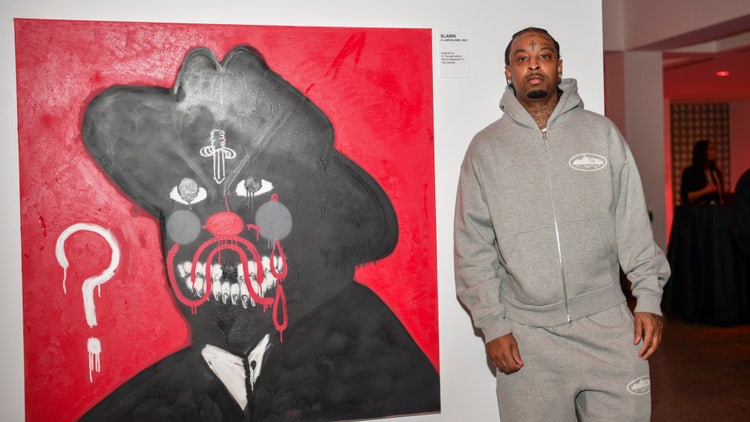
21 Savage isn’t chasing a reinvention on WHAT HAPPENED TO THE STREETS? He’s tightening the screws on what he already does best, with cold delivery, ominous production, and a worldview that treats headlines and home-life like they’re part of the same conversation. Across 14 tracks, the album keeps circling one big question: What happens to a city’s code when the internet gets loud, alliances get messy, and everybody’s watching everybody?
The feature list is exactly the kind of star power that can either feel routine or revealing, and here it lands as a bit of both. Some guests elevate the stakes, some stir the rumor mill, and a few moments feel designed to address the chatter without turning the album into a press conference. Add in the Slawn cover art (and the museum-level rollout around it), and you’ve got a project that’s as much about Atlanta’s (or even London’s) temperature as it is about 21’s.
1. “WHERE YOU FROM” keeps his opener streak alive
21 has a long history of setting the tone on track one, and “WHERE YOU FROM” does it again with focus, menace, and that genuine Zone 6 feel. The big takeaway is how he treats the internet like a physical place you can actually get touched in, not just something you scroll through. He even drops a quick warning shot that doubles as a “don’t put me in this” disclaimer: “P**sy don’t ask me ’bout Metro or Drake.”
2. The album’s “too online” tension is part of the storyline
A lot of WHTTS? is 21 reacting to the way rap narratives get built in real time through comment sections, podcasts, and “who picked a side” debates. Even when he’s rapping the usual flex-and-threat talk, there’s a repeated irritation underneath it: He’s hearing the chatter, and he doesn’t respect it. That push-pull (super famous, still defensive) becomes one of the project’s clearest through-lines.
3. “CUP FULL” uses Young Thug’s voice to frame the real theme
One of the smartest moves is how the album lets other Atlanta voices set the emotional table. “CUP FULL” opens with Thug talking about how people raised around survival don’t always learn emotional tools — just escape routes. You don’t need a whole monologue excerpt to catch the point; the key idea is right there: “We don’t know how to cope with agony.” The takeaway is that 21 doesn’t suddenly become “soft” after that. He just makes the same lifestyle sound heavier.
4. “HA” getting a video makes it the project’s early flag in the ground
If any record is positioned as the album’s “first punch,” it’s “HA.” It’s track two, produced by Zaytoven, and it flips Gucci Mane’s “Hit Another Lick,” so it feels like a deliberate nod to Atlanta’s DNA. The fact that “HA” also got the official visual treatment makes it even more of a mission statement: Minimal hook, mean energy, straight to the point. It’s the kind of song that doesn’t beg to be liked.
5. Latto’s verse is doing exactly what fans think it’s doing
“POP IT” is one of those features that instantly becomes a timeline moment, mostly because Latto leans into the 21 Savage rumors instead of swerving them. The bar people keep replaying is a little too pointed to ignore: “F**kin’ on this British man, crib look like the Buckingham.” Even if you treat it as pure trolling, it plays like a public wink, and it’s easily the song’s biggest headline.
6. Drake and 21 reconnect... and the contrast is the point
On “MR RECOUP,” Drake and 21 lean into their best shared trick: Flex talk that snaps into something heavier. Drake set it off with, “My life ain’t a movie, b**ch, it’s just us / They can’t find the shooter, b**ch, ‘cause it’s us,” then the chorus flipped the mood: “N**gas shot my brother, now I don’t know who to trust.” The record feels tense and focused with two voices, one hook, and no wasted space.
7. “ATLANTA TEARS” with Lil Baby is the “stop and really listen” moment
This is the one that feels like both artists showed up with something to prove. The beat gives them space to get reflective without turning it into a therapy session, and the verses carry actual weight — consequences, loyalty, survival math, all of it. If the album has a record that sounds like a late-night drive through everything Atlanta’s been dealing with lately, it’s this one.
8. The Slawn cover art isn’t just “cool” — it’s part of the message
Even before you press play, the album is telling you something. 21 tapping Slawn — and the way the cover references Kerry James Marshall’s “A Portrait of the Artist as a Shadow of His Former Self” — frames the project like commentary, not just packaging. The rollout pushed that idea further with a High Museum moment in Atlanta tied to the album’s world, which is a pretty loud statement for a rapper who usually keeps emotions on mute.
9. The closer (“I WISH”) is a tribute, and it lands like a heavy exhale
The last track, “I WISH,” is where the album stops posturing and lets grief sit in the room. He uses the song to run through names and alternate endings. He references multiple artists who passed, including Juice WRLD (one of the lines saw him wishing that the late star “never even took that Perc”). As a closer, it’s the album’s most vulnerable framing device and a reminder that, behind the ice-cold delivery, he’s keeping score in a different way.