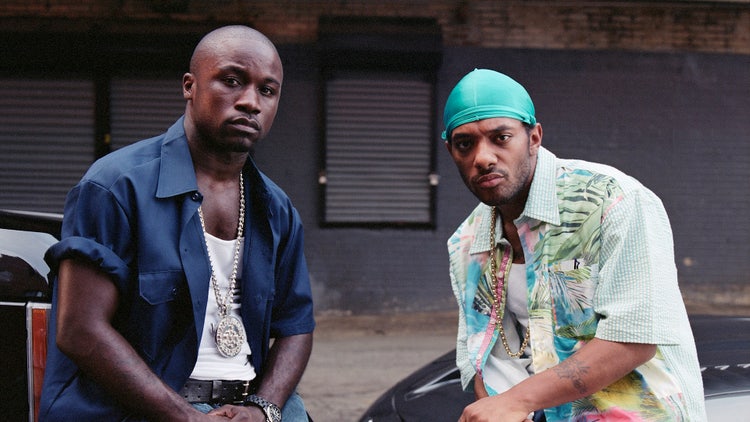
“You’s a d**k blower, tryin’ to speak the Dunn language,” rapped Prodigy on Mobb Deep’s classic “Quiet Storm.” For most listeners, the line sounded like another slice of gritty Queensbridge slang, or something tough, cryptic and unmistakably East Coast. But within those few bars lives a story about how friendship and invention turned everyday imperfections into immortal culture.
Every borough of New York has its own sonic fingerprint. Brooklyn slang bounces. The Bronx leans percussive. Queens — particularly Queensbridge Houses — built a dialect as coded as it was communal. In the mid-’90s, that dialect found its most famous translation through Mobb Deep.
As Prodigy recalled during a Red Bull Music sit-down, “Each neighborhood, each region got their own way of talking... Queensbridge just had a real unique slang and dress and all that. One of our friends out there named Bumpy, he had a speech impediment… every time he used to say ‘son,’ he’d be like, ‘what up, Dunn.’ He used to talk with a lisp… So, we all just started saying that.”
That casual, if not comedic, moment became the seed for a linguistic phenomenon. What started as mimicry turned into a symbol of kinship. Prodigy later explained it even more directly in an Aaron LaCrate interview:
“He used to talk kind of crazy… but certain things he said, it was like cool to us. So, it became popular. Everybody started mimicking how he talked,” the later rapper stated. “Then we put it in songs and next thing you know, you got Ben Stiller saying, ‘Yo, Dunn, what up?’”
Building the code of the Dunn language
Once the word took hold, Mobb Deep treated it like linguistic architecture. “We turned it into our version of Pig Latin,” Prodigy added. “We wanted to talk to each other, and if we didn’t want somebody around us to know what we were talking about, we’d be like, ‘Yo, Dunn, thorty over there got the thatty.’”
That private code, born from Bumpy’s mispronunciation, became a playful yet protective cypher for communication. The crew created their own lexicon, substituting sounds and flipping meanings until outsiders could no longer follow. A St. Ides malt liquor became a “dainey.” “Self” mutated into “delf.” “Deal” became “drilly.” Not at all random, it was a phonetically consistent pattern and a reshaping of English that imitated insider encryption.
If you go back to “Quiet Storm,” you can hear Prodigy weaponize that exclusivity: “You hooked on Mobb-phonics, Infamous-bonics.” It was both a brag and a barrier, as well as a reminder that the way Queensbridge spoke was its own kind of intelligence.
This is where Dunn language separated itself from other regional slang. E-40 built a Bay Area vocabulary rooted in hustle. Wu-Tang Clan transformed Staten Island slang and Five Percent Nation language into coded mythology. Snoop bent words into melodic California smoothness. Mobb Deep’s homegrown terminology was linguistic intimacy.
Fans first caught wind of it on The Infamous, where Mobb Deep’s verses and interludes carried a Queensbridge accent layered with altered consonants. Within a few years, affiliates like Nas, Capone-N-Noreaga and Big Noyd were peppering their verses with the same code.
The phrase itself became rap folklore. It resurfaced on “Live Foul” (“Now this Dunn language is the motivation of their talking”) and later through mixtapes literally titled The Dunn Language, Volumes I & II. Even Nelly’s single “Playa,” featuring Missy Elliott and Mobb Deep, included a lyrical salute: “I kick the Dunn Language, the response was better.”
Suddenly, what once felt like secret Queensbridge shorthand was rap lingua franca. Street corners in other boroughs, even other countries, echoed “what up, Dunn?” Teenagers on message boards copied it. One reminiscing Reddit user wrote, “I’m a white dude from the ‘burbs and was steady calling my friends ‘Dunn’ and ‘Kiko’ in school thanks to these guys.” Another commenter summed it up more poetically: “Stories like this are why I love Hip Hop.”
That mass adoption blurred the question of ownership. Some fans pointed out that A Tribe Called Quest used similar phonetic twists — “delf” and “dolo” — on “Award Tour” prior to Havoc and Prodigy’s prominence. Others argued that Mobb Deep’s consistency and cultural weight made their version definitive. Like so many elements of this culture, Dunn became collective property born of specific roots.
When slang outlives its creators
That’s why, decades later, the story still sparks nostalgia. When Prodigy passed away in 2017, fans flooded social media with “Rest in power, Dunn.” The word transcended its linguistic origins to become a spiritual one, shorthand for brotherhood, respect and legacy.
That’s the irony of its evolution: A language born to keep outsiders out ended up becoming a bridge between worlds. From project hallways to pop culture skits, it showed that Hip Hop doesn’t just sample beats. It samples speech itself.
“Dunn” will forever live quietly in the DNA of New York slang. You’ll still hear it in certain Queens circles, in older mixtape interludes, or buried in nostalgic Twitter threads. But its larger legacy is invisible. Every time rap fans invent a new phrase, flip a vowel, or remix pronunciation, they’re continuing the same practice that began with Bumpy’s lisp.
At its core, it’s all less about slang and more about how people in marginalized spaces create beauty out of imperfection, how inside jokes can become national dialects, and how sound itself can carry memory. As one Reddit oldhead wrote, “As someone... stuck in the ’90s, this s**t makes me want to cry happy tears.”
Maybe that’s the final translation of Dunn — not “son,” or “friend,” or “bro.” Maybe it’s just a word for belonging.