Key Takeaways
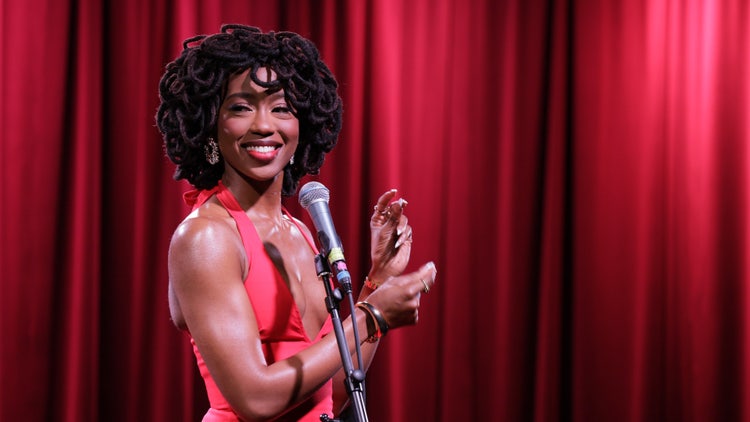
- Lynae Vanee's spoken-word EP, Sundays in the Overflow, is under consideration for Best Spoken Word Poetry Album at the GRAMMYs®.
- “I WANT MORE” calls for citizen journalism, media literacy, and greater political accountability.
- “MISSISSIPPI CRY” references Flint's water crisis, environmental exploitation, and state violence while challenging rhetoric that minimizes slavery.
For anyone who was introduced to Lynae Vanee through "Parking Lot Pimpin'," her move into recorded poetry should feel familiar. The Atlanta-based commentator built an audience by translating political arguments, Black history, and everyday frustrations into videos that were as entertaining as they were educational. Often armed with a folding chair and a drink, she could make a complicated headline feel like a conversation with the smartest person at the cookout, albeit one who came with citations.
That approach helped establish Vanee as a cultural voice before Sundays in the Overflow. A former educator and Spelman College graduate, she eventually brought her perspective to "The People's Brief," a series centered on the news and the people affected by it. In an interview with REVOLT, she described humor as a form of resistance and discussed making complex issues accessible. Her approach keeps those affected by the issues in the conversation.
Politics remain essential on the EP, particularly on "I WANT MORE" and "MISSISSIPPI CRY," but Vanee also makes room for Southern identity, romantic disappointment, self-protection, and the peculiar realization that getting older sometimes means getting excited about staying home. She delivers her thoughts through cultural references, pointed questions, unexpected punchlines, and moments of startling vulnerability, allowing even her sharpest declarations to leave room for contradiction.
In honor of Sundays in the Overflow being under consideration for Best Spoken Word Poetry Album at the GRAMMYs®. these seven selections show what makes her perspective distinctive. They also reveal how much of her work is concerned with one recurring idea: People deserve more, but sometimes they have to rethink what they are willing to accept.
1. "I WANT MORE"
The bar: "I want more citizen journalists. I want more media literacy."
Throughout "I WANT MORE," Vanee names politicians and public figures while demanding stronger leadership, greater accountability, and meaningful political participation. Her calls for citizen journalism and media literacy also turn that scrutiny toward the audience, emphasizing the importance of questioning the information people consume. Through references to American politics, popular culture, and international injustice, Vanee makes the case for critical thinking and informed civic engagement, reminding listeners that meaningful change requires an educated and engaged public.
2. "MISSISSIPPI CRY"
The bar: "If slavery was a choice, then tell me, who chose to conquer?"
Vanee confronts the rhetoric that minimizes slavery by returning attention to the people who imposed it, and the surrounding poem widens the indictment. References to Flint's water crisis, environmental exploitation, and state violence connect historical oppression with present-day systems. Her invocation of Sam Cooke's "A Change Is Gonna Come" also complicates the idea of waiting patiently for progress. Hope has a place here, but so does the insistence that somebody must act. Simply put, history becomes an immediate challenge.
3. "BETWEEN THESE THIGHS"
The bar: "You in the West End hollering, 'Revolution due,' peddling bean pies, whole time, revolution waiting on you."
Vanee takes aim at the disconnect between revolutionary rhetoric and personal accountability, questioning the value of demanding societal change while perpetuating harmful behavior. The imagery of someone selling bean pies and calling for revolution evokes grassroots activism, but her criticism extends to those who champion liberation without examining their treatment of women. Elsewhere in the poem, she addresses sexual entitlement, rejection, and the mistreatment of women, including lesbians and transgender women. The selected passage brings those concerns together, suggesting that meaningful resistance requires people to confront the prejudices and contradictions within their own communities. For Vanee, proclaiming revolutionary ideals means little without the willingness to practice them.
4. "IN EVERY UNIVERSE"
The bar: "I am delicate, I am sturdy, somewhat masculine in my femininity. I could be something else altogether, I don't know, but androgyny took tips from me."
On this track, Vanee sketches herself through Southern food, family history, Black music, and an irreverent sense of humor. The selected line is funny because it refuses the idea that she must explain or defend how femininity looks on her. Elsewhere, she considers the ancestry and languages disrupted by slavery alongside traditions that remain alive in her family. Those references reveal an identity holding several histories at once. In a project filled with demands for change, this poem offers a different declaration: She already knows who she is.
5. "THIRTIES"
The bar: "The big picture is ugly, but the view in front of me is full of potential."
Vanee finds material in the ordinary indignities of turning 30: Noisy knees, fewer friends, unpaid bills, and a growing fondness for staying home. She also talks about therapy, wanting children, and the pressure to have adulthood figured out by a particular birthday. Her references to Jill Scott's "Golden" and Mary J. Blige's "Real Love" capture the joy and optimism she still finds amid those uncertainties. There is no grand revelation about becoming an adult, only the increasingly useful understanding that unfinished business isn't the same thing as failure.
6. "HEALTHY HEARTBREAK"
The bar: "You were perfect just not for me, not at the time. Imagine needing 10 more cents and giving away your last dime."
Vanee considers the possibility that two people can share something meaningful and still be unable to make it last, without either person being at fault. The poem lingers over memories of affection while acknowledging that holding onto them isn't a reason to remain together. The selection reflects the artist's understanding that admiration can endure even after recognizing that a relationship is no longer right for either person.
7. "SOMEBODY"
The bar: "It's me. I am somebody."
The poem initially sounds like an account of someone taking advantage of Vanee's generosity. She describes giving away care, forgiveness, and emotional resources until almost nothing remains for herself. Its opening recalls Ntozake Shange's "somebody almost walked off wid alla my stuff," but Vanee introduces a particularly cutting reversal: The person who nearly emptied her out was also the one allowing it to happen. Her imagery of remedies and abandoned spaces turns caretaking into a story about depletion. By the end, she makes a distinction between being able to heal someone and being obligated to try, a boundary that changes the meaning of everything preceding it.