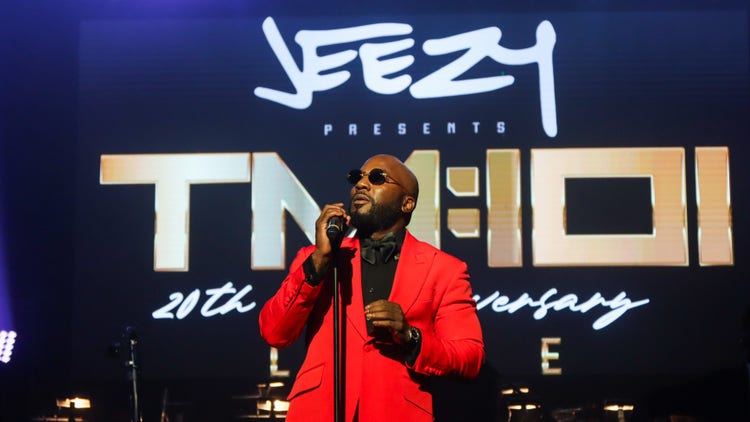
Jeezy’s debut album, Let’s Get It: Thug Motivation 101, defined a generation of hustlers and dreamers. Two decades later, the Snowman reimagined the project with a full orchestra. TM101 (Live) gives new weight to anthems like “Go Crazy” and “Trap Or Die,” which Jeezy performs backed by strings and horns. He also took the show on the road with a black-tie symphonic tour, inviting fans to celebrate in tuxedos and gowns.
In an exclusive conversation with REVOLT, Jeezy reflects on the mindset behind his debut, why he doesn’t fully embrace the “trap music” label, and the growth that’s shaped him. He also shares stories that show his range — like an unlikely backstage encounter with Betty White and the pride he feels watching young Black men put on suits for the first time at his symphonic shows.
Let’s take it back to the beginning. It’s been 20 years since your debut album, Let’s Get It: Thug Motivation 101, dropped and changed everything. What headspace were you in at that time, and what do you remember most about making it?
It was survival, scarcity. [There] was definitely a lot of survival mindset going on. And, also, [I] just wanted to be heard. I didn't really know, under the circumstances, if I would be around. I mean, you're talking about 20 years later. I didn't know if I was gonna be around next week at that time. So, it was a lot of rushing to go to the studio, staying in the studio, sleeping in the studio, just trying to get as much music I could get done because it felt like the walls were closing in. And the closer that I got to having some type of success, the closer the walls were to closing in. And it wasn't until The Recession, which was my third album, that I really realized that, okay, I could take a deep breath now, and I could kinda lean it into what I was doing.
A lot of what was going on in [2006 and 2007] — in that time after [Let’s Get It: Thug Motivation 101] came out — [there] was a lot of survivor's remorse too because it was thrown into this new life that I was trying to adjust to that I wasn't prepared for mentally, if that makes sense … I wanted to be successful. I wanted to sell records, but you think when somebody's telling you, “You're close to platinum,” you think your life would change, but it didn't. It was actually getting worse as far as the things that were happening around me and just the circumstances that I was in. I just couldn't process that. I didn't feel like I made it. But I knew that it was a blessing. And without going too far into it, I ended up getting Bell’s palsy. I was diagnosed with that. And then I also ended up tearing my vocal cords from polyps. So, there were two or three moments where I really felt like I was humble because I was almost there. And then these things were happening, and I was like, “Okay. What am I doing wrong?” And then it was also this survival mindset of, like, “If I could just make it through the day, then I can make it through the week. If I can make it through the week, I can make it through the year.” That was just my mindset.
Your breakthrough into the music industry helped define a generation, though, and some people even call you the blueprint of trap music. How do you take that in? And back then, did you at least have any sense you were creating something that would become such a staple in Hip Hop?
I personally don't subscribe to trap music. I look [at] it as art. I also look at it as something that no one had done my way. Meaning that my tempos [were] slower, my sonics were deeper, [and] my instruments were more sinister. My cadence was more call and response. And it's funny because I come from the trap. Like, I come from the trap. And the reason why it's called a trap is because you'll get trapped there if you don't figure something out. Like, your a** is going to jail or you're gonna be un-alived or you're not gonna be around for your kids, and that's why we call it the trap. So, to connect that with your art? I just don't know how I feel about that because I feel like all of us from the South who had something to do with these different sounds and its contribution, we were just doing what we were doing to survive and also to make our contribution to the world. I think it's art. I'm not the type of person that's gonna be all mad [that] somebody [calls] it trap, because I know that's the cultural “cool word.” But if it ever goes down in history, I would wanna be the person that contributed with some unique art, and it was able to be celebrated.
When I hear trap, I kinda just smile, and I go kinda like, “Oh, that's the thing that people call it that don't know and never really been to the trap.” Because if they've been to the trap, they definitely wouldn't be putting that s**t together. I bet you that. [Laughs] The trap is standing outside with a fire barrel, that you're just throwing trash in to keep warm, with the big Dickies suit on with the cotton under it. And you're standing out there trying to make $60 in a night, with your hand over the fire barrel hoping somebody [comes]. That's the trap. You're hoping that the police don't kick in the door. You're hoping that the guys from around the corner that y'all been beefing with all week don't come around here and just spray this whole thing. Like, to me, there's nothing [to celebrate] about that. But that's me.
Now, you’ve brought your debut album into a whole new era with TM101: Live. What made you want to reimagine it with a full orchestra?
I think two things. If you ever know anything about my movement and my purpose, I came in the game [and] told people that I was corporate thugging. I spoke to that in a position because I am an entrepreneur. Music has always been my talent, but business has always been my passion, and that's something I really wanted to get into. And, also, I said I was motivating the thugs [and these] same thugs have turned into doctors, lawyers, philanthropists, entrepreneurs, pediatricians [and] veterinarians. They're different things now because we all went through that era of trying to figure ourselves out, and we grew up. So, it's twofold. The first thing is musically… Like, just imagine your favorite artist. I would say Thornton Dial. He's one of my favorite artists. He's all in my living room and stuff. You know, he started [painting] this stuff in some dark shack in Alabama. But when you see it at Taj Mahal or these places where they're doing these art exhibits, that's where it's supposed to be, because over time, art becomes more valuable, and people appreciate it more. That's how I feel about the music. This is a time to elevate it, and it should be appreciated because I made it from a dark place. But now we get to celebrate it because it's withstood the test of time.
The second fold would be me doing this and having my people come out and put on ties and suits and gowns and celebrate this party. This really their party. I'm just a guest of honor. We're celebrating 20 years of them making it through some things that they probably thought they wouldn't go through. And not only just that, [but] the generation is coming up behind me. I want them to see that you don't gotta get stuck in this box where you have to actually live these things out when you're so far removed from it, to end up crashing out to prove a point. It's like, you're supposed to get better with time. You're supposed to be freer with time. You're supposed to be able to express yourself however you want to without going through the same things that you were trying to escape. And this is a contribution to that, because for myself, if I was just stuck in the trap music mindset, I would be celebrating this album at a trap house with my homeboys [Laughs]. But nah, I'm celebrating this with my culture at this black-tie event because we all [have] been through [a lot]. My story is no better than nobody else's. I don't care if you stood on the corner or in a classroom. You did what you had to do for you, and 20 years later, look how great you're doing. Look at all the people you're taking care of. Look at all the great decisions you're making. Look at how you're responsible for yourself, for your health, your wealth, your spirituality, and everything. This is what this celebration is about.
What’s it like seeing fans show up to the tour in suits and dresses, vibing to “Trap Star” with strings behind you?
Ahh man, it is the best because, one thing about us, when we look good, we feel good too. The thing I love most about it is seeing people not knowing what to expect. And quite naturally, if you wear a tuxedo, a bow tie, or an evening gown, or cocktail gown, you're thinking you're about to sit down, like, “This is gonna be really sexy and cool.” But, from the beginning, they're standing on their feet, and they never sit down. And I love to see that because they're looking around, they're looking at each other, and they're feeling [it]. Nothing is like the meet-and-greets when [I’m] seeing these young brothers, [saying], “Hey, man. You know, it's my first time putting on a suit, man. I feel good, man. How do I look?”
I ain't put on a suit ‘til I was 35. In our culture, the only time we wear suits is to go to court, for weddings and funerals. This is a celebration of life. So, you know, you got these young brothers coming in, and they looking like it. They done went on Google [to figure out] what they [needed] to put on, and they got it together. I'm happy to see that. Even the women, it's nothing like seeing sisters in these gowns … feeling [themselves] and they got [their] girl out. It's a whole experience. That's what makes me happy at the end of the night. Just hearing people say how good they look and seeing the uniqueness that they put to their outfits. Some people might come, and they have on a whole suit with a Snowman tie or a dress and have Snowman nails. I don't think that there's a lot of things that I would be intentional about unless I was excited about it.
In 2024, RZA also released a classical music album that he composed and produced himself. Why do you think this is the time for Hip Hop and classical music to collide?
We all look at that. We all looked at the John Gotti movies and The Godfather and all these things. We know how we are as a culture. We're gonna come in and take over everything, whether it's golf, baseball or the orchestra. It's like me doing the first show in Atlanta at the High Museum. The first thing I thought, and I'm 40 years old, I've never been to an orchestra. Right? So this is my first time actually performing and being at one. I've never seen this in my life. It was such an experience of elevation.
And I think with RZA, we're all realizing that as artists, we have the right to be as free as we want to be and experience anything that we wanna experience, musical. It [doesn't] have to be the typical, you know, R&B mixed with it. It could be whatever you want it to be if you appreciate it because the reality of it is somebody out there is gonna appreciate it just as much as you, or if not, even more. I haven't heard the RZA project yet. I'm glad you brought it up. I would definitely give it a listen. Love RZA. He's one of the coldest. But I just think it's the freedom to express yourself. That's what art is. It shouldn't be boxed in because it's coming from culture or from a bad place. When you look at the whole epidemic of poverty, Hip Hop came out of that. Mhmm. But we ain't just in poverty no more. Now we're politicians, now we're lawyers, we're doctors, we're running the country. We own platforms and companies and all this. Ain't nowhere to go but up.
You’re a bestselling author, entrepreneur and artist with real longevity. What’s been the biggest lesson you’ve learned about staying relevant and evolving through different chapters of your life?
Just knowing that nothing is the end-all be-all. There's been times in my career that I made a lot of unpopular decisions, and I had to understand that immediate gratification is not the way that I play the game. I'm playing for the long game and staying true to yourself and keeping integrity — I think that's the way to stay relevant, stay real, stay solid. Just to maintain getting support from people because they know you're someone they can trust, even when you're not winning. We all have our ups and downs, and it's just like, I might not be on the charts, but I'm still touching my people. I might not be on tour, but I'm still writing books. I might not be writing books, but I'm still doing things for the kids in the community. Because it's a leadership position. It ain't about just how many seats I could sell out or how many records I could sell. It's like, how much can I do? How many people can I impact? And that's always been my goal.
What’s a moment in your career — funny or wild — that fans don’t know about but still cracks you up when you think about it?
I think the funniest thing for me was — God bless her soul, she passed not too long ago — Her name is Betty. You remember the lady [who] played on “The Golden Girls”?
Oh, Betty White?
Betty White. I grew up watching “The Golden Girls.” I was a fan, and we happened to be on [“Conan”] together. She knew exactly who I was, and she wanted them to bring me to her dressing room. And I was so fanned out, and she was just loving on me. And I was just like, “Oh my god.” I couldn't believe it. Like, she knew who I was, and she was so cool. I just thought [it] was funny that she would even know who I was. She said, “I know Jeezy, the Snowman. I know you.” And I was just like, “Wow.” It just blew my mind. And I was a fan. Like, I watched “The Golden Girls” with my grandmother every night. So, it was great.
If you could speak directly to that young version of yourself in the studio with big dreams, what would you tell him now?
I would tell him in 2005, they're gonna hear you, and they're gonna appreciate it. But in 2025, they're gonna feel you. And that's exactly what's happening right now. Exactly what's going on.
Listen to TM:101 (Live) below: