Eddie Murphy’s impact on comedy is so expansive it feels almost mythic, and his Netflix documentary, Being Eddie, only sharpens that truth.
Chronicling five decades of brilliance, from his electric rise on “Saturday Night Live” to era-defining runs in stand-up and film, the project cements what fans and comics have always known: Murphy didn’t just shift the culture, he built the blueprint. He reimagined what a comedic superstar could look like, sound like, and embody. The doc threads together archival gems, raw personal portraits, and a rare look at the emotional weight Murphy carried as his fame exploded.
It reinforces how he became both a mirror and a megaphone for Black culture at a time when mainstream Hollywood rarely knew what to do with that level of audacity, talent, and authenticity.
But Murphy’s reach wasn’t limited to laughs as it widened lanes, created opportunity, and challenged an entire generation to be sharper, braver, and more versatile than the ones before them. Fans point out his influence among a class of heavy hitters like Kevin Hart, Tiffany Haddish, Jerrod Carmichael, Jamie Foxx, Lil Rel Howery, and Deon Cole, many of whom credit Murphy’s fearlessness and precision with shaping their own comedic voices.
There’s a through-line between Murphy’s 1980s swagger and the comedic DNA of today: a commitment to honesty, a refusal to play small, and a mastery of mixing physicality, vulnerability, and intellect into one unpredictable performance.
The Being Eddie documentary makes it clear that Murphy didn’t just change comedy, but he shifted the expectations of what Black comedians could command in the industry. His success proved that being multidimensional wasn’t just possible; it was the new standard.
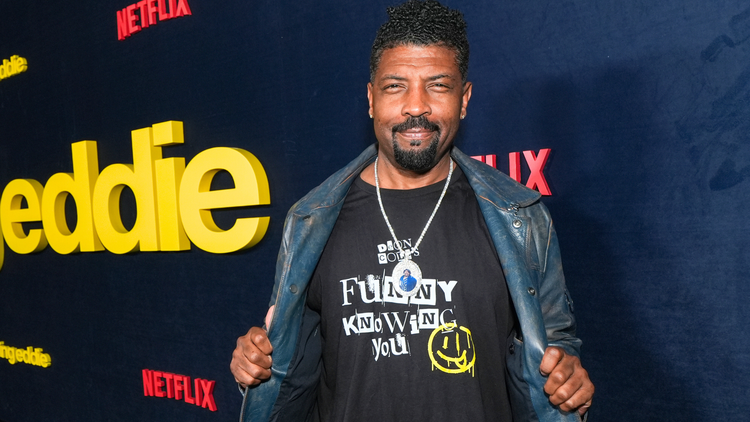
On the carpet at a premiere event for the film, REVOLT caught up with Deon Cole, an Emmy-nominated writer, beloved “Black-ish” standout, and one of today’s sharpest comedic thinkers to reflect on Murphy’s legacy and the imprint it left on him personally. The “Average Joe” star is part of a generation that grew up watching Murphy not just dominate but innovate.
Whether it was watching Raw on a bootleg tape, memorizing the cadences from Delirious, or studying the way Murphy balanced edge with accessibility, the veteran actor absorbed it all long before he ever took a mic.
His own career has followed a similarly layered path: stand-up that hits with both wit and warmth, scene-stealing TV performances, writing credits that earned him Emmy nods, and a voice in the culture that feels hilariously grounded yet deeply thoughtful. Cole has always moved like someone who knows the giants he stands on, and at the premiere, honoring Murphy wasn’t just ceremonial — it was personal.
The Illinois native opens up about how Murphy shaped his comedic compass, the lessons he learned from longevity, reflecting on his comments about streamer Kai Cenat and paying respect to legends, and what he wishes he could course-correct in Hollywood.
What has Eddie Murphy taught you that you didn’t realize you needed to incorporate in your stand-up and comedy to soar in your career?
Being diverse. His diversity was crazy, and he reached everybody. [Eddie] Murphy wasn’t a Black comic or a white comic; he was a comic for everyone, and he mixed it all up. So, I applied being diverse into my comedy.
You’ve had such a full-fledged career from sitcoms to standup and film. Which space has taught you the most about yourself?
I would say stand-up because it’s therapeutic, and it’s my thoughts — things that come from me. Acting is more like an escape and becoming someone else. I don’t really learn a lot from that in terms of learning about myself, but stand-up is very therapeutic.
When it comes to younger talent, sometimes respecting the legends and the OGs, it could be a bit better. You’ve spoken about this on “Drink Champs” in reference to Kai Cenat not recognizing a few Black musical icons. Why was it so important to share that sentiment, and what do you hope they learn from your critique?
First off, I want to start off by saying I love that brother and he’s great. I think what he’s doing is phenomenal and is reaching ceilings — doing things that have never been done before. I also want people to know that corrective criticism isn’t hate. Every time you try to tell somebody something, they say you hate them, and I don’t hate them. I’m just telling them what my thoughts are as being an OG. Like, I’m not telling you if you take a job like that, you need to know everybody. I don’t know everybody — I’m saying if you’re going to take a job like that, the people that are nominated, you should know them.
I was just giving my wisdom, and I got a lot of backlash from a lot of young people (laughs). However, a lot of older people were saying I was right on the money. It’s a debate that could still be had because you can’t teach them how to make money or anything like that, because I don’t know that lane. I don’t know about streaming or have stream wisdom (laughs). But when it comes to feeling and respect, I can give you my wisdom on that, and you do what you will with it. Shout out to Kai and everyone who is doing their thing, but I would love for people to give homage to those who came before them, like we’re doing with [Eddie Murphy]. We’re paying homage to the king.
Is there one thing you would love to “course correct” in Hollywood?
I would love for it to be more than a number one person. I would want it to be six number ones. I want ten people on screen, and they are all considered number one. Everyone is different, and you can’t have one person playing everybody.