Debbie Allen doesn’t just move through entertainment — she builds it.
For more than four decades, the choreographer, actor, director, producer, and cultural architect has been a guiding force across film, television, theater, and dance, shaping not only what audiences see on screen and stage, but who gets the opportunity to stand there in the first place. Her impact is so deeply woven into American culture that it’s easy to forget how many lanes she has mastered until you pause and take inventory.
From her breakout role in Fame, where she embodied discipline, artistry, and ambition, to her decades-long work behind the camera and at the helm of some of television’s most beloved series, Allen has always operated with intention. As a director and executive producer on “Grey’s Anatomy,” she helped steer one of the longest-running dramas in television history, while continuing to advocate for equity, excellence, and creative rigor.
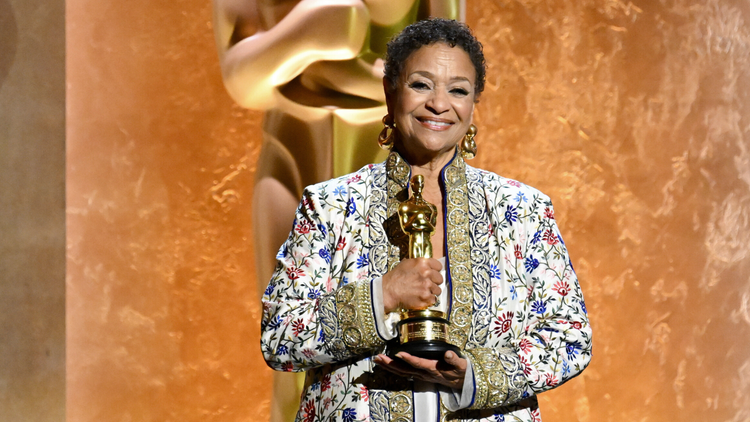
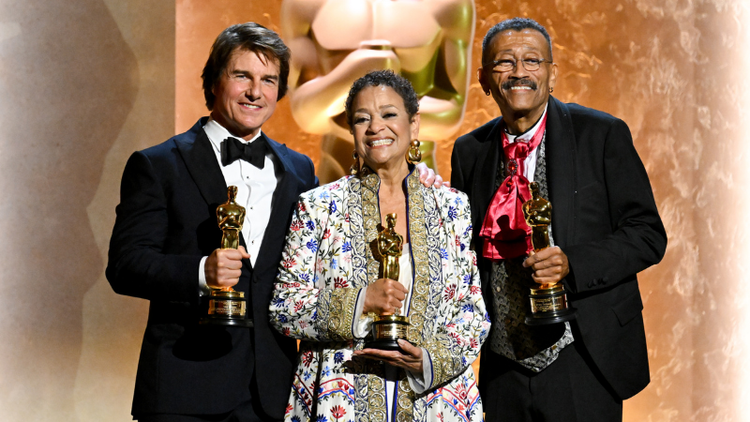
And long before multi-hyphenate became industry shorthand, Allen was already living it — balancing artistry with leadership, vision with execution. That commitment to legacy was formally recognized on Nov. 16, 2025, when the actress was presented with an Honorary Oscar at the Academy’s 16th Governors Awards, alongside production designer Wynn Thomas and actor-producer Tom Cruise.
Though the choreographer has never been nominated for a competitive Oscar, Allen’s fingerprints are all over the Academy itself. Over the years, the dancer has choreographed multiple Academy Awards ceremonies, four of which earned Emmy nominations, ultimately helping shape some of the most indelible moments in Oscars history.
As she accepted the statuette, presented by Cynthia Erivo, Allen thanked the room for “this glorious golden moment in the sun with Oscar,” while Erivo praised her as an “auntie” who has consistently lifted up fellow Black artists and brought others along with her. The moment was both overdue and deeply earned.
But if awards tell one part of Debbie Allen’s story, then her community tells the rest.
At the heart of her work is the Debbie Allen Dance Academy (DADA), a living testament to her belief that access to the arts should never be a privilege reserved for the few. Founded in Los Angeles, DADA has become a cornerstone of cultural education, serving thousands of young artists and families each year. More than 70% of academy students receive financial support through scholarships, for everything from dance training to tuition. And for the Debbie Allen Middle School, over 90% of students receive financial support. Through its outreach programs, DADA touches more than 15,000 community members each year — and over 5,000 young performers have taken the stage through its productions and partnerships.
The academy’s mission comes to life each holiday season with “The Hot Chocolate Nutcracker,” DADA’s signature production and a cherished Los Angeles tradition. The 2025 edition ran from December 4 to 14 at the Redondo Beach Performing Arts Center. The annual spectacle blends ballet, jazz, tap, Hip Hop, modern, and global dance styles into a vibrant journey across a land of wonder. Featuring many dancers of color, the production is both a celebration of movement and a declaration of cultural pride.
The 2025 cast included Allen herself as a director and choreographer, and featured stars like Carlo Imperato, Vivian Nixon Williams, April Watson, Jhaelin McQuay, and Kris Nobles. “The production is more than just a holiday tradition,” Allen says. “’The Hot Chocolate Nutcracker’ is where joy, culture, and community meet on one stage.”
The "S.W.A.T." actress remains in motion, from teaching, mentoring, creating, and reminding us that excellence isn’t accidental. The icon spoke to REVOLT about “The Hot Chocolate Nutcracker,” standing by her sister, Phylicia Rashad, through a tough time, and Netflix’s “A Different World” spinoff series. Read the full conversation below!
You’ve been directing Hollywood's phenoms and famous folks for many years. How does it feel to know that you are our “Mother of Hollywood”?
Well, that’s a very lovely thought. I've never thought of myself that way, but I know I have had tremendous influence and a wide reach that has touched so many young people, old people, and different industry creative people. I'm still doing it. I am mentoring and directing a whole new group of 5 to 7-year-olds who don't have that reference of me for many years. They have me right in front of their face and are experiencing what’s happening in that moment. It feels good to do this work. I’m really invested in the work and the growth of these students and seeing their transformation. I'm looking at girls that started out as dolls that are now in the Egyptian Royal Court in “The Hot Chocolate Nutcracker.” They've been working [toward] a purpose, and that says a lot. It feels good.
Each year, a new generation of dancers steps into a show older than they are, being cast in “The Hot Chocolate Nutcracker.” How do you pass down not just choreography, but purpose?
Before every show, we meet behind the curtain and have a moment of prayer, gratitude and a prayer to help us have the best performance that we can have and give more joy to the world, because there's so many who don't have what we have. I'm always talking to them about being grateful for their parents and for the possibilities and the opportunities that they have. That’s something that's a daily occurrence.
After more than a decade in, what part of “The Hot Chocolate Nutcracker” still makes you emotional or excited when the curtain rises?
I get excited when I'm watching the audience reaction to certain moments. I love when the audience sees the beautiful, Black fairy queen enter on stage and they all gasp (laughs). Or, when the boys hit their candy cane dance on the stage. You can’t stop the thunderous applause. They are hitting it. The little ones are so hopeful to appear in the production year after year, and it's that possibility that makes me want to keep doing it, and I must keep doing it.
When ballet institutions turned you away early in your career, they weren’t just rejecting a dancer — they were rejecting a future architect of Black arts. Looking back, how do you categorize or look at the refusals now that you’ve accomplished so much and become a staple in an industry that tried to shoo you away?
Well, this is a good kind of footprint for young people to look at. When somebody rejects you or says no, that's not you saying no to yourself. You have to believe in yourself. You just got to stay in the game. You got to stay on that track. The North Carolina School of the Arts rejected me, and then maybe five years later, they honored me with my honorary doctorate and a gold medal, and I gave my commencement speech. In my speech, what I said to the class was, “I am still in first place. I am graduating No. 1.” It may have taken me a little time, but I am here as proof that no doesn't mean no, but it may mean not now.
The Honorary Oscar placed you alongside Hollywood’s immortals. Did that moment feel like the industry finally catching up to you or simply documenting what you’ve always known about your worth?
For me, it was really less about me and more about how times have changed. I remember growing up as a kid watching the Academy Awards, and there was no one on the show that looked like me. Then, I became the choreographer, and I put all kinds of people from Asian, Latin, and our own people on stages. It speaks of what is possible. I didn't feel so much that it was about me, but more so our community is acknowledging our effort and who we are. When you’re acknowledging me, you’re acknowledging a whole community of people who have given and will continue to give. That's what's important. I mean, Ruby Dee never received an Academy Award, so I feel like part of this belongs to her, too.
You also shared a moment with Tom Cruise during the ceremony, rejoicing and dancing together. How was it celebrating such a feat with one of Hollywood’s most beloved actors and also receiving a shoutout from him during his speech?
I just adore Tom Cruise. I was so surprised when he recited my mom's poetry. That just took my heart. It took my breath away. We had had such a great night the night before and another one the night before that. There was a dinner party for him that I went to, and then my party was the one that was just off the hook (laughs). When it comes to Tom, I thought he deserved an Oscar for his performance in Born on the Fourth of July. He was incredible. I remember we were at the Golden Globes together or something. He came to one of my shows and brought his kids when they were younger, and he came backstage. He’s always been a very generous human being and very down to earth. But at the party, when we were celebrating our Oscars, we just got down, and it was so much fun.
Is there a film you were a part of that you felt should’ve received an Oscar?
Amistad. That movie was incredible. Steven Spielberg directed the film, and there was an Oscar nomination for the score and for Ruth Carter, who did the costuming. She then went on to win for Black Panther. It was like Amistad was her workshop for that; it was like a beginning. But that movie deserved a lot more Oscar attention, whether we win or not. But it was met with controversy... We had so many ridiculous claims of plagiarism and all this. I learned about this story by reading a book from Howard University's bookstore. I was reading factual information, and everything I researched [was] because I was determined to make it a movie. Everything I researched was factual. I was looking at real documents. I wasn't looking at anybody's novelization of what happened. I was looking at the real abolitionist papers and what would happen at the Supreme Court. All of that is on record.
When we were being challenged, because Steven decided to do it when we did it, and not in another term, it was just unfair. But, you know, the Oscars get a lot of things right, and sometimes there's controversy. Remember, there was such controversy when no Black people were apparently winning. I remember when Whoopi [Goldberg] became the second woman to win after what, 40 years after Hattie McDaniel. The nature of the universe is changing. The nature of the universe is that things are cyclical.
After Netflix announced the “A Different World” spinoff, what is the one truth about Black college life today that the series should get right in order to honor the original legacy you and your sister, Phylicia Rashad, helped build?
We have some very new freshman students that are wonderful — that I think that the world is going to fall in love with. We have our OGs coming back in waves, and not all at once. It’s going to be amazing. We have Kadeem [Hardison], Jasmine [Guy], Cree [Summer], and Darryl [Bell] returning. You’ll eventually see Colonel Taylor (Glynn Turman), Jaleesa Vinson (played by Dawnn Lewis), Kim Reese (Charnele Brown) and other people. I think what will be true of the show will be a truthful portrayal of young Black students. Felicia [Pride] is our showrunner, and she is wonderful. I met her on “Grey’s Anatomy” and welcomed her to come in. She’s tearing it up.
If the original “A Different World” showed Black students how to dream, what do you think the emotional assignment of the Netflix spinoff is?
We will see what they take away from it because we're going to see new people in different areas. We have a foreign student from Africa. We have a young woman from Compton who is amazing. We have Whitley and Dwayne's daughter, who is a bundle of joy and confusion. You have a football player in the mix. We have different people playing different things, and I think the audience is going to take away a lot.
You and Phylicia Rashad didn’t just portray excellence, but you protected it on and off screen. Long before the world saw you two as icons, you were just sisters moving through life together. What's a moment from that journey where your sisterhood truly saved the day?
There were so many wonderful moments where we just have been so close, even though growing up, I was on her nerves because I was her little sister that wanted to be her and wear her clothes. I remember one day in high school, there was a group of girls that were coming after me because the boy that was my boyfriend was a football player. The girls were coming for me, and they were surrounding me. Phylicia walked in the middle of that group with her baton, and she said, “Okay, who's going to be first?” It was over (laughs). Everybody backed down.
As for me standing up for her, she was in the middle of so much controversy coming out of “The Cosby Show,” and she always just tried to be silent. People were always wanting her to say something. That was difficult for Phylicia because her relationship was very different from what had allegedly happened.
From uplifting the next generation to standing tall on Hollywood’s biggest stages, Debbie Allen’s story is one of grit, grace, and generational impact. Her bond with her sister, Phylicia Rashad, her commitment to young artists, and her refusal to be boxed in continue to shape the culture. And she’s not done yet.