Key Takeaways
- The 1997 crossover between Allen Iverson and Michael Jordan became a turning point in NBA history.
- Both Iverson and Jordan have spoken positively about the iconic moment since.
- Iverson’s performance helped solidify his identity as a cultural icon beyond the court.
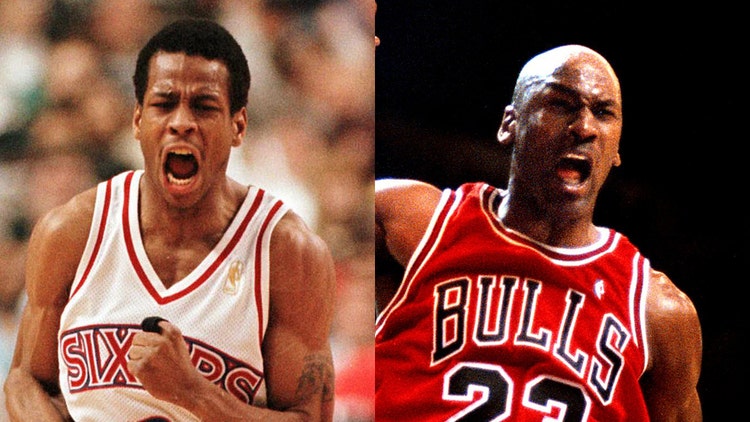
On March 12, 1997, a 21-year-old rookie from Hampton, Virginia, stared down his childhood hero under the lights of the CoreStates Center. The Philadelphia 76ers were hosting the defending-champion Chicago Bulls, a 55-8 powerhouse led by Michael Jordan. The Bulls would win, 108–104, but the night belonged to Allen Iverson and one unforgettable move that still lives in basketball lore.
Iverson was months into his first NBA season, already electrifying fans despite Philadelphia’s struggles. The Sixers were rebuilding, Jordan’s Bulls were rolling, and national highlight packages were capturing every glimpse of a league in its golden era. Yet what unfolded that night wasn’t about standings or playoff implications. It was a moment where reverence collided with rivalry... and where the fan finally faced his idol.
Allen Iverson’s awe before facing Michael Jordan
In his 2024 appearance on “The Tonight Show Starring Jimmy Fallon,” Iverson recalled the buildup with wide-eyed honesty. “I remember the first time I was just staring at him and just looking at him like, ‘That’s him,’” he said. “That was the first time I was really starstruck… He didn’t look real to me.”
He compared Jordan’s presence to something supernatural — “this orange force field around him,” a glow that made the six-time champion seem less like a person and more like a myth. For Iverson, who grew up watching NBA games on NBC with his mom, it was the embodiment of everything he’d dreamed about.
“He was my hero,” Iverson told Fallon. “He was the reason why everybody knew who Allen Iverson is today. Because of him.” That awe didn’t vanish easily. Even now, Iverson admits he still gets nervous around Jordan. “I’m still starstruck,” he laughed. “My friends have to tap me, like, ‘Chuck... calm down. You’re embarrassing us.’”
The crossover that shook the GOAT
Admiration, however, only lasts until competition begins. That night, midway through the first half, Iverson got the matchup he wanted: Jordan switched onto him near the right wing. What happened next became one of the NBA’s most replayed highlights.
He faked right. Jordan slid. Iverson pulled back, crossed left, then snapped it back right — a double crossover so fast it looked animated. The crowd gasped. Jordan bit, lunged, recovered, and still nearly blocked the jumper. The shot splashed anyway.
“He was a casualty of war,” Iverson told Fallon, grinning. “We were competing. Once the ball went up… it was time to dance.” That line captures the duality of the moment — deference off the court, defiance on it.
In another sit-down, Iverson said his confidence was already set: “Once he came out there, I was gonna put my money to the test.” Jordan, ever the technician, broke down what happened in a post-game interview. “He keeps the ball real low and he’s small,” he told reporters, “Certainly closer to the ground than I am. His quickness is unbelievable.”
Iverson finished with 37 points on 15-for-23 shooting, including 5-of-8 from three. Jordan, who scored 23 points on 9-for-24, walked off with the win but not without acknowledging what he’d just witnessed. Scottie Pippen carried much of the load for Chicago, adding 31 points on 12-for-18 shooting as the Bulls held off Philadelphia’s late push before 21,061 fans.
Sometime well after that moment, Jordan offered more of the calm professionalism that defined his greatness. “That was a great move,” he said. “I’m never the type of guy that says I can’t get showed up. I just try to limit those opportunities... He’s good, he’s quick — that’s a challenge for me to go out to him and his stature. But it’s a challenge I won’t back away from. He may cross over on me again.”
He was right about Iverson continuing to get better. Within four years, “The Answer” would be league MVP, an All-Star fixture, and the face of an NBA generation that blended hip-hop swagger with unfiltered authenticity.
The lasting legacy of the Iverson–Jordan moment
Iverson still sees that night as sacred. Fans remind him of the crossover constantly. “Almost every day, if not every day,” he told Fallon. “That’s how great he was. If you think about it, on that play, he still almost blocked my shot.”
Culturally, the play symbolized more than a bucket. It marked the NBA’s generational handoff — the passing of spirit from Jordan’s polished dominance to Iverson’s raw individuality. For many, it was the moment basketball’s aesthetic shifted from clean suits and fadeaways to (eventually) braids, tattoos, and crossovers.
It also cemented Iverson’s bond with the City of Brotherly Love. “There’s no relationship like Allen Iverson and the city of Philadelphia,” he told Fallon, comparing it to Jordan’s with Chicago or LeBron’s with Cleveland. That connection began the night the city watched him fearlessly go at the greatest ever.
Iverson saw an aura. Jordan saw a challenge. The world saw a moment when two eras brushed shoulders and the future briefly crossed over the past. “He was my hero,” Iverson recalled telling him. “And he said, ‘I couldn’t have been too much of a hero if you crossed me like that.’”