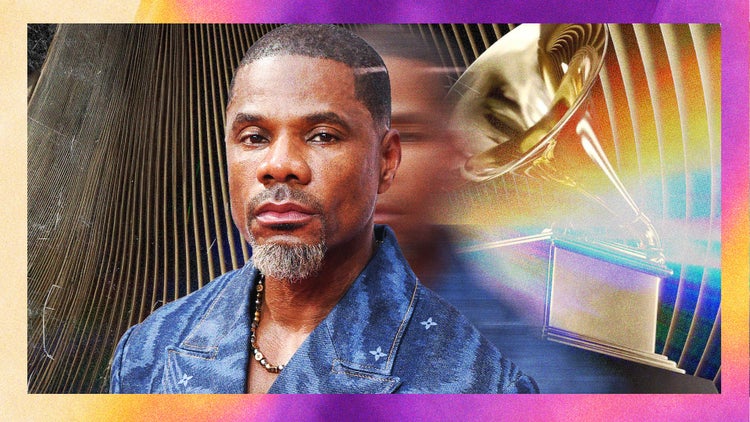
When you press play on a Kirk Franklin record, you know within seconds it’s him.
The choir hits, the drums knock a little harder than expected, and somewhere between the harmonies and the honesty, you feel that blend of church, culture, and conviction that Franklin has been refining for more than 30 years. The Fort Worth native didn’t just arrive on the gospel scene in the early ’90s — he shifted it.
His 1993 debut, Kirk Franklin and The Family, became one of the best-selling gospel albums of all time, introducing a sound that felt both deeply rooted and refreshingly current. While traditional gospel had long centered choirs and worship structure, the singer infused his music with Hip Hop rhythms, contemporary production, and lyrics that spoke directly to real life and not just Sunday mornings.
Songs like “Stomp” and “Revolution” weren’t subtle about their intentions. They were loud, joyful, and unapologetically modern. Suddenly, gospel music wasn’t confined to church walls. It played at family reunions, on mainstream radio, and in arenas packed with fans who saw themselves reflected in the message.
Albums like The Nu Nation Project, Hero, and Losing My Religion continued that momentum, proving that Franklin wasn’t chasing trends — he was setting them. Over the years, he’s collected numerous GRAMMY Awards and industry accolades, but what’s kept him at the center of the conversation is his transparency.
Franklin has never shied away from talking about faith in complicated terms. He’s addressed doubt, family struggles, church criticism, and accountability, often in ways that sparked dialogue far beyond music charts. That willingness to be open has allowed multiple generations to connect with him, whether they grew up on his earliest records or discovered him through a viral clip.
In January 2026, Franklin’s impact was formally celebrated when he received the Black Music Icon Award at the fourth annual Recording Academy Honours, presented by The Recording Academy’s Black Music Collective. The moment felt significant — not just because of his longevity, but because of how deeply his influence runs through modern Black music.
Gospel has always been foundational to R&B, soul, and Hip Hop, and Franklin’s contemporary spin helped reintroduce that foundation to new audiences. Still, he isn’t content to stay in one lane.
His podcast, “Den of Thieves,” shows another layer of the artist that fans thought they already knew. The title alone hints at something more conversational than preachy. On the show, Franklin leans into honest discussions about faith, relationships, leadership, mental health, and cultural tension. The vibe is less sermon, more dialogue. He listens, questions, reflects, and doesn’t judge any of his guests.
It’s a space where belief and reality can sit at the same table. That balance has defined his entire career. Franklin understands how to honor tradition without being trapped by it. He’s collaborated across genres, mentored emerging voices, and used his platform to speak on social issues that matter to his community.
At a time when audiences crave authenticity, he continues to show up as himself — flawed, faithful, and evolving. More than three decades after his debut, the musical icon remains a driving force in gospel and beyond. Whether he’s leading a choir, accepting an industry honor, or hosting layered conversations, one thing is clear: his voice still resonates. His message in music and conversation is one of the reasons fans still love and connect with Franklin across generations.
REVOLT spoke with the pioneer on the red carpet at the 2026 Grammy Awards, where he shared encouraging thoughts to the world about navigating a complicated cultural climate. He shares why it’s important for society to walk in humility and gratitude, how “Den of Kings” creates a safe space for Black men, the mantra he stands by, and what he’s more intentional about saying no to in this season of his life.
Read below.
In today’s cultural climate, what’s an affirmation you could share to the world or something you want the world to not do?
The one thing I would encourage people to not do is... to not forget the grace that you’ve given. It’s the same grace that you have to give. It’s very easy to get comfortable and hide your own junk, and you’re so critical of others that the junk you’re hiding — you should be grateful it didn’t get exposed. That is why we must walk with humility and gratitude and be quick to give it to others, because if ours was exposed, we would not have the same arrogance that we sometimes maneuver in.
On your talk show, “Den of Kings,” you really center Black men, and the way that you break down certain discussions makes men more comfortable and in tune with their vulnerability in themselves. What is something you want Black men to remember?
Thank you so much for watching “Den of Kings,” we’re working on Season 2. More than anything, when Black men get comfortable and when we trust, we will communicate. We have to feel safe, and I feel all men of color should hear that, and we need that.
As your career continues to grow, what are you being more intentional about saying no to?
I’m saying no to the thoughts that are not of truth. I only try to give room to the thoughts that I know are true. And don’t make something a problem until it becomes a problem.