Key Takeaways
- Outkast transformed Bobby Brown’s former studio into Stankonia, a creative hub that redefined Atlanta’s music scene.
- Earthtone III, the duo’s production team, blended gospel, techno, and funk to craft a sound that pushed Southern Hip Hop forward.
- The album’s recording process welcomed constant collaboration, with artists and producers flowing in and out of the studio.
- Tracks like “B.O.B.” and “Ms. Jackson” balanced innovation with commentary, helping the album resonate across audiences.
On Halloween 2000, Outkast unleashed a record that felt less like a release and more like a detonation.
By that point, André 3000 and Big Boi had already evolved from teenage emcees in East Point, Georgia, into Southern rap innovators through Southernplayalisticadillacmuzik, ATLiens, and Aquemini. Each project expanded rap’s borders, but by the time they began recording Stankonia, both felt boxed in by predictability.
“Man, as far as Hip Hop… I used to be a real big fan, but not anymore, really,” André 3000 revealed to Spin. “It’s not that it’s not good. It’s just not inspiring.” Big Boi echoed that feeling: “They’re real comfortable out there right now. Nobody’s hungry anymore.”
That frustration became fuel. Stankonia was a furious, funk-fueled reset button. It was a collision of church choirs, punk guitars, and breakneck drum-and-bass that redefined what Southern rap could sound like. “I didn’t think we could get any bigger after Aquemini,” André 3000 told Craig Seymour. “Let’s crank it up. Let’s make it fierce.”
From Bobby Brown’s studio to Atlanta’s creative ground zero
The journey began with a piece of Atlanta music history. After Aquemini, Outkast purchased Bobby Brown’s old recording studio — a space they’d once hung around as teenagers hoping to catch a glimpse of the R&B star.
“We used to camp out outside, just waiting days at a time for Bobby Brown to come... We saw him at a show in North Carolina, and we was like, ‘Yeah, we like the studio,’” Big Boi recalled to MTV. “He’s like, ‘Man, y’all can have the studio.’ And so, we bought it out of the foreclosure.”
They renamed it Stankonia, a word André reportedly coined to represent a place “where you can open yourself up and be free to express anything.” Inside, the atmosphere was equal parts mystical and mechanical: Glowing console lights, haze in the air, and constant motion. “When you own the joint, you stay there all day,” Big Boi said. “You never know when the vibe’s gonna come. It could be seven in the morning, could be seven at night, could be midnight.”
That ownership changed everything. The duo no longer had to rent time or rush ideas. Sessions stretched for days, collaborators floated in and out, and the line between work and life disappeared. “It was a real free-flowing period,” Big Boi remembered. “All the doors were blown off the hinges. No boundaries, no nothing. That’s when you make the best music.” Soon, Stankonia Studios became the nucleus of Atlanta’s creative community, as well as the meeting ground for Dungeon Family affiliates like Goodie Mob, Killer Mike, and CeeLo Green.
How Earthtone III rewired Hip Hop’s DNA
With Stankonia, Outkast fully embraced independence. Organized Noize guided their early albums, but now the duo, alongside engineer David “Mr. DJ” Sheats, produced nearly everything themselves as Earthtone III. Working with an MPC, an SP sampler, and a single keyboard, they built songs piece by piece, calling in musicians as needed.
“You got two cats on the drum machine,” Big Boi explained, “Let’s call the bass player, piano player. Let’s hire a tuba. Let’s try every instrument.”
One of the first creations was “B.O.B. (Bombs Over Baghdad).” André and Mr. DJ sequenced the beat on a tour bus, inspired by the drum-and-bass scenes they’d witnessed in London. “Techno was too cheesy and dance-oriented for people [in the States],” André admitted to Rolling Stone. “But if you make it hard, with feeling and lyrics on top, it’s a new type of music. We call it slumadelic — slum dance music.” Before lyrics even existed, they decided it would be the first single.
The track’s title came from the U.S. bombing of Iraq. The result was 135 BPM of electrified chaos, along with a gospel choir colliding with machine-gun percussion. “We wanted to be the music industry’s defibrillator,” Big Boi said.
Label executives hesitated, calling the track too fast for radio. Outkast refused to compromise. When “B.O.B.” hit airwaves in September 2000, it sounded like the future — an apocalyptic rave, even. Its Atlanta-shot video turned Atlanta's Bowen Homes projects into a psychedelic battlefield. “They just made it look so artsy and beautiful when this was a very treacherous trap,” T.I. explained to MTV.
Stankonia wasn’t all chaos. “Ms. Jackson” emerged from André’s acoustic noodling after his breakup with Erykah Badu. “[If you’re] wondering how somebody feel about you after certain things don’t work out,” Dre stated, “[This is] just really just saying, ‘It’s nobody's fault, but let's try to make the best of what we got.” The song’s apology to a “baby mama’s mama” became universal. It topped the Billboard Hot 100 and won a Grammy for Best Rap Performance by a Duo or Group in 2002.
Elsewhere, the pair tackled bigger social themes. “Gasoline Dreams” exploded with guitars and existential angst (“All of my heroes did dope”), while “Red Velvet” mocked empty materialism. “The focus of lyrics in Hip Hop lately has been braggadocio,” Big Boi said to Rolling Stone, further calling it an “overabundance”. “If you’re doing that, what’s your focus? What are you doing? ... People got to realize that 80 percent of the brothers out there ain’t got half what they got, and they puttin’ it in they face. It’s like dangling raw meat in front of dogs.”
That dual consciousness of street realism and cosmic reflection made Stankonia a study in contrasts. André brought Afrofuturist imagination; Big Boi brought blunt humanity. Together, they mapped out Hip Hop’s next frontier.
Diving deeper into the art of duality
The creative tension that fueled Stankonia was real. By 2000, André and Big Boi’s lifestyles were diverging. André was evolving into a reclusive artist-philosopher, experimenting with fashion and introspection. Big Boi remained rooted in Atlanta’s hustler energy, a father and family man balancing street wisdom with ambition.
In interviews, both admitted to recording separately and trading verses later. Dre’s experiments with melody — what CeeLo Green jokingly called “the comedic approach” — quietly rewrote the rules for rappers. “’If you like it, then I’m serious. If you don’t, I’m just trying,’” CeeLo recalled his peer stating. That willingness to blur the line between rap and singing paved the way for generations of genre-benders from Drake to Kid Cudi.
The push and pull between the two became part of the album’s DNA. Stankonia wasn’t a split (that would come in its follow-up), it was a conversation: One side grounded, one airborne. “We were fighting for the civil rights of Southern Hip Hop to be counted,” CeeLo expressed to MTV. André, meanwhile, was reaching beyond Earth entirely. Together, they built a world where contradictions could coexist in seemingly infinite forms.
The legacy of Stankonia
When Stankonia debuted at No. 2 on the Billboard 200, it sold over half a million copies in its first week, outselling even U2’s heavily promoted All That You Can’t Leave Behind (Notably, the JAY-Z-led The Dynasty: Roc La Familia took pole position that week. Critics compared it to Sly & the Family Stone’s There’s a Riot Goin’ On for its scope and defiance. Rage Against the Machine’s Zack de la Rocha even called “B.O.B.” “maybe the most exciting thing I heard [that] year.”
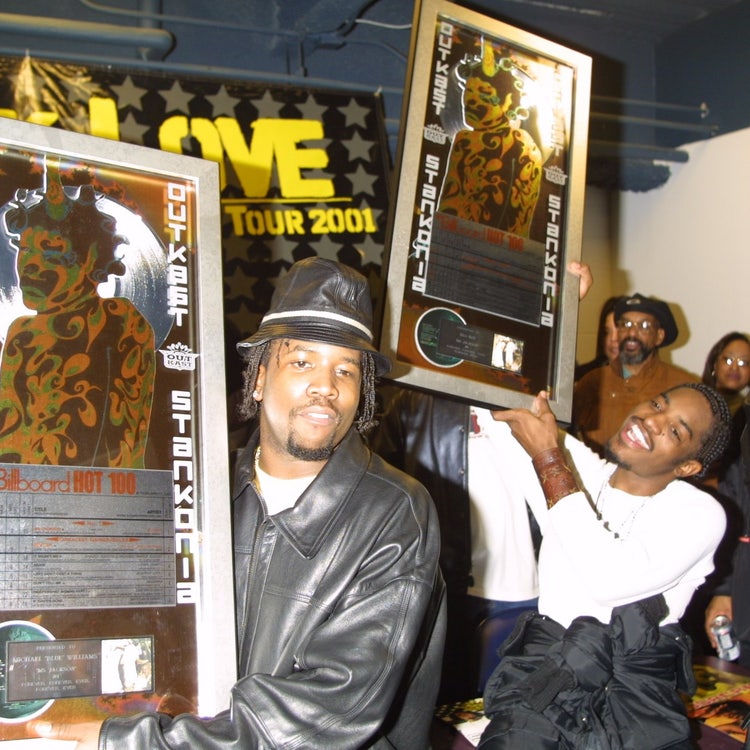
But its greater legacy was cultural. Before Outkast, Atlanta’s Hip Hop identity was fragmented. The city was home to acts like Kriss Kross, TLC, and Arrested Development, but lacked a unifying sound. Stankonia changed that. As CeeLo Green later described them as “mavericks” who “broke down walls.” By fusing funk, soul, gospel, and electronic, they effectively gave the ATL a permission slip for eccentricity. Just look at artists like Father, Young Thug, and JID.
As André once said (per the late Rico Wade), he wanted to “look like the music” — wild, unpredictable, impossible to box in. Big Boi phrased it more simply: “We make timeless classics. You can always go back to an Outkast record and find something you didn’t hear before.”