Key Takeaways
- Watch the Throne went through multiple rewrites and abandoned versions before JAY-Z previewed an 11-track version in 2011.
- The album’s creation stretched across continents, with producers like No I.D., Hit-Boy, S1, and Mike Dean shaping its sound in real time.
- Public teases and later reversals kept Watch the Throne 2 in discussion for years without a confirmed release.
By the time JAY-Z invited a small group of journalists into New York City’s Mercer Hotel in July 2011, Watch the Throne had already been made, scrapped, and rebuilt twice. Sitting with a MacBook in his lap, Hov previewed an 11-song version that included “No Church in the Wild,” “Lift Off,” “Otis,” and the unreleased “Italian Living,” a song built around Andrea Bocelli’s “Con te partirò.” According to GQ, he revealed that what the room was hearing was the album’s third iteration, following two abandoned rounds of songwriting and recording that he attributed to the ambition and expectations surrounding the project. The revisions were significant enough to sideline “H.A.M.,” the project’s first single; JAY-Z acknowledged disappointment with the record, which was absent from the Mercer preview and ultimately relegated to the deluxe edition.
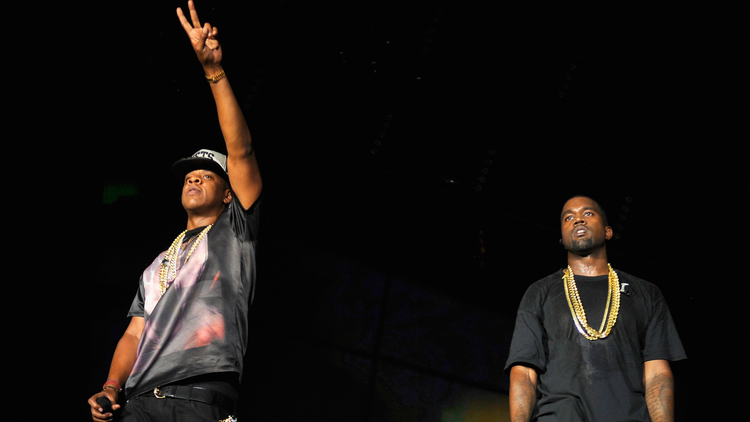
In August 2010, Kanye West announced Watch the Throne as a five-song EP with JAY-Z. Two months later, he told MTV’s Sway that it became a full album. The partnership itself was years in the making, with West going from producing records for Hov to becoming a superstar in his own right. Per Rolling Stone, JAY-Z said the process had to happen in person: “If we were gonna do it, we were gonna do it together. No mailing it in.” Even the title carried a broader meaning for the Brooklyn legend, who later explained that it referred to protecting Hip Hop’s place as youth culture rather than simply declaring himself and West its kings.
An official release announcement said Watch the Throne was created over more than a year in London, Bath, Abu Dhabi, Sydney, Paris, and New York City. Speaking to REVOLT, producer S1 recalled flying to London for what he described as the first week of work on the album, joining West, No I.D., and Mike Dean. JAY-Z arrived two or three days later, after the beatsmiths started assembling tracks.
Hit-Boy’s experience demonstrated how unpredictable the operation could become. The West Coast talent told XXL that a planned multiweek stay in Abu Dhabi ended after one night when West decided he was not feeling the atmosphere. The group returned to the United States after Hit-Boy took a 16-hour flight there. By January, Hit was in New York creating music specifically for Watch the Throne.
S1 remembered he and his peers working from stations along a platform while JAY-Z and Ye occupied the middle of the room with microphones facing each other. He watched JAY begin mumbling flows after hearing a beat, mentally construct lyrics, and sometimes be ready to record roughly 10 minutes later. West used a different method, freestyling vocal patterns before returning to replace unfinished portions with words. Hit-Boy similarly recalled West directing additions and removals from his production while JAY-Z quietly tested flows.
The freedom of the process did not mean a lack of scrutiny. JAY-Z later told GQ that disagreements between the two centered on “what’s best for the song.” West’s perfectionism could become painstaking: Hov remembered reaching “seventy-five versions of a snare” while his collaborator was still demanding changes.
How the final version of Watch the Throne took shape
No I.D. expressed to Complex how he heard an early direction for Watch the Throne and told JAY-Z and West that he wanted the two icons to “push intelligence and decadence” forward creatively. He believed the project was also missing an essential piece of West’s production identity, asking, “The sample record that Kanye does with no co-producer, where is that?” According to No I.D., West accepted the challenge and “Otis” followed within days.
Roc Nation executive Lenny Santiago’s recollection of “Otis” captures the spontaneity that survived all that perfectionism. Near the end of a Mercer session, West was preparing to leave for a flight when he decided to demonstrate an idea involving Otis Redding’s “Try a Little Tenderness.” As explained to XXL, Santiago said West moved to an MPC and keyboard and began chopping the sample. Roughly 15 to 20 minutes later, the foundation of “Otis” was complete.
Hit-Boy’s eventual signature contribution came together differently. He said he created the beat that became “N**gas in Paris” at home and was not present for the Paris sessions. While Ye and Hov were overseas, he received a request for the beat’s files. The song eventually became one of the album’s defining records, despite its instrumental beginning outside the traveling studio environment that shaped much of the project.
Another particular standout did not begin as one composition. S1 revealed that Swizz Beatz created a piece called “Black on Black Murder,” while his own production was titled “Black Excellence.” West played the tracks consecutively in the studio and proposed combining them. An engineer joined the two during the session, and their titles became “Murder to Excellence,” turning separate ideas into one record.
Watch the Throne's biggest boasts celebrated wealth at an almost surreal scale, while records such as “New Day” considered future fatherhood and “Murder to Excellence” confronted violence alongside Black upward mobility. JAY-Z pushed back on interpreting the album’s luxury as simple bragging. Describing the perspective behind songs such as “Otis” and “N**gas in Paris,” he told GQ, “It’s like, ‘I’m shocked that we’re here.’”
As far as protecting the music prior to release, Billboard detailed an anti-leak operation involving fingerprint-protected hard drives and tightly restricted access to recordings. Watch the Throne arrived digitally through iTunes on Aug. 8, 2011, before expanding to other physical and digital retailers on Aug. 12, and Rolling Stone noted that the album reached its release without an advance leak, an increasingly uncommon result for a major album at the time.
As stated before, not everything created around the sessions survived. In addition to “Italian Living,” JAY-Z later told Zane Lowe that “Holy Grail” and “Oceans” existed during the Watch the Throne period. West wanted both for their joint album, and Hov wanted to preserve them for his next solo project. He confirmed that they argued about the records for four days. Both ultimately appeared on 2013’s Magna Carta... Holy Grail.
The complicated history of Watch the Throne 2
In December 2011, JAY-Z publicly floated the possibility of another Throne album the following year, saying he and West had “really found our zone.” In May 2012, Mike Dean went further: When chatting to Quiet Lunch about his upcoming work, the longtime collaborator said Watch the Throne 2 was “not started yet, but that’s coming."
Enter Mr. West. During a 2016 "Saint Pablo Tour" stop, the Chicago icon declared that “there will never be a Watch the Throne 2,” blaming disputes connected to Tidal and Apple Music. Two years later, he reversed course and tweeted, “throne2 coming soon.”
West revived the idea again during a "Drink Champs" appearance. While holding a bottle of JAY-Z’s D’USSÉ, he said, “Courtesy of The Throne. Part two coming soon, hint hint,” without providing a release date or additional details. Years of teases kept the possibility of a sequel alive, even as Watch the Throne 2 remains one of Hip Hop’s most enduring what-ifs.