Key Takeaways
- ANTI marked a shift in Rihanna’s approach, prioritizing creative freedom over commercial formulas.
- The album’s rollout — including a TIDAL exclusive and Samsung partnership — helped define its narrative.
- Its 500-week Billboard 200 run highlights ANTI’s staying power in the streaming era.
On Jan. 28, 2016, Rihanna released ANTI, her first studio album in more than three years. That gap mattered. From 2005 through 2012, she moved like a pop metronome: Album, tour, hit single, repeat. ANTI was the moment she stepped off that pace and started building on her own instincts instead of the industry’s calendar.
Long after its arrival, ANTI is still arguably the clearest snapshot of Rihanna as an album artist. It’s not a tidy “reinvention” story, because she didn't abandon what made her a star — she just refused to make the music easy. The project drifts through dubby tension, slow-burn R&B, Caribbean swing, rock-leaning drama, and minimalist trap moods. It sounds like someone with nothing left to prove, and that is exactly why it has lasted.
Honesty over the “pop formula”
ANTI doesn’t sound like a checklist of hit singles. It sounds like Rihanna picked songs she believed in. In a Vogue interview following the LP's release, she described her evolving mindset. “I didn’t really know what the sound of the album would be in the beginning. I knew what I wanted to feel,” she explained. “I went through a host of songs — songs that I thought were big and songs that I thought were up-tempo and would make sense. In the end, I just gravitated toward the songs that were honest to where I’m at right now, and how I think.”
This approach also explains why ANTI often favored feel and emotion over perfection. Rihanna used her voice in a way that felt unguarded. Sometimes that means silky control (“James Joint”), bringing a sharper edge (“Needed Me”), or leaning into a rasp (“Love on the Brain”).
The cover was a thesis statement
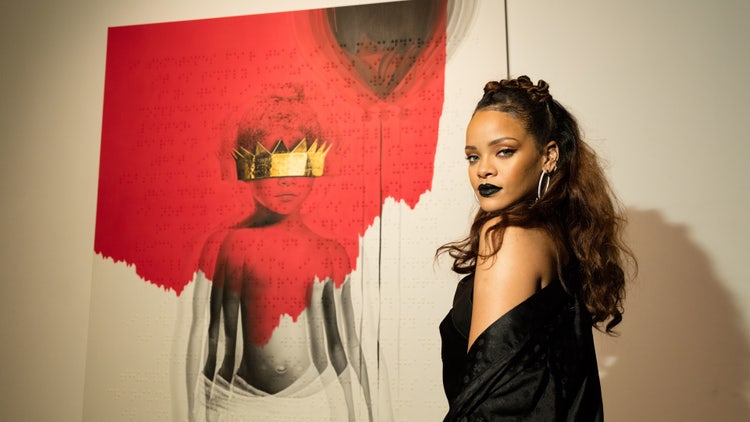
ANTI’s artwork helped set expectations before anyone heard a note. The cover shows Rihanna as a child with a crown placed over her eyes, with a Braille poem across the image. “I wanted to do something that opened people’s eyes and let people think,” explained artist Roy Nachum, who created the artwork as part of his “Blind” series. “On the other side, it’s an opportunity [for] people who cannot see [to] experience visual art as well.”
Rihanna reportedly addressed the poem’s origin directly, which speaks to being “misunderstood” when translated: “This beautiful message in Braille is a poem that came from my heart but was written by Chloë Mitchell. She got the spirit of what I wanted into words... words that I couldn’t put together.”
A rollout that turned into a headline, then a win
ANTI’s release was famously chaotic. It arrived first as a TIDAL exclusive tied to a Samsung partnership that pushed one million free downloads through an offer connected to the rollout. The strategy, and the album’s shifting availability, quickly became as discussed as the music itself.
But the noise didn’t stop the record from connecting. When ANTI hit the Billboard 200 in a standard sales window, it went No. 1. “Work,” her duet with Drake, was already the dominant hit of the era. A lot of pop stars can take creative risks after a long winning streak; far fewer can do it while still pulling the biggest numbers in the room. ANTI proved Rihanna could do both at once.
The collaborators and Rihanna’s taste as the final filter
ANTI’s credits run deep. That’s nothing new for a major pop album, but what stands out is how often collaborators describe Rihanna’s taste as the deciding factor. The project doesn’t sound like a committee. It sounds like a star with clear preferences.
Mustard, who co-produced “Needed Me,” recalled being nervous about playing the track for Rihanna, then realizing how much that moment mattered in hindsight: “I remember I was at the studio and I was like, ‘I don’t want to go, I don’t feel like going, I’ve done so many songs, she’s not going to like it,’” he admitted. “The next day, they told me she liked it. It was great that I had a team that could take me and actually get it done because if it wasn’t for them, I probably wouldn’t have went. There would have been no ‘Needed Me.’”
ANTI also benefited from writers and creatives who didn’t approach the sessions like a polished pop factory. Bibi Bourelly, who worked in the album’s orbit, remembered how casually the invitation came: “We got a call: ‘Yo, we want you to come in and write for Rihanna,’ and I was like, ‘Word. Sick.’” That looseness is part of the album’s personality. Even when the production is expensive, the songs keep the edges. They don’t sound scared of being messy.
SZA’s presence on “Consideration” is another example of ANTI pulling from voices that weren’t yet “obvious” choices for superstar pop. Speaking to Variety, the TDE songstress revealed how she originally wanted the song for Ctrl. "I cared so much. I was so frustrated. I felt like, ‘I’ll never make anything this cool again,’” she expressed to the publication. “That was so crazy and so wrong... I’m so glad that that happened and that it didn’t cost me anything.”
Where the songs land and why they still hit
ANTI is a breakup album, a freedom album, and a confidence album, sometimes on the same track. “Work” is a dancehall-inflected hit that still feels conversational, like you’re overhearing something private that happens to have a hook. “Kiss It Better” reaches for rock melodrama and turns it into R&B seduction. “Needed Me” is cold and addictive, a song built on the idea that leaving first can feel like winning. “Love on the Brain” pulls from old-school soul without sounding like cosplay.
Then there’s “Higher,” the album’s rawest moment. It plays like a late-night voice memo kept on purpose, not cleaned up for radio. That decision matters. It shows Rihanna trusting feeling over a glossy approach, and trusting the listener to follow her there.
Success turned into longevity
ANTI’s immediate wins were obvious, but the deeper story is how the album stayed. In the streaming era, longevity is a stronger flex than a splashy debut, and ANTI has lived as both a hit album and a comfort album. It’s the kind of project that keeps gaining new listeners because the mood doesn’t date.
By late 2025, ANTI reached 500 weeks on the Billboard 200, a rare milestone that reflects how deeply the record settled into everyday rotation. Rihanna also treated the album like a personal benchmark. “I listen to ANTI from top to bottom with no shame,” she said to Harper’s Bazaar. “I used to always have shame. I actually don’t like listening to my music, but ANTI — I can listen to the album. It’s like it’s not me singing it, if I’m just listening to it. That’s the one album that I can have an out-of-body experience where it’s not like… You know, when you hear your voice in a voicemail, and it’s like, ‘Ugh.’”
That’s why ANTI will forever be an important body of work across any medium. It wasn’t just “Rihanna trying something different.” It was Rihanna defining what different meant for her, then making the world live with it until it made sense. And once it did, the album stopped feeling like a pivot and started feeling like the point.