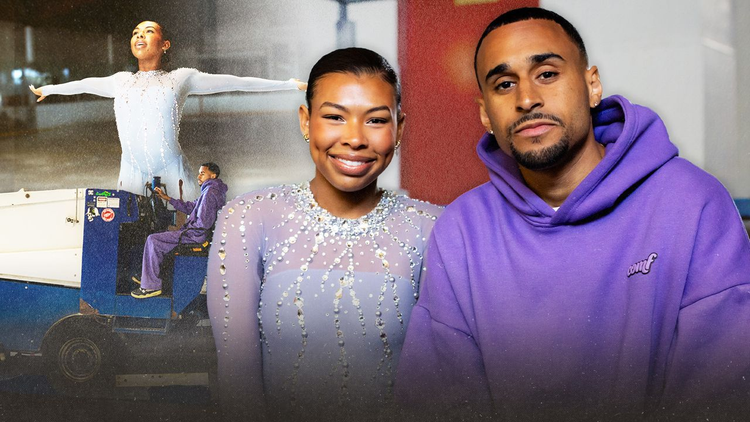
“I need a break.” That’s how Speedy Morman summed things up after spending season two of “Overtime Hustle,” presented by Ally, trying everything from golf to rowing to gymnastics. On the finale, the host-slash-journalist swapped sports for something a little less demanding: running his own skating rink.
He started his morning with the basics, like resurfacing the ice and taking business calls. “Yes, everything’s going to be straight. It’s not a serious financial concern,” he explained over the phone. “It’s a seasonal dip. It’s the summertime.” Later, while polishing a set of skates, Morman crossed paths with figure skater Starr Andrews.
Andrews — the first Black woman to win an ISU Grand Prix medal in singles since 1995 — has been skating since she was 3 years old. Watching her glide across the ice, Morman immediately let his awe show. “Wow, that was fire,” he said. “I have never seen anything like that in my eight months of owning this place.”
“You’re special,” Morman told her. Although he hadn’t seen Andrews at his rink before, he asked, “Where have you been?” The Los Angeles native then explained she wanted a quiet place to practice: “I wanted to find somewhere quiet where no one would see me fall.” With two decades of skating under her belt, Morman was convinced. “If you and I teamed up, the next 20 years could look really special,” he said.
“I just feel like, and maybe this is me being optimistic, but I saw a crazy talent right now and I know what I’m capable of,” Morman continued. In fact, he was so confident they could make millions — “like Kobe and Shaq,” to be exact.
Ally fast fact 💡
Ice Skaters earn money through competition, prizes, sponsorships, and federation funding, but many rely on performing in shows, cruise contacts, or coaching. Training costs can reach tens of thousands per year. Top athletes can secure significant income, but most ice skaters combine multiple income streams to sustain their year.
No, Morman isn’t about to try his hand at skating (not yet anyway). Instead, he put to use a skill he picked up earlier in the season. “I really feel like I could manage, I could be an agent, I could represent you in some way,” he told Andrews. “I’ma be honest, I don’t know how much money you’re supposed to make in this, but I know for a fact that we could make way more.”
It’s an offer Andrews said she’ll think about. “I guess this is it,” Morman said after closing up shop, only to walk out and find his car being towed. That’s a headache for another day, but in the meantime, Season 2 of “Overtime Hustle,” presented by Ally, has officially come to a close!
Everything that went down in Season 2 of “Overtime Hustle,” presented by Ally
Season 2 saw Morman exploring sports and sports-adjacent roles that, generally speaking, can be a bit less visible. In the premiere, Olympic gymnast Jordan Chiles joined him to discuss how athletes like herself build wealth through sponsorships, endorsements, and competition earnings.
From there, we watched Morman refereeing on a basketball court alongside Rob Wann, who taught him the technical basics of officiating. He also linked up with golf pro Troy Mullins and Arshay Cooper, a member of the first-ever all-Black high school rowing team. Along the way, Morman picked up tons of financial knowledge, including wisdom from former WNBA star and entrepreneur Renee Montgomery about Ally’s 50/50 Pledge.
Watch the episode
Watch Season 2 of “Overtime Hustle,” presented by Ally, on REVOLT and YouTube.