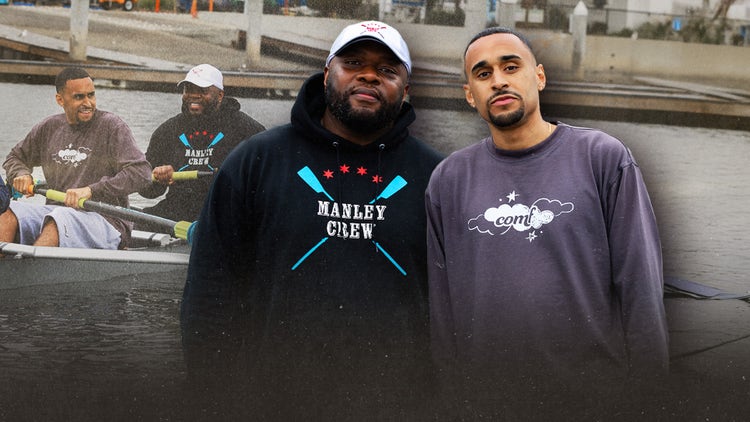
Speedy Morman traded the crowded rooftop pools for access to the open ocean on the latest episode of “Overtime Hustle,” presented by Ally. Season two’s fifth episode saw him tackling a sport that could definitely use more love: rowing.
Guiding him was Arshay Cooper, who brought a personal story to the table. Growing up in Chicago, he was part of the first all-Black high school rowing team in the 1990s. “I knew at some point, I wanted to go back and reach out to others and get ‘em in a boat,” he shared. As Cooper put it, “There’s plenty of money to be made in rowing,” but like with any lucrative sport, “You gotta row at a high level.”
Before heading out on the water, Morman and Cooper warmed up on a rowing machine, arguably the closest thing to the real deal on land. During their reps, they discussed the peaceful nature of the sport. “Going from seeing dirt and concrete every day to water and grass changes everything. It’s noncombative,” Cooper said. “To me, it’s less about sports and more about wellness.”
Of course, unlike the machine, rowing on open water doesn’t come with timeouts. While Morman cracked jokes about the tiny seat, Cooper pointed out, “There’s a lot of people who sat in that seat and got full scholarships to D1 [schools] and then they rowed in the dough.” To which Morman laughed, “When you’re talking money, you’re talking my language.”
Calling the shots on the boat itself was Nevaeh Rhodes, who walked Morman through the basics: pulling the oar up to his chest, learning the difference between the stern and the bow, and more. “We’re moving kind of fast,” he admitted. It wasn't long before Morman experienced his first crab — when a rower loses control of their oar — but luckily, the crew quickly got him back on track.
Now, onto the money! “It’s not super easy. Rowing is kind of a long-term grind. You gotta get faster, but what you can do is get sponsorships,” said Cooper, who co-founded the A Most Beautiful Thing Inclusion Fund. “There’s still so much history to be made by folks that look like us, and I think the sponsorship is what works, especially the more people see us growing.”
“You make a lot of money speaking by being a rower,” Cooper continued. “The same lessons you use in the sport of rowing, you can use that talking to a company.” He also pointed out other ways to earn money, such as building boats or selling oars.
Ally Fast Fact 💡
Making money in rowing typically involves fundraising for a club or team, rather than direct payment for rowing itself. Athletes can also explore opportunities like coaching, sponsorships, or leveraging their profile for other business events.
For those chasing fast money, though, rowing isn’t it. “You ain’t gon’ earn no money anytime soon,” Cooper cautioned. That being said, he suggested there might be financial opportunities for Morman to teach others about rowing, especially given his following. “That’s the hustle. You’ll make money out the boat, [and] with a little bit more practice, you’ll make it inside the boat.”
The physical demands of rowing might not be Morman’s strength, but he did manage to conquer a fear. “It made me wonder: Am I doing this for the right reason? What do I really want out of this new version of Speedy?” he reflected. Stay tuned for the season two finale of “Overtime Hustle,” presented by Ally, next week to see where Morman takes his next hustle.
Watch the Episode
Watch Season 2 of “Overtime Hustle presented by Ally” every Tuesday at 2 p.m. ET on REVOLT and YouTube.