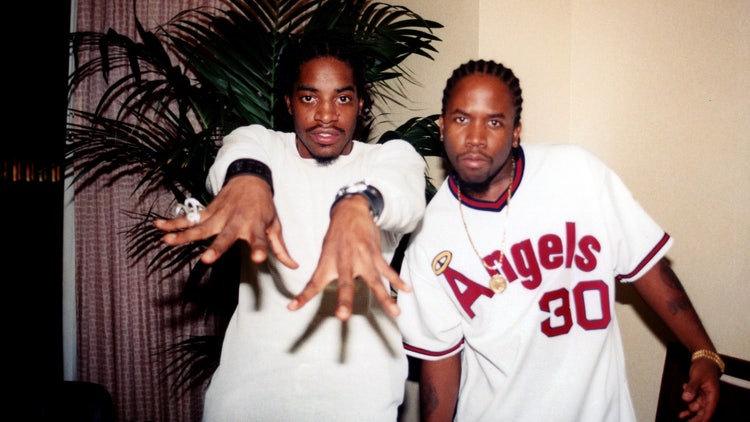
At the 1995 Source Awards, Outkast walked onto a New York stage to accept their trophy and were met with boos. André 3000 answered with a short speech that would become inseparable from his region's history. “I'm tired of... close-minded folks. It's like we got a demo tape, and don't nobody wanna hear me," he stated to the raucous crowd before declaring, "The South got something to say.” The line has since been treated like prophecy, but what Outkast did next mattered as much as the declaration itself. Instead of making a second album designed to prove Atlanta could compete within Hip Hop’s existing boundaries, André and Big Boi returned with a record that questioned why those boundaries should exist at all.
Released Aug. 27, 1996, ATLiens was stranger, darker, and more inward-looking than Southernplayalisticadillacmuzik. It fused Atlanta bass weight with cavernous space, live instrumentation, turntablism, gospel feeling, funk, soul, and science-fiction imagery. It also marked the point when Outkast began producing a substantial portion of their own music. The result was an album that did not make the duo less Southern as it became more experimental. It made their idea of Southernness larger.
Outkast expands their musical scope and steps behind the boards
Southern Hip Hop was already developing distinct traditions before ATLiens. Houston had Geto Boys, and UGK were carving out their own lane from Port Arthur, Texas. Miami bass spread throughout the Bible Belt, all while Atlanta was beginning to establish a sound of its own. Organized Noize, the production trio of Rico Wade, Ray Murray, and Sleepy Brown, was central to that emergence. Brown told POW Magazine that Atlanta artists were working with Miami-style beats before his crew realized they needed to “come up with our own thing.”
Organized Noize produced Southernplayalisticadillacmuzik and helped make the Dungeon, Wade’s basement studio, into a creative incubator for the larger Dungeon Family. By the second album, however, André and Big Boi were no longer content to remain only on the microphone. In a 1996 interview with the Guardian, André said the group recorded 30-something songs before narrowing ATLiens down to 13 or 14. Retrospectives described the duo investing early earnings in production equipment and learning through years spent around Organized Noize. Notably, André’s early setup included an MPC3000, an ASR-10, and a Tascam mixing board.
The shift was visible, as Outkast were credited as producers on “ATLiens,” “Wheelz of Steel,” “Elevators (Me & You),” “Ova Da Wudz,” and “E.T. (Extraterrestrial).” Detailed credits also list the duo for drum programming and mixing on those recordings.
“Elevators (Me & You)” became the clearest proof that learning the equipment could change Outkast’s possibilities. André assembled the spare, low-slung production and Big Boi developed the hook, creating a record built as much around empty space as sound. It became the project’s first single and spent 20 weeks on the Billboard Hot 100.
ATLiens builds a new language for Southern Hip Hop
Southernplayalisticadillacmuzik leaned heavily into warm live funk and the imagery of Cadillacs, players, and Atlanta streets. ATLiens retained the low end and regional grounding while opening enormous pockets of air around them. Echo, reverb, and dub influence gave the album a suspended, almost underwater quality. The music could feel heavy and weightless at once.
That experimentation still depended on musicianship. Album credits for ATLiens include Preston Crump, James “Jay” Nicholas, and Marq Jefferson on bass; Marvin “Chanz” Parkman and Kenny Wright on keyboards; Skinny Miracles on piano; Craig Love, Ed Stroud, Tomi Martin, and others on guitar; Dee Simmons on drums; Kerren Berz on violin; and Mr. DJ on scratches. Organized Noize’s philosophy helped make that mixture possible. Brown recalled LaFace telling the producers that it would not simply clear whatever samples they wanted, which pushed them further toward learning live instrumentation.
Nonetheless, ATLiens used samples, but often as ingredients rather than shortcuts to an instantly recognizable groove. The album drew from sources as varied as The Chambers Brothers, Mikey Dread, Lamont Dozier, Vangelis, Lou Bond, Iron Butterfly, and The Commodores. Those pieces sat beside original bass, guitar, keys, drum programming, and effects until the overall sound belonged unmistakably to Outkast and Organized Noize.
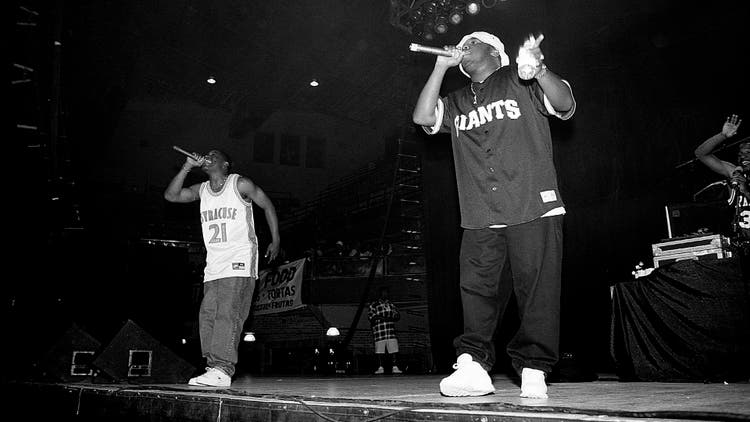
“Wheelz of Steel” placed Mr. DJ’s scratching inside a murky, futuristic track built with bass, organ, and guitar. “E.T. (Extraterrestrial)” was even more radical, moving without conventional drums and relying on atmosphere, texture, and low-end motion. “You May Die (Intro)” opened the album with a solemn, almost ceremonial mood, while “13th Floor/Growing Old” closed it with piano, gospel-inflected vocals, and Big Rube's thoughts about mortality and spiritual survival.
Even the duo’s biggest hit from the project challenged expectations. “Elevators” was minimalist instead of maximal, slow and eerie instead of immediately celebratory. Yet, ATLiens reached No. 2 on the Billboard 200 and sold nearly 350,000 copies within two weeks, eventually earning a double-platinum certification. Instead of pushing Outkast to the margins, experimentation moved them closer to the center.
André 3000 and Big Boi widen their emotional range
The musical change coincided with two young men rapidly becoming different people. Touring after Southernplayalisticadillacmuzik expanded their worlds beyond Georgia and the South. Big Boi became a father around 1995, while André underwent a significant personal and spiritual transformation that increasingly showed up in both his appearance and writing. By ATLiens, the player personas of the debut were being complicated by adulthood.
Fame, money, and sex remained in the picture, but so did anxiety, religion, parenthood, isolation, death, and the instability that came with success. “Elevators (Me & You)” punctured the fantasy of rap stardom by presenting success as something far less financially secure than outsiders imagined. “Babylon” tangled sexuality with morality and religion. “13th Floor/Growing Old” looked toward aging, consequence, and the limits of material ambition.
That did not mean Outkast left Atlanta’s streets for abstract philosophy; “Decatur Psalm,” “Mainstream,” and other records remained connected to neighborhood survival and the Dungeon Family’s communal perspective. The breakthrough was that none of those modes had to cancel the others. Southern rappers could describe hustling and spiritual uncertainty, street danger and parenthood, and confidence and alienation within the same body of work.
André explained the concept directly to the Guardian: “Being an alien is just being yourself, when people don’t understand you.” Big Boi similarly argued that Hip Hop from Atlanta reflected the same human realities found elsewhere, only through “the Southern lifestyle.” ATLiens turned outsider status into an artistic position (a perfect result for a group with such a name). Rather than sanding down the traits that made Outkast unfamiliar to parts of the industry, the duo exaggerated the difference until alienation became an identity of its own.
ATLiens turns an album into a creative universe
ATLiens arrived with comic-book imagery that transformed André and Big Boi into superheroes while keeping Atlanta visible inside the fantasy. Former LaFace creative director D.L. Warfield spoke to Andscape about hearing the album and thinking it sounded like a movie, which helped inspire the comic approach. Nigel Sawyer and Vince Robinson, who were immersed in comics at the time, helped develop the visual concept, and illustrator Frank Gomez rendered the cover.
André also brought Parliament-Funkadelic records into the discussions as visual reference points. The connection made sense: The iconic George Clinton-led collective already demonstrated how Black music could use outer space, mythology, and alter egos to build an alternative world. Outkast translated that impulse through Atlanta. Robinson added a Braves cap to Big Boi’s illustrated character, a small decision that made the larger concept plain. Simply put, they could travel to another galaxy without severing the line back home.
Inside, the album included a multipage comic centered on Outkast battling a force threatening positive music. That kind of packaging made ATLiens feel less like a collection of tracks than a self-contained creative universe. The title, artwork, music, clothing and characters all reinforced one another. Outkast were expanding what a Southern rap album could be as an object as much as what it could sound like. That visual world remained part of the album’s identity long after its original release, with a 2021 expanded reissue accompanied by new animated visuals that revisited ATLiens’ comic-inspired universe.
Big Boi’s later description of Outkast’s creative philosophy helps explain the approach. “There are no boundaries, there are no lines that cannot be crossed,” he told The Creative Independent while discussing the range of music that shaped the duo. He described growing up on everything from N.W.A and Geto Boys to Bob Marley, Kate Bush and Neil Young, a listening philosophy that rejected the idea that genre should dictate what an artist could try.
Southernplayalisticadillacmuzik had already established that Atlanta deserved a national audience. ATLiens pushed the argument further. Southern Hip Hop did not need one prescribed production style, visual language, emotional register, or definition of authenticity. Church organs could sit beside synthesizers. Scratching could coexist with eerie sound design. Cadillacs could share a universe with spaceships. Street stories could lead into questions about God, aging, and mortality.
The South truly did have something to say, and ATLiens helped prove there was no creative ceiling on how it could say it.