Key Takeaways:
- Spike Lee’s Do the Right Thing was born from real-world tragedy and transformed a Brooklyn block into a cinematic landmark.
- The film’s cast, soundtrack, and visual style created a layered portrait of heat, tension, and resistance.
- Its influence continues to shape conversations around race, protest, and artistic expression in American culture.
Before Barack and Michelle Obama were household names, they were just two young professionals on a first date in Chicago — walking through the Art Institute, then heading to a local theater to catch a new Spike Lee joint. The movie was Do the Right Thing.
The heat. The music. The rage. The love. That date would go on to help shape the future First Family. That film would become one of the most radical and enduring statements in American cinema. Spike Lee would later joke, “I said, 'Thank God I made it. Otherwise [Barack] would have taken her to [see] Soul Man. Michelle would have been like, ‘What’s wrong with this brother?’”
Set in Bed-Stuy during one sweltering day, Do the Right Thing captured a neighborhood at a boiling point — and by extension, a country on the brink. It wasn’t just a film about race, or heat, or pizza. It was about pressure, and how it builds quietly until it explodes. With prophetic intensity, Lee gave us a cinematic time bomb that feels just as urgent long after it first landed in theaters.
Spike Lee’s two-week screenplay was fueled by real-world tragedy
Lee wrote the script in just two weeks. Mornings were for writing, afternoons for living. But the ideas had been simmering far longer, stirred by real events like the Howard Beach killing, the police murders of Eleanor Bumpurs and Michael Stewart, and an old episode of “Alfred Hitchcock Presents” that suggested rising temperatures could spark murder. The working title was Heatwave. The final product was anything but subtle.
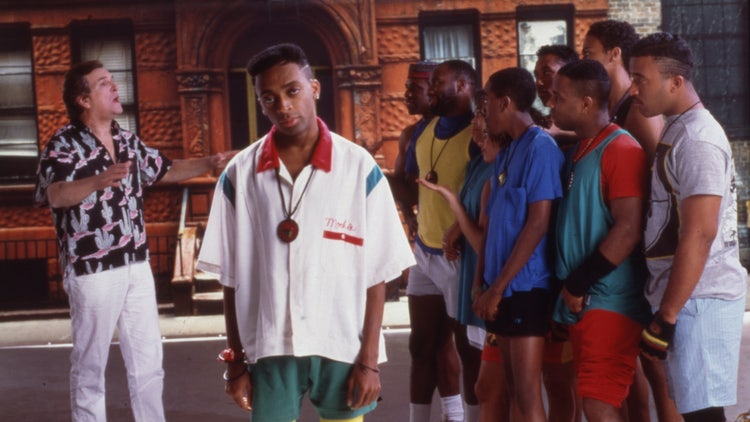
To make the story real, Lee and his crew took over a block of Stuyvesant Avenue between Quincy and Lexington in the summer of 1988. They constructed Sal’s Pizzeria and the Korean grocery from scratch, transformed a church façade, and used a real brownstone for Mookie’s home. Local skepticism ran high. St. Clair Bourne’s behind-the-scenes documentary captured community members wondering if the production would actually help the block or simply pass through. But others found power in its presence. One unhoused woman even secured a job with the crew and was supported by the neighbors when she faltered.
The Fruit of Islam, associated with Louis Farrakhan’s Nation of Islam, were brought in as security. They cleared nearby crack houses. The block turned into a soundstage, a battleground, and a canvas. Some residents remained wary. One man told Bourne, “The president of the United States can come through here. They’ll clean the street for one day, but that’s it.” But others saw it as a spark: “I’m talking about trying to keep our community together,” one woman reportedly said. “There’s a lot out here.”
Bourne’s camera gave time to everyone — not just the stars, but the locals. His documentary closed not with a triumphant shot of the crew, but of the same empty lot where the pizzeria once stood. It’s a quiet but powerful reminder that even radical film sets eventually disappear. What remains is the impact, and the neighborhood that has to keep pushing forward.
The cast, the costumes, and the culture of Bed-Stuy
Spike assembled a cast that would define his cinematic universe. Samuel L. Jackson. Giancarlo Esposito. Bill Nunn. Ruby Dee. Ossie Davis. Joie Lee. Danny Aiello. Rosie Perez, in her debut role, danced through the opening credits to Public Enemy’s “Fight the Power,” a song Lee commissioned that became the film’s heartbeat.
The track wasn’t just a soundtrack choice — it was a call to action. Lee approached the group with a request for something bold and politically charged, and Chuck D crafted the song around that vision. The song subsequently turned it into an anthem that bled from the screen into real-world protests, effectively setting a new precedent for what film music could do.
Bill Lee, Spike’s father, composed the jazz score that ran underneath the more militant selections, creating a layered sonic backdrop that gave emotional shape to the block. The soundtrack would go on to peak at No. 68 on the Billboard 200 and No. 11 on the Top R&B/Hip Hop Albums chart. The blend of hard-hitting raps and melancholic jazz perfectly added to the duality of tension and tenderness woven into the movie.
Ernest Dickerson, Spike’s longtime cinematographer, used heat as both metaphor and technique. Reds, yellows, and oranges dominated. Blue and green were banned. He even waved a lighter under the camera lens to make scenes ripple like asphalt. In addition to watching characters overheat, viewers were almost sweating in solidarity.
The symbolism bled into every detail. Ruth E. Carter’s costumes reflected the African diaspora and Brooklyn’s street fashion. Vendors in Bed-Stuy sold hand-painted T-shirts and African prints, and Carter sourced directly from them. Radio Raheem’s iconic LOVE/HATE rings were spray-painted prototypes until a local jeweler delivered the final pieces.
Jackson, who played Mister Señor Love Daddy, later recalled that real neighborhood hustlers occasionally threatened the actors for disrupting business. “You acting motherf**kers came in here and ruined our business," he remembered hearing. But the vibe, somehow, stayed harmonious.
Rosie Perez’s experience during the now-famous bedroom scene with ice cubes wasn’t as lighthearted. “When Spike puts ice cubes on my nipples, the reason you don’t see my head is because I’m crying,” she recalled in an interview. “I didn’t feel good about it because the atmosphere wasn’t correct… I felt like I violated myself.” She later said her nude scene in White Men Can’t Jump felt far more empowering because it was done on her own terms.
Studio pushback and cultural fallout
Even the violence at the film’s climax was difficult to pull off. Mookie’s trash-can toss didn’t break the window on the first try. It took three takes and some glass scoring to make it land. Studios got cold feet. Paramount begged Lee to rewrite the ending so Mookie and Sal reconciled with a hug and a singalong of “We Are the World.” Spike refused. He gave us fire instead.
The reviews? Rapturous and racist. David Denby warned that Black audiences might riot. Lee never forgot it. “That still bugs the s**t out of me,” he told Rolling Stone. “I don’t remember people saying people were going to come out of theatres killing people after they watched Arnold Schwarzenegger films.”
The Academy barely noticed. Driving Miss Daisy won Best Picture. Do the Right Thing wasn’t even nominated. Onstage at the 1990 Oscars, Kim Basinger called out the snub in real time, saying, “There is one film missing from this list that deserves to be on it because, ironically, it might tell the biggest truth of all. And that’s Do the Right Thing.”
Nearly 30 years later, when Green Book — another film about a white driver chauffeuring a Black man — won Best Picture over BlacKkKlansman, Spike stood wearing Radio Raheem’s rings. “Every time somebody’s driving somebody, I lose,” he quipped during a backstage interview at the Academy Awards.
Fortunately, Spike did win his first Oscar for Best Adapted Screenplay that year, which prompted him to leap into Samuel L. Jackson’s arms. A long arc had closed. But Do the Right Thing remained his most studied, most taught, most remembered work.
Legacy and cultural resonance
The boombox from the film now lives in the Smithsonian. Teachers use the movie in classrooms. Protesters quote it. As previously mentioned, future presidents go on dates to see it. And students from film schools to sociology departments still treat it like a sacred text.
The block in Bed-Stuy has changed. Gentrified. Renovated. But the fire Spike lit still burns.
He didn’t just do the right thing. He did the lasting thing.