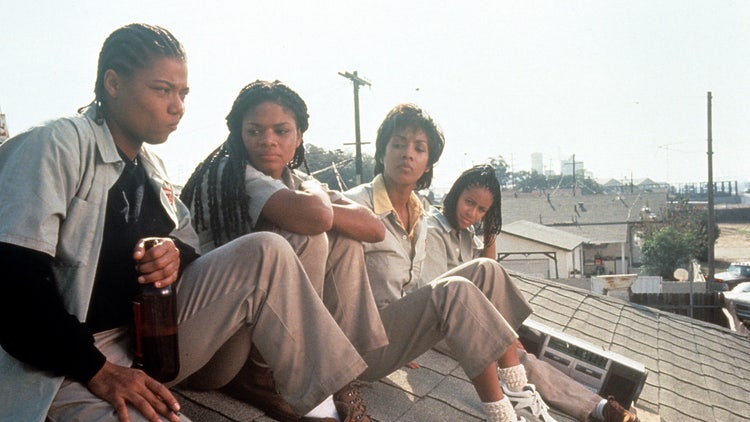
In 1996, Set It Off exploded into theaters and the cultural consciousness, delivering a gritty, emotional, and radical vision of Black womanhood under pressure. Directed by F. Gary Gray and penned by Takashi Bufford and Kate Lanier, the film tells the story of four friends, Stony (Jada Pinkett Smith), Frankie (Vivica A. Fox), Cleo (Queen Latifah), and Tisean/T.T. (Kimberly Elise), who turn to bank robbery after enduring personal and systemic traumas. Long after it arrived, the film is not only a cult classic — it’s a time capsule of ‘90s Black America and a rare example of genre filmmaking rooted in real-life rage. Beyond the bullets and blunts, the true story of Set It Off also lives in its audacious creation, from casting to soundtrack to cultural impact.
A heist film about so much more
The film opened with a bang: A violent robbery that cost Frankie her bank job and set the tone for the interconnected injustices that pushed each woman to the edge. The film is steeped in the realities of post–Rodney King Los Angeles, two years after the 1994 Crime Bill and amid ongoing conversations around police brutality. Where most films of the era focused on young Black men, Set It Off centered Black women of different types forced to fight their way through a world designed to grind them down.
Each character embodies a different mode of survival. Stony, the heart of the crew, lost her brother to police violence. Frankie was scapegoated because she “knew” the stick-up man. T.T. can’t afford childcare, and the brash-yet-brilliant Cleo simply wanted to provide for her partner and prove she belongs in a world that denies her. The four weren’t heroes in the traditional sense. They’re angry, funny, desperate, loyal. Their decisions are flawed. Their trauma is valid.
The film didn't moralize their actions. Instead, it showed how structural inequality pushes people into impossible corners. As the crew evolved from amateurs to criminal tacticians, so did the film’s tension. Scenes like the rooftop celebration and Cleo’s iconic final stand hit harder because, beyond the crime, they’re about love, grief, and resistance. By the time Stony escaped to Mexico, the message was clear: This is a story about self-preservation, even when it costs you everything.
Building the cast and characters
Takashi Bufford’s initial idea came from a friend’s casual comment about robbing a bank. With Kate Lanier joining for rewrites and F. Gary Gray fresh off his Friday debut, the script evolved into a Black woman-led action drama. It was something rare, if not unheard of, at the time.
Casting director Robi Reed played a pivotal role. The film was written with Pinkett Smith in mind, who encouraged Gray to cast Queen Latifah. Elise, a theater actress with no film credits, won her role after an emotionally raw audition left the producers stunned. Vivica A. Fox, cast last, brought a grounded, no-nonsense energy to Frankie, reportedly refined with acting tips from Independence Day co-star Will Smith.
Gray ran intense table reads and encouraged collaboration. Some lines were ad-libbed in the Beverly Boulevard production office. The characters were molded with input from the actors themselves. Queen Latifah famously read for Cleo and told the room, “I am this b**ch.”
According to Gray in the behind-the-scenes documentary Setting It Straight, creating chemistry among the actors was essential. “I had a specific process in rehearsals,” he said. “It was to drop the script and to allow them to just hang out with each other… I want you guys to go to dinner. I want you to go to the movies. I want you to actually start to experience each other.”
The effort paid off. “You feel like they were family,” he added. “And that’s, I think, invaluable with a movie like this and with characters like this.”
The actors understood the significance of the moment. “Set It Off was actually my very first film,” said Kimberly Elise. “I was probably the only character in the film that was actually living the story… being completely broke.” Fox reflected, “We really dug into this script… He [Gray] stepped up all of our level of performing and wanting to do well.”
Much of the film was shot on location in Los Angeles, using real neighborhoods rather than Hollywood backlots. Gray wanted the city to feel lived-in, from the housing projects to the banks, and he insisted on keeping the visuals grounded and urgent. Cinematographer Marc Reshovsky’s handheld camera work added a documentary edge that made even the quietest moments pulse with energy.
Soundtrack of a revolution
If Set It Off shook audiences, its soundtrack slapped just as hard. Released via East West Records, it blended R&B and Hip Hop in a way that matched the movie’s emotional beats.
En Vogue’s “Don’t Let Go (Love)” became a runaway hit, peaking at No. 2 on the Billboard Hot 100. Other standout tracks included Brandy’s “Missing You,” Bone Thugs-N-Harmony’s “Days of Our Livez,” and Ray J’s “Let It Go.” Each one added emotional context to the film’s pivotal moments. The soundtrack went platinum, solidifying its place as one of the most impactful rap-infused compilations of its time.
The musical cohesion wasn’t accidental. Queen Latifah contributed, but didn’t overtake. The producers curated songs to reflect the movie’s themes of grief, resilience, and female camaraderie. The soundtrack wasn’t just background noise; it was a co-narrator.
Decorated artist and producer Ivan Matias, who was behind multiple cuts on the soundtrack, told Urban Bridgez that he was “glad to have met and worked with [then-EastWest head] Sylvia Rhone.” The score, composed by Christopher Young, also deserves credit for balancing the layers of action with the intimacy of the women’s struggles.
Gray reinforced how carefully he chose moments for music: “Sometimes, I didn’t even want to score the moment. Because if the actors are doing their job, if the audience is invested, you don’t need to push it. You let it breathe.”
Lightning in a bottle
Shot on a modest $9 million budget, Set It Off went on to gross $41 million, becoming New Line’s highest-grossing film of 1996. Critics were mixed, but audiences — especially Black audiences — knew what they were watching was special. Over time, the film gained cult status and was placed in various rankings by various outlets in film and entertainment.
In an interview with BlackFilm.com, Bufford recalled experiencing rejection because New Line Cinema “thought Black males would not support a film with gunslinging Black females.” “That obviously proved not to be true,” he added.
According to The Hollywood Reporter, a reboot has floated in and out of development with Issa Rae’s name attached to a potential reimagining. Not long after the news, Rae effectively shut down the possibility while speaking to Entertainment Tonight. “I would never remake a classic,” she told the outlet. With that said, screenwriter Syreeta Singleton seemed to confirm that something is in the works.
In the end, Set It Off did what few films have dared: It let four Black women tell their own story. It honored their complexity. It asked tough questions about survival and justice. And behind every frame was a director with something to prove, a cast that showed up for each other, and a soundtrack that didn’t just ride the wave — it made one.
The result? A film that didn’t just set it off. It set the bar.