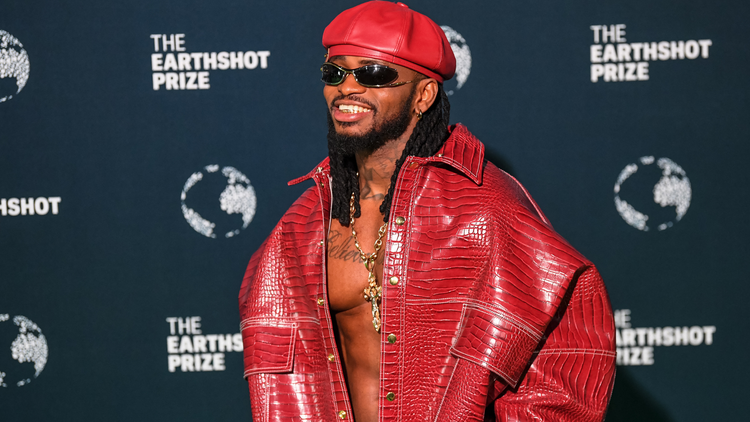
Diamond Platnumz’s rise wasn’t overnight — it was a strategic collection of movements. Long before the fame, streaming plaques, and sold-out shows, the Tanzanian artist was hustling for studio time, doing whatever it took to fund his dream. That early hunger laid the foundation for a career that’s turned him into one of Africa’s most influential entertainers and entrepreneurs.
With a Hot 97 Summer Jam debut, multiple hit albums, and an ever-growing empire outside of music under his belt, Diamond shifted his focus to longevity. In this interview with REVOLT, the singer opens up about balancing the spotlight with real life, why he doesn’t trust the music business, and how we shouldn’t take his actions on “Young, Famous & African” too seriously.
Does your neck feel heavy with all those chains on?
No. No. No. No, I'm used to it.
There’s a story out there that you had to hustle just to get your first studio session — selling clothes, juggling jobs, even pawning your mom’s jewelry. Is that true?
Yeah. I told my mom I [didn’t] wanna continue with school. I wanna do music. And then it was difficult because my family was very poor. So, it was hard for me to get money to go to the studio. I started doing different things — selling clothes, working at the petrol station, and different things. And then I remember my mom gave me a gold ring to wear, and I went to sell it. My brother told me to sell it, and I went to pay for studio [time]. That was when I recorded my first single. But unfortunately, I didn't have enough experience, so the song was trash. The song [pushed] someone to help me, and at least it took me somewhere.
Looking back, what made you believe music was the way out?
I think I used to love music since then. I started doing music because I liked it first, and then people started believing in me. They were like, “You can do it, you can do this.” And it got to a point, like, when I listen to other artists’ songs, I was like, “Ah, I feel like these people got nothing.” I wanted to prove a point, and not only prove a point to myself, but I wanted to encourage and to inspire people from where I came from that everything is possible. And that's what I've been doing.
You’ve been called a pioneer of Bongo Flava and one of the first artists to really put Tanzania on the map. For people who only know African genres like Afrobeats or Amapiano, how do you describe the sound of Bongo Flava?
Bongo Flava is music that comes from Tanzania. It's a mix of Arabic, Hindi, and our own East African rhythms. A good thing is that I [make] different sounds.
I know you do. We've seen you dabble in Amapiano, too, right?
I'm a musician. I do everything. But I'm from Tanzania. Where I came from is where Bongo Flava came from, but I do all types of sounds. I do R&B. I do Amapiano. I do Afrobeats. I do Francophone music. I do all of them. I'm blessed to be born in Tanzania and to start my journey from Bongo Flava music. I can say that's what paved my way to all this [success] that I've been doing right now. I do Bongo Flava because Bongo Flava is my origin sound, but I fuse it with different things. Even if I do Amapiano, once I sing in Swahili, then it’s Bongo Flava.
You’ve headlined massive shows across Africa, but your first time performing at HOT 97’s 2025 Summer Jam was special, and you shut it down. What did it mean for you to hit that stage, especially as one of the few East African artists to ever do it?
It’s a privilege for me to be here representing African music, African culture. Back then, we used to watch that on TV. We used to hear about it. So now we're here, and I'm glad that I'm alive representing the continent, representing our culture with my other brothers and sisters. I just [always] want all Africans to always come out and support. Well, not only Africans, but if you love African music, if you love Swahili music, if you just love the culture in Africa, just come because we'll be representing that. Now, we know that we are loved in different continents, so let's all come together. Let's celebrate. Let's have fun.
Let’s talk about your hit “Komasava.” The song took over social media and the world, with celebrities like Travis Scott and Chris Brown vibing to it, and now there’s a remix with Jason Derulo. Did you expect that kind of viral love globally?
Honestly, when you drop a song, you wish for the song to do good. But I can't say I expected it. I felt so good, and it proved to me that everything is possible. I’m just going to continue to work so hard and be more creative because the support is there.
Do you have a vision for your next era when it comes to producing more albums?
I can't remember when was the last time I dropped an album. So, this year, I'm coming with my album. And I am going to have different brothers and sisters in there. I did a lot of research to do crazy sounds, a lot of fusion, different sounds, and I'm excited. I took my time. I did not want to rush, to make sure that you guys get something that you deserve.
A lot of artists don’t mentor new talent, but you’ve built a whole label around it. Why was it important for you to create WCB Wasafi and invest in other artists?
I still remember what I went through for me to become this musician. I went through hell. I know I can't empower everybody, but I'm trying my level best as much as I can. That's why I started that record label. It can help whoever [has] talent to achieve their goals.
On “Young, Famous & African,” we’ve seen you balance family, fame, drama, and relationships. How real is reality TV for you? Like, is that really Diamond or is there editing involved?
I wanted, as an African, to have this big reality TV [presence] because I know we've been seeing that in other countries. Like, here in America, they've got a lot of reality shows. Before that show, we didn't have a proper reality show. So, when I got that opportunity, I knew I had to do it for the sake of the culture, for the sake of the continent, so that we can have proper representation. And I'm there to entertain you, so don't take it personal. And whatever character you see me as, I'm just trying to make you proud. I’m just trying to entertain you. I know I can be crazy... I can be bad. In a good way.
You definitely had a lot of people talking.
Yeah. But, you know, positively. Like, you can't be having a boring life. Or a boring reality.
I get it, and that’s why you were the storyline.
Definitely. And to be able to do that, it takes a lot. It takes me too far — with my girlfriend, with my baby. It used to be very crazy. [When] the show aired, it was trouble because of the things that I used to do in that show. And I was like, “You know what? Whatever I'm doing here, it's just a show. So, it's there to entertain. Don't take it serious. Don't take it personal.”
If someone asked you today, “Who is Diamond Platnumz outside of fame?” What would you say?
Diamond Platnumz is a very humble man, understanding, a hardworking person, [and a] businessman. [Music] is just a platform that introduced me to the world, and as a starting point, a capital starting point. I'm a family man. I love people. I respect people a lot. Respect women, respect men, respect my work. And I'm a very innocent boy.
You really are a businessman too, though. You even sell soap called Wasafi Soap.
Yeah. I sell soap. I have a betting company. I have a radio station. I have a TV station, recording label. I do real estate.
What drives you to do these things outside of music?
I don't trust the music business. Because if you depend just on music, and one day you don’t drop a hit, [you're done]. As I said, music to me is like a platform or just the capital starting point. So, music, honestly, is there so that I can have a better future — me and my family.