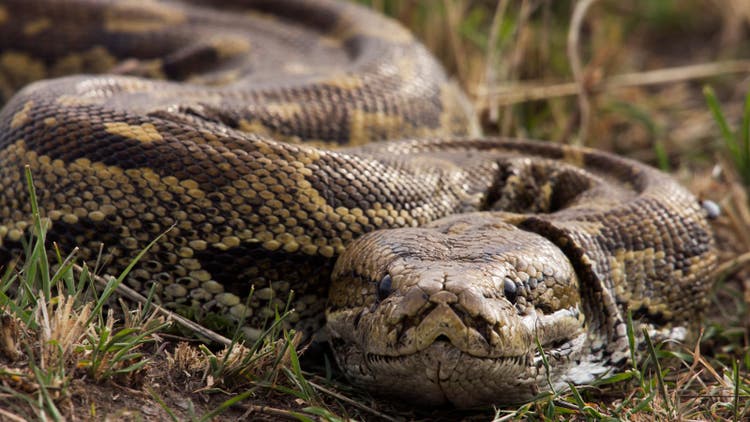
An Indonesian woman’s body was found in the stomach of a 23-foot-long python after being reported missing by her husband. According to a report by People on Wednesday (Oct. 26), the victim — identified as Jahrah — disappeared on Sunday (Oct. 23) after leaving to work at a rubber plantation.
Jahrah’s husband reported her missing later that evening after she did not return home from work and he was unable to locate her himself, The Guardian reports. However, the unidentified man reportedly found his wife’s sandals, headscarf, jacket, and work tools near the plantation.
Betara Jambi police Chief AKP S Harefa told local media outlets, including news website Detik, that the python was located and killed near the plantation the following morning. “When the security team and residents conducted a search around the rubber plantation, [we] then found a python — seven meters long. It is this snake that is suspected of preying on the victim. After we caught him, we found the victim’s body in the snake’s stomach,” he said. The 54-year-old woman’s body was reportedly found mostly intact inside the snake’s belly, leading officials to believe she may have been hunted as prey.
Reports say that pythons usually eat smaller animals and swallow their food whole, killing through constriction. It is rare for a human to be swallowed. However, according to USA Today, on the island of Muna, off the coast of Sulawesi, another 54-year-old woman, Wa Tiba, was killed when she was swallowed by a giant python in 2018. It was reported she disappeared from her garden, which was located at the bottom of a rocky cliff where snakes were known to live in caves. In search of the woman, the family and villagers found the snake with a bloated belly just 54 yards away from her belongings.
There are far more people who are affected by snake bites. The World Health Organization estimates that about 5.4 million snake bites occur each year, of which between 1.8 million and 2.7 million result in poisoning. The risk of being bitten is greater in poorer rural areas, especially among children and agricultural workers.